


Imagine spending an hour creating a LinkedIn post. You write an interesting opening, organise your thoughts, add a few useful insights and finally publish it.
Then, instead of creating something new, you copy the same post and share it on Instagram, Facebook and X.
Same words. Same message. Same presentation.
It takes less than a minute, and technically, you’ve published on four platforms.
Efficient? Absolutely.
But here’s something worth thinking about: Are you actually communicating with four different audiences, or are you simply repeating yourself in four different places?
There’s a difference.
Cross-posting has become a familiar part of social media management. For creators, freelancers, small businesses and marketing teams, it seems like a sensible way to save time. Why create four separate posts when one can be shared everywhere?
The logic isn’t entirely wrong. But it overlooks something important: people don’t use every social media platform in the same way.
Someone scrolling through Instagram might be looking for visual inspiration. The same person might open LinkedIn to learn something about their industry, visit TikTok for entertainment or use Facebook to catch up with a community.
They’re still the same person. But their expectations change depending on where they are.
And your content strategy should recognise that.
This gives the argument another dimension: people aren’t only using platforms differently; they’re also using them to discover different kinds of information.
Why We Started Posting the Same Content Everywhere
Let’s be honest. Creating good social media content takes time.
You need an idea, a decent opening, the right visuals, an engaging caption and, ideally, something useful enough to make people stop scrolling.
Now imagine doing all that separately for five platforms.
For a small business owner or a solo creator, that’s a lot of work. Even social media professionals managing multiple accounts can struggle to maintain that level of production.
So, naturally, cross-posting becomes attractive.
You create one piece of content and distribute it across multiple networks. Scheduling tools make the process even easier. A single post can be prepared in advance and published to several accounts.
There’s also a reasonable argument in favour of this approach: your audience isn’t necessarily present on just one platform. Some followers might find you on Instagram, while others follow your work on LinkedIn or Facebook.
Reusing content helps you reach people who might otherwise miss it.
In other words, cross-posting isn’t a bad habit by definition. It can be a practical way to distribute useful information.
The problem begins when saving time becomes more important than understanding the audience.
We start treating different social media platforms as distribution channels for identical messages, rather than distinct environments where conversations happen in different ways.
That’s where the strategy starts to lose its effectiveness.
Different Platforms, Different Expectations
Here’s a simple way to understand the problem.
Imagine you have written an interesting post about five mistakes businesses make on social media.
You could publish it on Instagram, LinkedIn, Facebook, TikTok and X.
The subject might be relevant to all five audiences. But does that mean the same presentation will work everywhere?
Not necessarily.
On Instagram, you might turn the five mistakes into a carousel, giving people something they can swipe through and save for later.
On LinkedIn, you could discuss why businesses make these mistakes, share an observation from your experience and explain what they should do differently.
On TikTok, you might turn the subject into a short video, using a strong opening to catch someone’s attention before explaining the mistakes.
On Facebook, you could present the same ideas in a more conversational way and invite business owners to share their experiences.
On X, you might turn each mistake into a short observation and build a thread around the larger argument.
Notice what happened.
The original idea didn’t change. The audience still receives the same underlying message. But the way you communicate it changes according to the platform.
That’s a much more thoughtful approach to content distribution.
And there’s research to support the importance of understanding these differences.
Buffer’s March 2026 analysis of more than 45 million social media posts found that the content formats associated with stronger engagement varied considerably across platforms.
For example, LinkedIn carousels (PDF document posts) recorded a median engagement rate of 21.77% in its dataset. On Instagram, carousels recorded 6.90%, compared with 3.31% for Reels. Meanwhile, TikTok videos recorded a median engagement rate of 3.39%, outperforming photo and carousel posts in that analysis.
These numbers aren’t directly comparable across platforms because engagement is measured differently. But they demonstrate an important point: different formats can serve different purposes in different social environments.
The takeaway isn’t that every Instagram post should be a carousel or every TikTok post must be a video.
It’s that choosing a format simply because it worked somewhere else isn’t a particularly thoughtful strategy.
Your Audience Might Be the Same. Their Behaviour Isn’t.
There’s another reason identical content doesn’t always make sense: people behave differently across platforms.
Think about your own social media habits.
You might spend a few minutes scrolling Instagram during a break, open LinkedIn when you’re thinking about work, and visit Facebook to see what friends or communities are discussing.
You haven’t become a different person each time you open an app. But your mindset, attention and reasons for being there might have changed.
This matters to anyone creating content.
A detailed professional observation might be perfectly appropriate on LinkedIn. The same text, copied without any changes to Instagram, might feel out of place.
Likewise, a funny 20-second video that works well on TikTok might not communicate the same value when shared as a professional LinkedIn post.
The subject isn’t necessarily the problem. The context is.
A 2023 peer-reviewed study published in SAGE Open, titled Platform or Content Strategy? Exploring Engagement With Brand Posts on Different Social Media Platforms, offers an interesting perspective here.
Rather than simply arguing that brands need entirely different content strategies for every network, the research suggests that choosing an appropriate platform strategy can improve engagement.
That’s an important distinction.
We don’t need to invent five completely different ideas every time we publish something. We need to understand how an idea should be presented in the environment where we’re sharing it.
The Real Problem Isn’t Cross-Posting. It’s Mindless Cross-Posting.
Let’s not take this argument too far.
There are plenty of situations where sharing the same content across platforms makes perfect sense.
A product announcement, an important company update, an event invitation or a public service message doesn’t always need five different creative treatments.
Sometimes, consistency is more important than variation.
And if you’re a small creator with limited time, adapting every single post for every platform might not be realistic.
The goal isn’t to make content creation unnecessarily complicated.
It’s to stop assuming that because you can publish something everywhere, you should publish it in exactly the same way everywhere.
Think of it this way: you wouldn’t normally explain a complicated business idea to a five-year-old, a university student and an industry expert using precisely the same words and examples.
You might have one central idea, but you’d adjust the explanation to suit the person listening.
Social media deserves the same consideration.
The smartest approach isn’t to create five different ideas for five different platforms. It’s to learn how to communicate one good idea in five different ways.
And that raises a more practical question: What should that actually look like?
With these principles in mind, let’s look at how to practically adapt a single core message across different platforms without losing its original value.
How to Adapt One Content Idea for Different Social Media Platforms
Let’s say you’ve come up with a good content idea.
Perhaps you’ve written an article about why businesses struggle to get engagement on social media. It contains five useful lessons, a few examples and some practical suggestions.
Now, you want to share those insights on Instagram, LinkedIn, TikTok, Facebook and X.
You have two choices.
The first is to copy the article’s main points, write a caption and publish the same thing everywhere.
The second is to think about how people might prefer to consume that information on each platform.
The second approach requires a little more effort. But it also gives you an opportunity to get more out of an idea you’ve already invested time in developing.
Here’s how I’d approach it.
Adapting content isn’t just about tweaking word counts or resizing images; it requires adjusting the message to align with specific platform dynamics. While your core brand message and key facts must remain consistent—such as preserving key data points or core brand takeaways across every channel—the presentation and format should be tailored to match the audience’s intent. For example, a single core takeaway about social media strategy can be presented as an engaging 30-second video hook on TikTok, a multi-slide visual breakdown on Instagram, or a professional narrative discussion on LinkedIn. Modifying tone, structure, and call to action while holding the central message firm ensures your brand maintains a recognizable voice while resonating naturally in each environment.
1. Instagram: Make Your Content Worth Stopping For
Instagram is a visual-first platform. People scroll through a constantly changing mix of photographs, Reels, carousels and Stories.
You have a relatively small window to give someone a reason to stop.
That doesn’t mean every post needs an elaborate design or a trending audio clip. It means the presentation should make the value of your content immediately clear.
Let’s return to our example: five reasons businesses struggle to get engagement on social media.
Instead of publishing a long block of text, turn the information into a carousel.
Your first slide could say:
“Posting regularly but getting almost no engagement? Here are 5 possible reasons.”
The following slides could explain one reason each:
- You’re creating content without understanding your audience.
- Your opening isn’t giving people a reason to continue reading.
- You’re focusing on promotion instead of providing value.
- You’re not encouraging meaningful interaction.
- You’re measuring success only through likes and followers.
The final slide could offer a practical suggestion or invite readers to share their biggest challenge.
You could also turn the same subject into a Reel, explaining the five mistakes in a short video.
The important thing is to give people a reason to save, share or discuss your content rather than simply filling another space in their feed.
A useful question to ask before publishing on Instagram: Would someone find this interesting enough to stop scrolling, or useful enough to save for later?
2. LinkedIn: Give People Something Worth Thinking About
LinkedIn is often treated as a place to share professional achievements, company announcements and career updates.
But some of its most interesting content comes from people who have something useful to say about their industry.
This creates an opportunity for creators and businesses.
Instead of turning your five social media mistakes into a colourful carousel, consider approaching the subject through an observation or argument.
For example:
“Most businesses don’t have a social media consistency problem. They have a content relevance problem.”
That’s a more interesting starting point for a professional discussion.
You could explain why businesses often confuse posting frequently with communicating effectively. Include an example, challenge a common assumption and offer a few practical recommendations.
A document post or carousel could work too, especially if the information benefits from being broken into clear steps.
But don’t assume that every LinkedIn post needs to look like a corporate presentation.
Sometimes, a thoughtful piece of writing with a strong opening is enough.
The objective is to give people something they can learn from, question or apply to their work.
A useful question to ask before publishing on LinkedIn: Does this contribute something meaningful to a professional conversation?
3. TikTok: Show the Idea Instead of Just Explaining It
TikTok has made short-form video a major part of how people discover content.
But creating a TikTok video isn’t simply a matter of reading your Instagram caption aloud in front of a camera.
Video has its own strengths. You can demonstrate something, tell a story, show a mistake, compare two approaches or explain an idea through an example.
For our social media engagement topic, you could start with:
“If you’re posting every day and nobody is interacting with your content, you might be making one of these five mistakes.”
Then explain each mistake using quick examples.
For instance, show two different opening lines:
Opening A: “We are excited to announce our new product.”
Opening B: “Looking for a simpler way to manage your monthly expenses?”
Explain why the second opening might be more relevant to a particular audience.
You could also use screen recordings, visual demonstrations, text overlays or a short storytelling format.
The goal isn’t to cram as much information as possible into 30 seconds. It’s to communicate one useful idea clearly enough that someone wants to keep watching.
And don’t get obsessed with video length alone. A useful video should be as long as it needs to be to deliver its message.
A useful question to ask before publishing on TikTok: Can I demonstrate or explain this idea in a way that makes someone want to keep watching?
4. Facebook: Make Room for Conversations
Facebook offers something that can get overlooked when businesses focus entirely on reach and engagement numbers: communities.
People use Facebook to connect with friends, participate in groups, follow local businesses and discuss subjects that interest them.
That creates opportunities for content that feels less like a broadcast and more like a conversation.
Using our example, you could publish:
“Business owners: What’s the biggest frustration you face when managing your social media accounts?”
You could briefly mention common problems, such as low engagement, inconsistent posting or difficulty coming up with new ideas.
Then invite people to share their experiences.
Another option is to turn your original article into a useful post with a short introduction and a link for people who want to explore the subject further.
The key is to give people something worth responding to.
Not every Facebook post needs to end with “Comment YES if you agree!” Audiences have seen enough of that.
Ask genuine questions. Share useful information. Participate in relevant conversations.
And if you’re managing a community, remember that responding to people is part of the content strategy too.
A useful question to ask before publishing on Facebook: Does this give people a reason to participate in a conversation or share something useful with their community?
5. X: Get to the Point
X has a different rhythm from platforms built primarily around visual content.
It’s a place where people share opinions, react to developments, exchange ideas and participate in ongoing discussions.
This makes it particularly suitable for sharp observations and concise arguments.
For example, instead of publishing the entire five-point list, you could start with:
“Posting every day won’t fix a social media strategy that doesn’t understand its audience.”
Then develop the argument through a short thread.
Each post could explore one mistake, explain why it matters and offer a possible solution.
You could also publish one particularly interesting observation as a standalone post.
The advantage of this approach is that you don’t need to reproduce your entire original article. You can identify the strongest thought within it and build a discussion around that.
However, don’t confuse being concise with being shallow. A short post can still communicate a thoughtful idea.
A useful question to ask before publishing on X: Can I express this idea in a way that makes people want to respond, discuss or share their own perspective?
Understanding Audience Intent, Action, and Context
To build an effective multi-platform presence, you must evaluate three core components for every post: audience intent, appropriate action, and cultural context.
1. Audience Intent: Recognize why users open a specific app. On LinkedIn, users seek career growth and industry insights, whereas on TikTok or Instagram, they often look for quick entertainment, personal stories, or visual inspiration.
2. Appropriate Action: Tailor your desired outcome to match user behavior. Prompting a deep discussion works well on Facebook or LinkedIn, while asking users to save a post for later reference aligns better with Instagram carousels.
3. Cultural Context: Honor the unwritten rules and norms of each network. Oversimplified or overly casual posts can feel out of place on LinkedIn, just as rigid, corporate text can feel stiff and unengaging on TikTok or X.
It’s to get more value from the ideas you’re already creating.
How to Build a Smarter Cross-Platform Content Strategy
By now, one thing should be clear: posting the same content everywhere isn’t necessarily wrong, but doing it without considering the platform can be a missed opportunity.
However, there’s a practical problem.
If you’re expected to create a different post for Instagram, LinkedIn, TikTok, Facebook and X every time you have an idea, content creation can quickly become a full-time job.
Not everyone has a marketing team, a video editor and a designer working behind the scenes. Many creators and small businesses are managing their social media accounts themselves.
So, does adapting content mean creating five completely different pieces every time?
Fortunately, no.
The smarter approach is to build a system where one good idea can become several pieces of content without requiring you to start from zero each time.
Let’s look at how to make that happen.
1. Reusing, Adapting, and Copying: Key Differences
To create a sustainable workflow, it is essential to distinguish between reusing your own ideas, adapting original material, and copying other people’s work.
Reusing Your Own Ideas: This involves revisiting concepts you’ve previously published and presenting them again over time. It reinforces your core brand messaging without requiring constant novelty.
Adapting Original Material: Here, you take a comprehensive primary piece—such as a detailed guide or article—and transform its core insights into custom formats (carousels, threads, or short videos) designed specifically for different platforms.
Copying Other People’s Work: Simply replicating trending posts or copying someone else’s content undermines your credibility and fails to establish an authentic voice for your brand.
2. Know When You Should Actually Post the Same Content Everywhere
Here’s where I want to push back against the idea that every social media post needs to be customised.
Sometimes, publishing the same content across multiple platforms is perfectly reasonable.
Consider a few examples.
Company announcements: If your business is launching a new product, announcing a major update or sharing an important change, consistency across platforms might be more important than creative variation.
Event announcements: If you’re promoting a webinar, workshop or public event, the essential information needs to remain consistent. You might adjust the presentation, but the date, time and registration details shouldn’t change.
Public information: Important notices, service updates and educational information may need to reach as many relevant people as possible.
Evergreen content: If you’ve created a useful resource that remains relevant over time, there’s nothing wrong with sharing it across different platforms.
The important thing is to distinguish between content that needs consistent distribution and content that would benefit from a platform-specific presentation.
You don’t need to turn every announcement into five different creative projects.
But if you’re trying to build an audience, establish expertise or encourage meaningful engagement, simply copying and pasting might not be the best use of your content.
3. Build a Content Repurposing Workflow
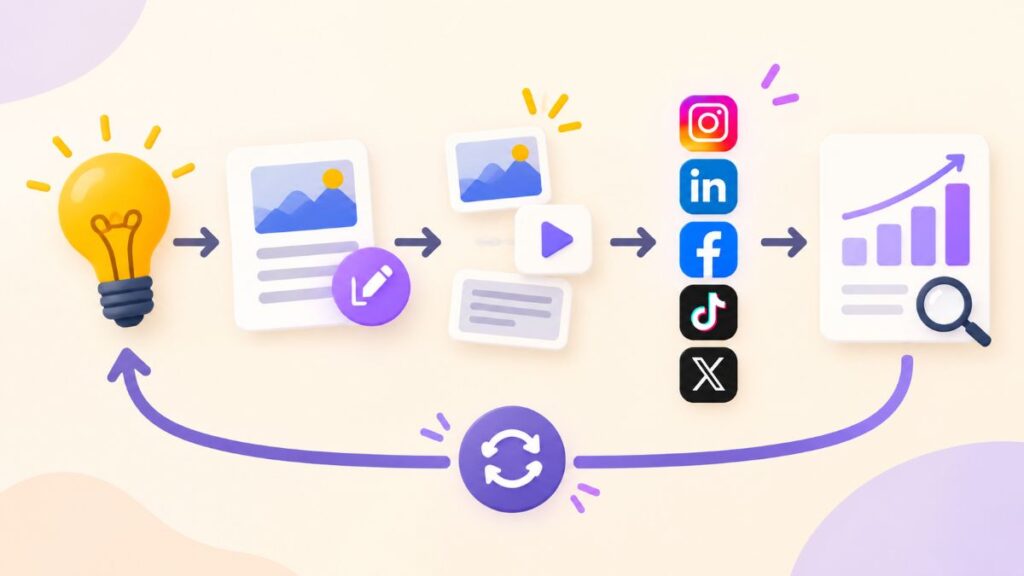
A good content strategy shouldn’t depend on how inspired you feel every morning.
It should have a process.
Here’s a relatively simple workflow that creators, freelancers and small businesses can follow.
Step 1: Start with one strong idea.
Don’t begin by asking, “What should I post on Instagram today?”
Instead, ask, “What is one useful thing I can explain to my audience this week?”
It could be a common mistake, an industry development, a customer question, a personal observation or a practical tutorial.
The stronger the original idea, the easier it becomes to develop different content from it.
Step 2: Create a primary piece of content.
This could be a blog article, a detailed LinkedIn post, a video, a case study or a newsletter.
Think of this as your main resource.
For example, if you’re writing an article about why businesses struggle with social media engagement, you might include five reasons, supporting examples and practical solutions.
Now you have enough material to develop several smaller pieces.
Step 3: Identify the strongest individual insights.
Don’t try to squeeze the entire article into every platform.
Look for individual ideas that can stand on their own.
One paragraph might become an Instagram carousel. A particularly interesting argument might become a LinkedIn post. A practical demonstration might work as a TikTok video.
Each piece should offer something useful independently.
Step 4: Adapt the presentation.
Think about the format, opening, tone and context.
Does the idea need a visual explanation? Would a short video communicate it better? Is it worth developing into a professional discussion?
Make these decisions before publishing.
Step 4: Adapt the presentation.
Step 5: Assign each platform a specific job and next action.
Every channel in your network should serve a defined strategic purpose rather than existing just for broad distribution. For instance, YouTube or a primary blog might act as your authority builder, LinkedIn as your professional networking engine, and Instagram or TikTok as top-of-funnel discovery channels. Aligning each platform with a clear next action—whether directing users to a newsletter, driving store visits, or encouraging post saves—ensures your audience experiences a coherent journey across your ecosystem. For further insights on structuring platform roles effectively, explore SocioBlend’s guide on giving every social platform a job and a stop rule.
Step 6: Measure the results and learn from them.
Don’t assume that a particular format will work simply because an industry report says it performs well.
Your audience might respond differently.
Pay attention to what people actually engage with, what they share, what they save and what brings them to your website.
Over time, this information should influence your content decisions.
4. How to Turn One Idea into a Week of Content
Let’s make the workflow even more practical.
Suppose you’re a social media marketer and your main topic for the week is:
“Why businesses struggle to get engagement on social media.”
Here’s one way you could distribute that idea.
| Day | Platform | Content |
| Monday | Blog | Publish the complete article |
| Tuesday | Share a carousel covering five common mistakes | |
| Wednesday | Discuss why posting consistently isn’t enough | |
| Thursday | TikTok | Create a short video explaining one engagement mistake |
| Friday | Start a discussion about the biggest social media challenges businesses face | |
| Saturday | X | Share a short thread with practical observations |
This is just an example, not a publishing schedule that every business should follow.
You might prefer publishing on fewer platforms. You might also discover that certain platforms deserve more attention than others.
The important point is that you don’t need five unrelated content ideas to maintain a presence across five platforms.
One well-developed subject can provide the foundation for an entire week’s content.
And if one of those posts performs particularly well, you can explore the topic further instead of immediately moving on to something unrelated.
5. Stop Measuring Every Platform by the Same Numbers
Here’s another mistake worth avoiding.
Many creators use the same performance metrics to judge every social media platform.
They look at likes, comments and follower growth, then decide whether their content strategy is working.
But different pieces of content can serve different purposes.
A LinkedIn post might generate meaningful professional conversations. An Instagram carousel might be saved by people who want to refer to it later. A TikTok video might introduce your business to people who have never heard of it.
Judging all three by likes alone doesn’t tell you much.
Instead, think about what you wanted each piece of content to achieve.
If your goal was awareness, look at reach, impressions and relevant discovery metrics.
If your goal was engagement, examine meaningful comments, shares, saves and other platform-specific interactions.
If your goal was website traffic, pay attention to link clicks and referral visits.
If your goal was generating business enquiries, look at leads and conversions.
One useful habit is to compare similar content over time on the same platform rather than treating engagement rates from different networks as directly interchangeable.
You should also consider the time invested.
A video that takes four hours to produce and generates slightly better engagement than a simple post might not be the most efficient choice for a small business.
The question isn’t simply, “Which post got the most engagement?”
It’s also, “Which content delivered the most value relative to the time and resources we invested?”
Turning Audience Feedback into Future Content
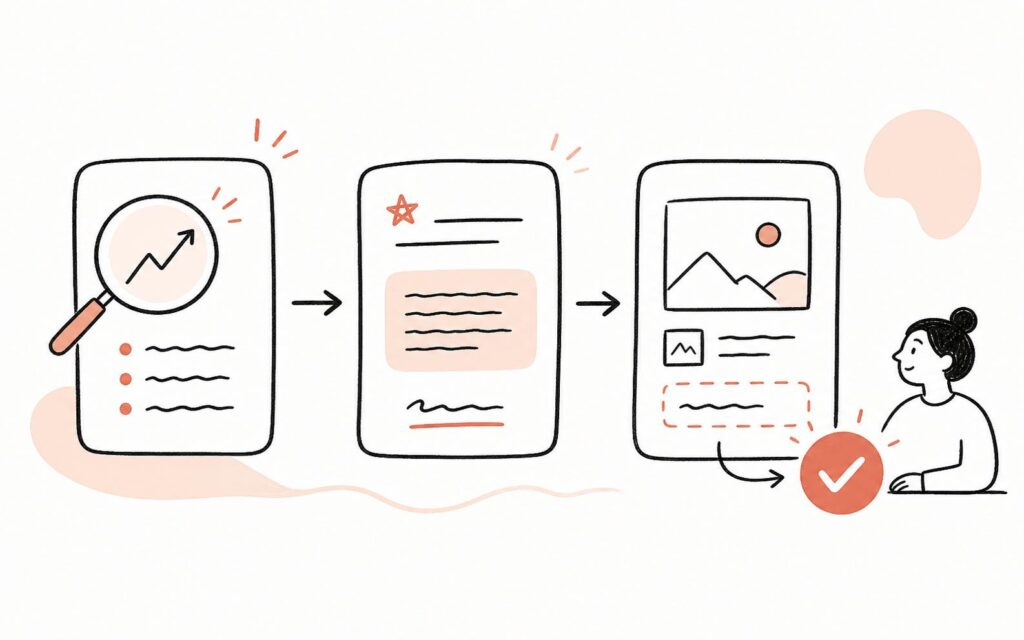
Performance evaluation shouldn’t mark the end of your content cycle; it should power the next one. Building a practical, actionable feedback loop involves three structured steps:
- 1. Categorize Audience Inputs: Regularly group comments, direct messages, and questions into themes—such as common misunderstandings, technical hurdles, or requests for deeper detail.
- 2. Convert Feedback into Core Questions: Turn recurring issues into concrete editorial topics. If multiple readers ask how to measure video engagement, make that the exact focus of your next primary piece of content.
- 3. Feed the Repurposing Workflow: Use these user-generated topics directly in Step 1 of your repurposing workflow, ensuring your upcoming articles and videos directly answer real audience needs.
6. Run Your Own Cross-Posting Experiment
Industry research can provide useful direction, but it cannot tell you exactly what will work for your audience. Conducting a structured 30-day cross-posting experiment will help you evaluate whether platform-specific adaptation yields a worthwhile return on investment.
That’s why I’d encourage creators and businesses to conduct a small experiment.
Experimental Methodology:
Select 10 comparable topic ideas over 30 days and split them evenly between two distinct distribution strategies, ensuring publish times and baseline themes remain consistent.
Approach A (Traditional Cross-Posting): Publish substantially identical content across all selected networks, altering only mandatory technical formatting (such as image dimensions).
Approach B (Platform-Specific Adaptation): Take the core concept and tailor the format, hook, tone, and call to action specifically for each platform (e.g., carousel for Instagram, discussion hook for LinkedIn, short video for TikTok).
Measurement & Tracking Framework:
- Platform-Specific Metrics: Track saves and profile visits on Instagram; reposts, comments, and connection requests on LinkedIn; watch completion time on TikTok; link clicks and thread engagement on X.
- Production Time & Resource Tracking: Record the exact time spent creating and adapting content for each approach. Calculate your engagement rate per hour of effort to determine whether tailored posts yield a proportional return.
There are limitations to this experiment. Audience size, publishing time, content quality and platform distribution can all affect the results. Ten ideas aren’t enough to establish a universal rule.
Still, it can help you understand whether adapting your content produces worthwhile improvements for your own audience.
You might discover that your LinkedIn audience responds better to detailed written posts, while your Instagram audience prefers visual explanations.
Or you might find that simple cross-posting works perfectly well for certain types of announcements.
Either way, you’ll be making decisions based on actual performance rather than assumptions.
7. You Don’t Need to Be Everywhere
There’s one final point that deserves attention.
Sometimes, the problem isn’t that you’re posting the same content everywhere.
It’s that you’re trying to maintain a presence on too many platforms in the first place.
Every social media platform requires attention. You need to understand its audience, create relevant content, respond to people and evaluate performance.
If you’re managing five accounts but doing a poor job on all five, expanding your reach might not be the right priority.
Start by identifying where your audience spends time and where your content has the greatest potential to achieve your goals.
Build a consistent presence on those platforms first.
You can always expand later.
It’s better to build a meaningful presence on two platforms than to publish mediocre content on five simply because you feel obligated to be everywhere.
Final Thoughts: Stop Copying Posts. Start Adapting Ideas.
Social media content creation doesn’t have to be an endless cycle of coming up with new ideas, writing captions and publishing posts.
Sometimes, the best thing you can do is take one good idea and explore it from different angles.
A useful article can become a video. A professional observation can become a discussion. A customer question can become an educational carousel.
The possibilities are there, provided you’re willing to think beyond copying and pasting.
But don’t make the opposite mistake either. Not every piece of content needs a completely different version for every platform. Sometimes, the original post is good enough.
The real skill is knowing the difference.
Stop thinking about how to publish the same post everywhere. Start thinking about how to make the same idea valuable everywhere.
That’s a much better foundation for a social media content strategy.
