


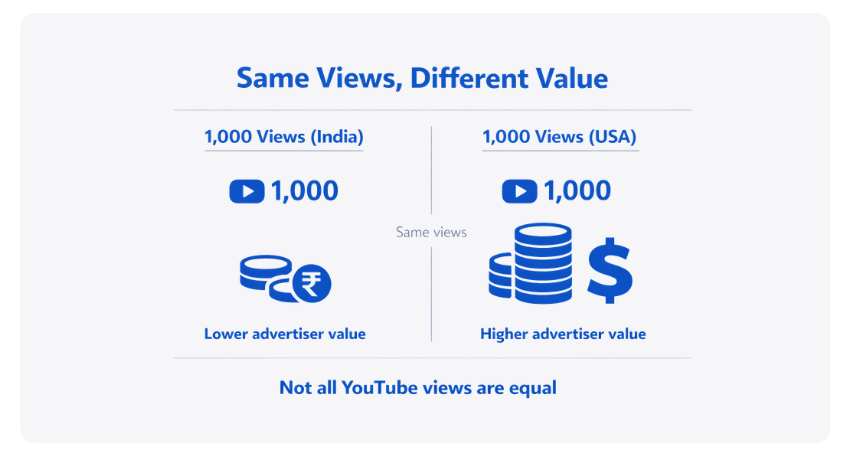
1,000 YouTube views from the US and 1,000 views from India do not carry the same value. Not even close.
In some cases, US views can be worth several times more than Indian views. That gap is what confuses most creators and buyers.
A common assumption is that cheaper views mean lower quality or even fake traffic. That is not accurate.
The difference has very little to do with authenticity. It has everything to do with how YouTube’s ad system works behind the scenes.
YouTube is an advertising marketplace. Every view has a value based on what advertisers are willing to pay for that audience.
And that value changes depending on where the viewer is located.
In this guide, we will break down exactly why YouTube views from India are cheaper. You will see how advertiser demand, audience behavior, and market economics all play a role.
By the end, the price difference will make complete sense.
If you’re unsure how YouTube actually evaluates views, here’s a deeper breakdown of real vs fake YouTube views and what YouTube rewards.
Table of Contents
The Core Reason: Not All YouTube Views Are Equal
At a surface level, a view looks simple. Someone clicks, watches, and leaves.
But on YouTube, every view has a different value behind it. That value is not random. It is determined by how much advertisers are willing to pay to reach that specific viewer.
This is why two videos with the same number of views can generate completely different revenue.
This is also why growth strategies differ. Some creators focus purely on organic reach, while others combine it with paid promotion. Here’s a clear comparison of organic vs paid YouTube views.
What Determines the Value of a YouTube View
There are a few key factors that decide how much a view is worth.
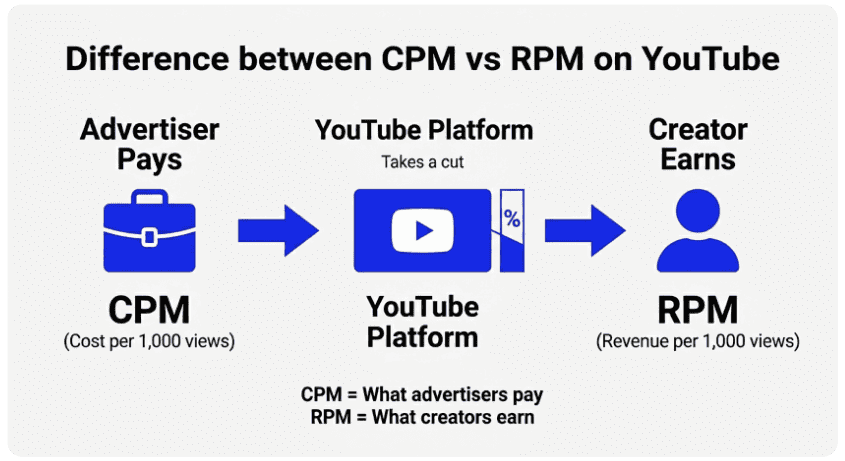
CPM (Cost Per Mille)
This is what advertisers pay for 1,000 ad impressions. Higher CPM means advertisers are spending more to reach that audience.
RPM (Revenue Per Mille)
This is what the creator actually earns after YouTube takes its share. RPM is always lower than CPM, but it follows the same pattern.
Geography
This is one of the biggest factors. Where your audience comes from directly affects how much advertisers are willing to spend.
A viewer from the US is more valuable because they have more money to spend. Advertisers pay for the chance to make a sale.
Why This Happens
YouTube operates as an advertising marketplace.
When an ad is about to be shown, advertisers compete for that placement. They place bids based on how valuable they think that viewer is.
The higher the competition, the higher the price.
So every time someone watches a video, there is a mini auction happening in the background.
And that auction is exactly why the same 1,000 views can have completely different values depending on location.
1. Lower Purchasing Power = Lower Ad Value
One of the biggest reasons YouTube views from India are cheaper comes down to simple economics.
Advertisers care about one thing above everything else. How much money can they make back from the audience they are targeting.
If the expected return is lower, they spend less. That directly reduces the value of each view.
Why Advertisers Pay Less for Indian Audiences
The average purchasing power in India is significantly lower than in countries like the US or UK.
That affects how much people are likely to spend after seeing an ad.
For example:
- A user in the US might sign up for a $200 insurance plan
- A user in India might be looking at a much lower-priced alternative
From an advertiser’s perspective, that changes everything.
If a single customer in the US can generate more revenue, advertisers are willing to pay more to reach that audience. That pushes CPM higher.
In India, even if the audience size is massive, the expected revenue per user is lower. So advertisers bid less.
Advertisers only care about sales. If they think a viewer will buy their product, they pay more to reach them. This is why prices change based on where the viewer lives.
Also read: YouTube SEO Checklist 2026: Rank Your Videos and Get More Views
2. Advertiser Demand Is Lower (Per User)
Purchasing power is one side of the equation. The other side is demand.
Even if two audiences had similar behavior, the number of advertisers competing for them would still change how much a view is worth.
And this is where the gap becomes obvious.
Ad Spend Gap Between India vs US and UK
The advertising market in the US and UK is significantly larger than in India.
There are more companies running ads, bigger budgets, and more aggressive bidding strategies. Entire industries depend heavily on digital advertising to acquire customers.
That creates intense competition.
When multiple advertisers want to reach the same audience, they start outbidding each other. This pushes CPM higher.
In India, the situation is different.
- Fewer advertisers competing for the same viewer
- Lower average ad budgets
- Less aggressive bidding
So even with a large audience, the competition per user is lower. And that keeps prices down.
When many brands want to show an ad to the same person, the price goes up. In the US, brands are always fighting for attention. In India, there is less fighting, so the price stays low.
3. Audience Value and Conversion Rates
Not all audiences behave the same after watching a video.
Some viewers watch and leave. Others click, sign up, and spend money.
From an advertiser’s perspective, that difference is everything.
Why US and UK Views Convert Better
Audiences in the US and UK tend to convert at a higher rate. There are a few reasons behind this.
Higher buying intent
Users in these markets are more used to taking action online. Clicking ads, signing up for services, and making purchases is normal behavior.
Higher spending power
They can afford higher-priced products and services. This increases the lifetime value of each customer.
Stronger online payment culture
Credit cards, subscriptions, and digital payments are widely adopted. That removes friction from the buying process.
All of this leads to better conversion rates.
Why Brands Prefer Western Audiences
For brands, it comes down to results.
If an audience is more likely to convert and spend more money, it becomes more valuable. That is where advertisers see stronger returns.
So they shift more budget toward those regions.
US and UK views cost more because those viewers spend more money. Advertisers fight to reach these big spenders.
And that directly increases the value of each view in those markets.
This is completely off topic but you can read this article to know the best time to post on YouTube.
4. Language and Market Fragmentation
Audience size alone does not determine value. How easily that audience can be targeted also matters.
This is where India and Western markets differ in a big way.
India’s Multi-Language Problem
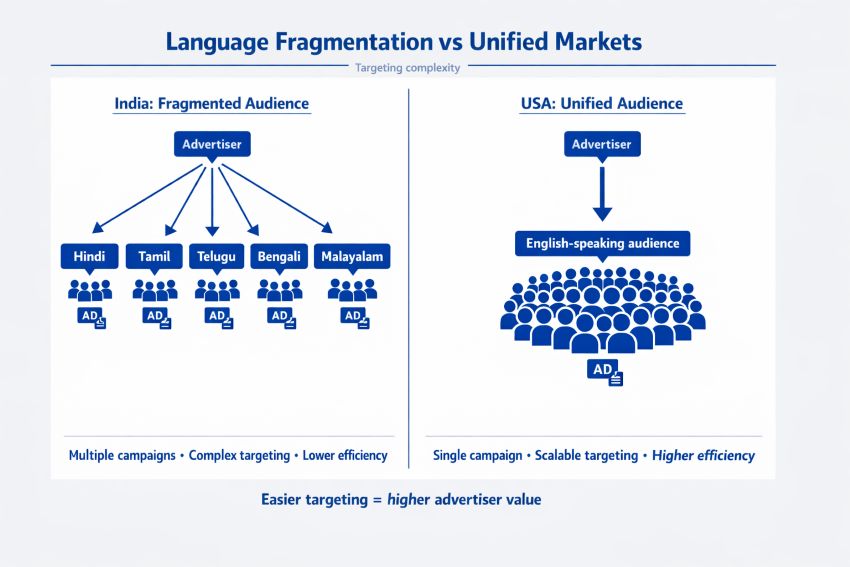
India has a massive user base, but it is split across multiple languages.
Hindi, Tamil, Telugu, Bengali, Malayalam, and many more. Each language represents a different segment with its own content preferences and behavior.
For advertisers, this creates complexity.
Instead of targeting one large, unified audience, they often have to:
- Create multiple campaigns
- Adjust messaging for each language
- Work with smaller, segmented audiences
That reduces efficiency.
Why This Matters for Ad Value
In contrast, the US market is largely English-speaking.
That makes it easier to scale campaigns.
- One campaign can reach a huge portion of the audience
- Messaging stays consistent
- Targeting is simpler and more efficient
For advertisers, this is a big advantage.
When targeting is easier and more scalable, advertisers are willing to spend more. That increases competition and pushes CPM higher.
In India, fragmentation makes scaling harder. And that keeps ad costs, and view value, lower.
5. The Neighborhood Effect: Why Better Tools Cost More
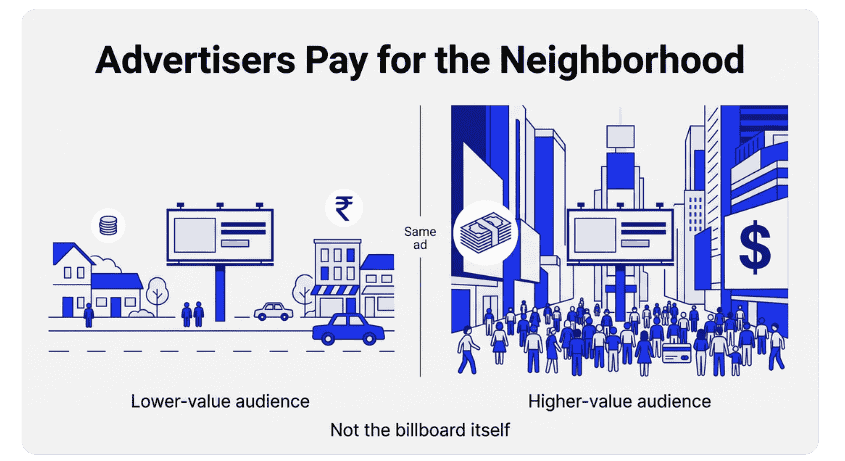
A view from India is like a billboard in a small town. Millions of people drive past it, but they have less money in their pockets to spend. A view from the US is like a billboard in Times Square. Fewer people might see it overall, but those people are carrying credit cards and looking to buy right now. Advertisers pay for the neighborhood, not the billboard itself.
Better tracking: Advertisers in the US have better tools to find specific buyers.
Bigger brands: High-paying companies like banks and insurance firms fight for US viewers.
Better ad spots: There are more premium places to show ads in Western markets.
All of this increases competition and pushes prices higher.
The Key Insight
India is a growing market, but its digital tools are still catching up. In the US, advertisers have better ways to find and track buyers. This makes their ads more successful. Until the tools in India reach that same level, the price for each view will stay lower.
India vs USA vs UK: Quick Comparison
| Factor | India | USA / UK |
| Money to Spend | People have less extra money for shopping. | People have more money and use credit cards often. |
| Ad Fighting | Fewer brands are bidding for ads. | Thousands of brands fight for every single click. |
| Language | Many different languages: it is harder to reach everyone at once. | Mostly English: it is easy to reach everyone with one ad. |
| The Result | You get a massive crowd of viewers. | You get fewer viewers, but they buy more things. |
This table sums up the core idea.
India offers scale, but lower value per user.
The US and UK offer smaller scale compared to India, but significantly higher value per view.
That is why the same number of views can produce completely different results depending on where they come from.
Does Cheap Mean Low Quality? (Important Section)
Price often gets misunderstood.
When people see cheaper YouTube views from India, the first assumption is that something must be wrong with them.
That assumption is flawed.
The Big Myth
Low prices come from basic market rules. These views are from real people: they are not bots or spam.
A real viewer in India is still a real viewer.
The difference is in how much that viewer is worth to advertisers.
What This Actually Means
Think of it like two different markets.
India is a high volume market.
You can reach a large number of viewers at a lower cost.
The US and UK are high value markets.
Each viewer is more expensive because they are more likely to generate revenue.
Neither is inherently better. They serve different purposes.
If your goal is reach and visibility, lower-cost markets can be very effective.
If your goal is revenue and conversions, higher-value markets become more important.
Understanding this distinction is what separates guesswork from strategy.
Why Creators Still Want Indian Views
Even with lower value per view, Indian traffic is far from useless.
In fact, many creators actively target it, especially in the early stages of growth.
Because when used correctly, it solves a different problem.
Advantages
Massive audience scale
India has one of the largest YouTube user bases in the world. This makes it easier to reach large numbers of viewers quickly.
Faster virality potential
With a larger pool of active users, content can gain momentum faster. More impressions can lead to more engagement in a shorter time.
Easier to gain traction early
New channels often struggle with visibility. Lower-cost views from high-volume markets can help build initial social proof and break out of zero-view territory.
This is a choice between a big crowd and big sales. India gives you a crowd. The US gives you sales. Smart creators use both to grow their channel.
Smart Strategy – Mix of Geo Views
Looking at this as an either-or decision is a mistake.
You do not have to choose between cheap views and high-value views. The smarter approach is to use both, but for different goals.
What Smart Creators Do
Creators who understand how the system works don’t rely on a single audience source. They combine markets strategically, using India to drive volume while leaning on the US and UK for stronger revenue and conversions.
Where most people struggle is not in understanding this idea, but in actually applying it without hurting their metrics. Bringing in views from different regions sounds simple, but if it’s done poorly, it can damage watch time, retention, and the way YouTube interprets engagement.
If you want to approach this in a more controlled way, you can see how it works here:
https://socioblend.com/youtube-views
When done right, this approach helps you build momentum and then shift toward higher-value audiences as the video starts to gain more engagement and popularity.
The Key Insight
Smart creators use different audiences for different goals. Use India for growth and the US for profit.
Volume drives growth, while value drives revenue.
The real advantage comes from knowing how to balance both.
Should You Buy YouTube Views from India?
This depends on what you are trying to achieve.
Buying views is not a one-size-fits-all decision. It only works when it aligns with your current stage and goals.
When It Makes Sense
New channels
If you are starting from zero, initial visibility is the hardest part. A boost in views can help your content get noticed.
Social proof building
Higher view counts make your videos look more credible. This can improve click-through rates and user trust.
Boosting initial traction
Early engagement signals can help your content gain momentum and perform better in recommendations.
When It Doesn’t
Monetization-focused channels
If your main goal is ad revenue, lower-value views will not maximize earnings.
Premium audience targeting
If you are targeting high-paying customers or specific regions, you need views from those markets.
If your goal is to build momentum and get your content moving, Indian views can be a practical starting point. And if you are looking for a reliable way to do that, you can explore a trusted option to buy YouTube views that aligns with your growth strategy.
Final Verdict
YouTube views from India are cheaper because of market economics. Advertisers spend less in India because viewers have less money to spend on products. This is not a quality issue: it is a pricing difference based on the size of the viewer’s wallet.
