

The standard answer to this question is a lie: YouTube does not have an instant “fake view” switch.
People love the idea of a perfect filter because it makes the platform feel fair. It makes them feel like a digital police force is protecting their hard work. In reality: detection is a messy, lagging process that often fails in the short term.
Some views are killed at the door. Others sit on your dashboard for weeks like they belong there, only to vanish during a quiet midnight audit. The entire fake-view industry exists because the system is reactive: it is a game of cat and mouse where the mouse often gets a head start.
If you want the truth about how views are actually scrubbed, you have to look past the official PR. The view counter is a working draft: it is never the final word.
The Myth of the Perfect Filter
The myth of “perfect detection” survives because it makes everyone feel safe. It is easier to believe in an all-seeing algorithm than to admit the platform is constantly being outrun by teenagers with server farms.
If the system worked as advertised, the fake view industry would have collapsed years ago. Instead, it is a booming economy. Businesses sell views every day because they know exactly where the cracks are. They know the system is reactive: it is not proactive.
Most articles ignore this reality. They want to keep the narrative clean and simple. They want to pretend the “bad guys” never win. But they do win, at least for a few days. Admitting the system is flawed feels dangerous: it makes the platform seem vulnerable.
YouTube is a game of constant correction. It doesn’t catch every fake view at the door. It finds them later, often after the damage is done. The platform is a sieve. It is never a wall.
The Four Tiers of Trash
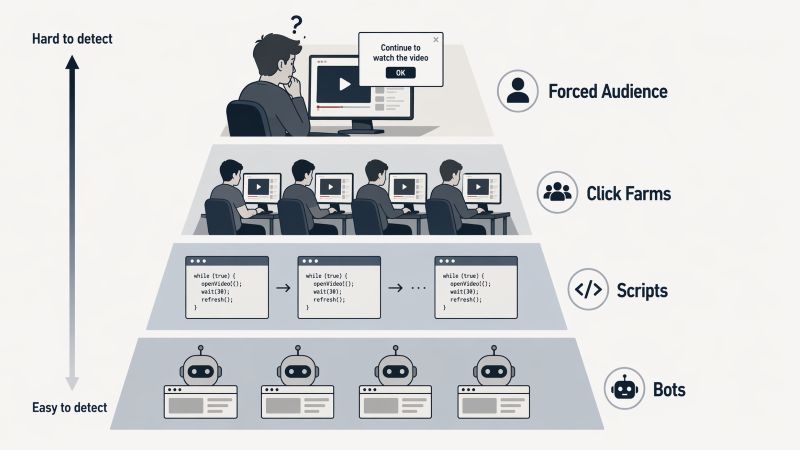
The word “fake” is too broad. It covers everything from a simple script to a room full of underpaid humans. YouTube categorizes this traffic based on how hard it is to spot: it is a hierarchy of deception.
1. The Zombie Bots These are the bottom-feeders: automated bots. They do not scroll. They do not pause. They hit the play button and vanish. These are the cheapest views on the market. They usually run on “headless” browsers from server IP addresses that YouTube flagged years ago. They lack a basic digital history: no Google search history, no logged-in accounts, and zero mouse movement. This is the digital equivalent of putting a cardboard cutout in a chair and expecting the host to think you attended the party. YouTube kills these almost instantly because they do not even try to look human.
2. The Lazy Scripts These are the bottom-feeders: automated bots. They do not scroll. They do not pause. They hit the play button and vanish. This is the digital equivalent of putting a cardboard cutout in a chair and expecting the host to think you attended the party. YouTube kills these almost instantly because they do not even try to look human.
3. The Human Robots Click farms are more deceptive. These involve real people sitting in rows of cheap plastic chairs. They are real humans, but they are following a script. They watch for exactly thirty seconds: they click like: they move to the next link. It looks human at a glance, but the patterns are too perfect. Real humans are messy. They get distracted: they leave early: they skip around. Total consistency is the red flag that gets these views scrubbed during the audit.
4. The Forced Audience This is the gray area: manipulated traffic. This is when a user is forced to “view” a video via a pop-up or a hidden redirect just to see the content they actually wanted. These are real devices and real people, but the intent is zero. They are watching because they have to, not because they want to. This is the hardest tier to flag immediately because the technical data looks perfect.
YouTube does not just care if a view is “real.” It cares if the view has value. A real person forced to watch a video against their will is just as useless to the platform as a bot. The system focuses on intent: if the intent is missing, the view is eventually treated like garbage.
Also read: what YouTube actually considers real vs fake views
How YouTube Actually Detects Fake Views
Here’s where people expect some kind of smart, all-seeing system.
Like YouTube can just look at a view and decide if it’s fake or real.
That’s not what’s happening.
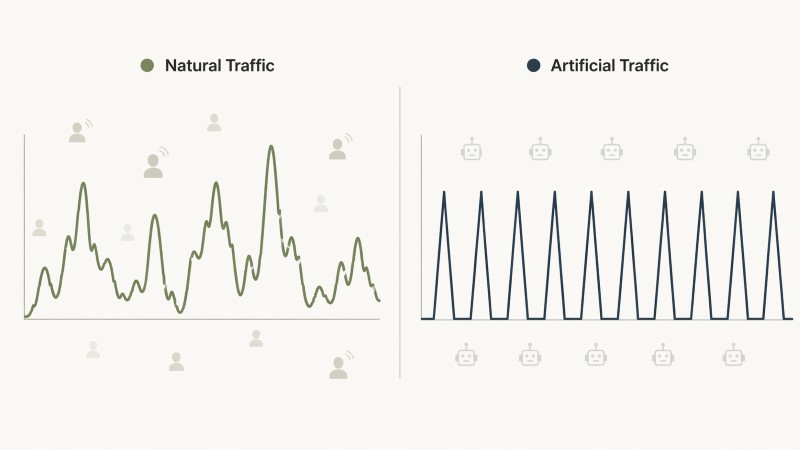
YouTube isn’t sitting there labeling views one by one. It’s watching patterns. It’s looking for behavior that feels off when you step back and look at the bigger picture.
And once you understand that, the whole thing starts to make more sense.
Read this guide to know more about how YouTube SEO actually works
Pattern Recognition (Behavioral Analysis)
This is the first layer.
Not the most complex one. But one of the most effective.
YouTube tracks how views come in and how they behave over time.
Things like:
- Sudden spikes that don’t match the channel’s normal growth
- Multiple views following nearly identical watch durations
- Repeated sessions that look too consistent to be random
One of these on its own doesn’t mean much.
But when everything starts lining up a little too perfectly, it stops looking like an audience.
It starts looking controlled.
And that’s usually where the system begins to pay attention.
Engagement Mismatch
This is where things start to look suspicious fast.
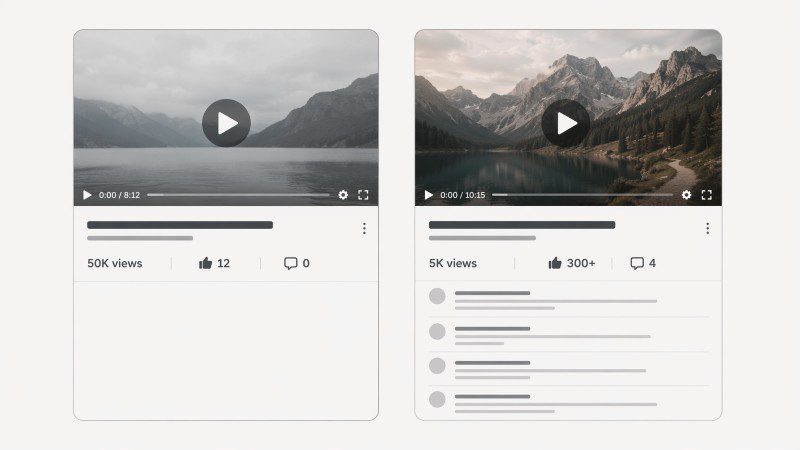
A video shows thousands of views.
But almost no likes. No comments. No real interaction.
That gap is hard to ignore because real viewers don’t just watch and disappear. Some like, some comment, some click around. The behavior is messy, uneven, unpredictable.
Fake views don’t have that variation.
They show up, do the bare minimum, and leave.
Another signal is watch time.
If people are clicking the video but leaving within a few seconds, it sends a very clear message. The view exists, but the interest doesn’t.
And when you stack high views with weak engagement and poor watch time, it stops looking like growth.
It starts looking artificial.
IP and Device Fingerprinting
Now it goes a level deeper.
It’s not just about how people behave. It’s also about where they’re coming from and what they’re using.
If a large chunk of views comes from the same IP ranges or tightly grouped locations, that stands out. Same thing if the devices look too similar. Same browser versions, same setups, repeating over and over.
Individually, none of this proves anything.
But when patterns start stacking, it becomes hard to ignore.
Machine learning systems are built for this exact job. They don’t need perfect certainty. They just need enough similarity to say this doesn’t look natural.
Also read this guide: why YouTube views are cheaper in some countries
Technical Validation
This is where a lot of fake traffic quietly fails.
YouTube doesn’t just count a view because a video was loaded. It looks at how that playback actually happens.
Did the player load properly?
Did scripts execute like they should?
Did the session behave like a real user interacting with the page?
Bots often struggle here.
They might trigger a view, but they don’t fully replicate everything happening behind the scenes. Something breaks, something is missing, something doesn’t line up.
And those small gaps are enough to raise flags.
Session Behavior Depth
This is the layer most people don’t even think about.
A real viewer rarely watches just one video and disappears. They click something else. They scroll. They open another tab. They fall into a rabbit hole for a few minutes.
That’s normal behavior on YouTube.
Now compare that with fake or low-quality traffic.
The session starts and ends with one action. Watch the video, leave. No follow-up, no browsing, no interaction beyond that single view.
Individually, that might not look suspicious.
But when a large number of sessions start looking isolated like that, it stands out.
Because real users don’t behave in isolation. They move around the platform.
When that movement is missing, the traffic starts to look incomplete. And incomplete behavior is often a sign that something isn’t real.
What Happens When YouTube Detects Fake Views
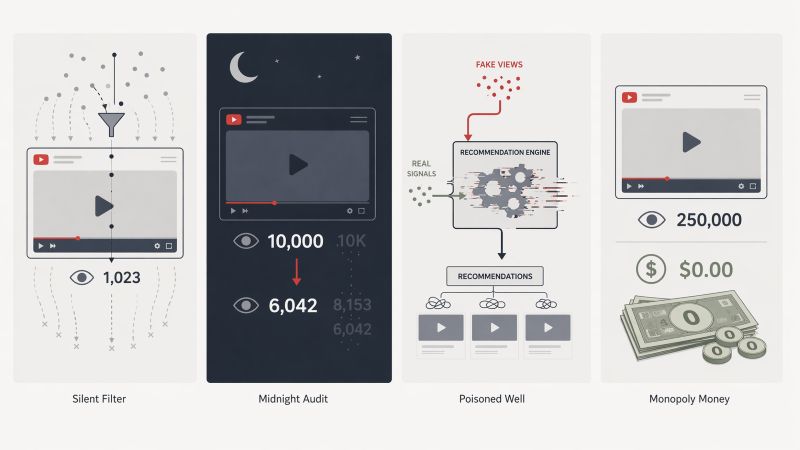
Most creators expect a warning or a notification when things go wrong. They want a chance to explain themselves. They won’t get one. YouTube is a silent executioner: it doesn’t argue, it just adjusts.
1. The Silent Filter Some views are dead on arrival. You pay for 10,000 views, but only 200 ever show up on your dashboard. YouTube doesn’t send an error message: it simply ignores the traffic. The bot hits the video, the server registers the hit, and the system discards the data before it ever touches your public count. This is the most common outcome. It is quiet, efficient, and frustrating for anyone trying to game the system.
2. The Midnight Audit This is the “cliff” that keeps vanity creators awake at night. You see your numbers climb, you celebrate your “success,” and then you wake up to find 40% of your views have vanished. This is not a glitch: it is a correction. YouTube treats your view count like a working budget. It is a temporary number that is subject to a background audit. If the audit finds trash, it claws the numbers back. Your count is never final until the video is old.
To know more why some views disappear later you can read this guide.
3. The Poisoned Well The drop in numbers is annoying, but the damage to your reach is a tragedy. YouTube is a recommendation engine that thrives on trust. When you feed it fake traffic, you are feeding it garbage data. The system tries to find “more people like your viewers” and finds only empty servers. It gets confused: it stops showing your video to real humans because your “audience” shows zero interest. Even if you keep the fake views, you have successfully killed your visibility.
4. The Monopoly Money Fake views are digital play money. They look like wealth on the dashboard, but they buy nothing in the real world. YouTube’s monetization system is separate from the view counter. If the traffic does not meet specific quality standards, the revenue is simply withheld. You might have a million views, but your bank account stays empty. Advertisers do not pay for bots: therefore, neither does YouTube.
The real punishment is not the deletion of the views. It is the loss of momentum. A video with fake views is a dead end. It might look popular, but it is effectively invisible to the people who actually matter: real viewers.
Why Some Fake Views Still Work
This is the part people notice, but rarely understand.
They buy views. The numbers go up. Nothing happens. No drop, no warning.
So they assume it worked.
Not exactly.
Detection is not instant
YouTube doesn’t judge a view the moment it happens.
It watches patterns over time.
A single view doesn’t mean much. Even a few hundred might not trigger anything immediately.
It’s when behavior starts forming a pattern that the system reacts.
So in the short term, things can look clean.
Some traffic looks real enough
Not all fake views are obvious.
Basic bots are easy to catch. But more advanced setups try to mimic real users.
They scroll a bit. They watch longer. They behave just enough like a normal viewer to avoid immediate flags.
That doesn’t mean they’re invisible. It just means they blend in better at first.
The audit lag effect
This is where most confusion comes from.
Fake views can sit there for a while, making everything look fine.
Then later, they start disappearing.
Not because something new happened. But because YouTube went back and re-evaluated the data.
So yes, fake views can “work” for a short time.
But that window is often temporary.
What looks like success in the moment is sometimes just delayed correction waiting to happen.
The Myths Killing Your Channel
The internet is full of bad advice regarding YouTube. Most of it comes from people who want your money or people who have never actually looked at a data audit. Let’s kill the three biggest myths right now.
1. Detection is instant. This is a fantasy. People think the system is a laser: it is actually a slow-moving filter. Some views get blocked at the gate. Others sit on your dashboard for weeks, making you feel like a genius who outsmarted a billion-dollar company. Then, during a quiet midnight audit, they vanish. The system doesn’t rush: it waits for the data to stack up. Thinking you “got away with it” because your numbers didn’t drop in ten minutes is amateur thinking.
2. All bought views are “fake.” This is too simple. There is a massive difference between a script and a bored human clicking a pop-up in a click farm. YouTube tracks behavior: it does not just track the source. If a view comes from a real device and shows interest, it carries weight. The problem is that 99% of bought traffic is low-quality garbage. It provides zero value to the platform, so the platform eventually treats it like it never happened. Quality is the only metric that matters.
3. High views lead to high rankings. This is the most dangerous belief in the industry. A view without retention is a negative signal. If 10,000 people click your video and leave after three seconds, you have officially told the algorithm that your content is a disappointment. You are literally paying money to damage your own reputation with the machine. A video with 500 “real” views and high retention will outrank a video with 50,000 “bought” views every single time.
Creators focus on the surface number: the machine focuses on the intent behind it. If the intent is missing, the view is just a ghost. It has no power.
Real-World Signs YouTube Has Flagged Your Views
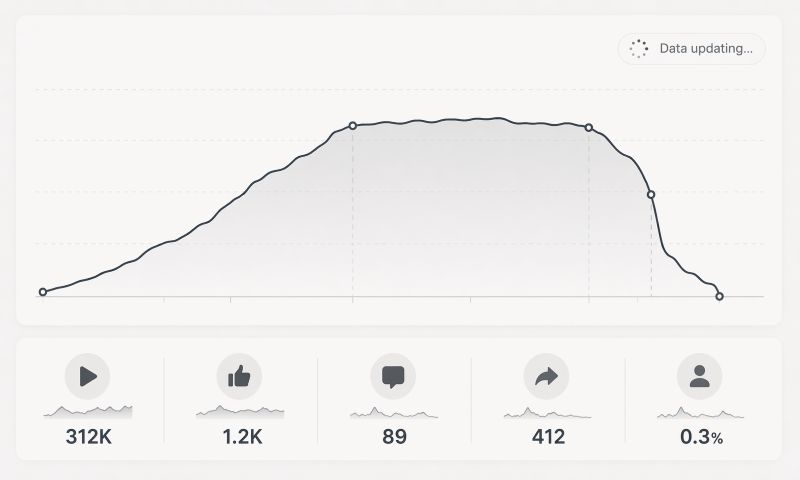
You usually don’t get a warning. No notification saying something went wrong.
But if you pay attention, the signals are there.
One common sign is views freezing at a certain number. The video is still getting traffic, but the count stops moving like it hit a ceiling.
Another is the sudden drop. You see a spike, everything looks great for a while, and then the number falls back down. Not gradually. Just gone.
Then there’s the mismatch between views and engagement. Thousands of views, but almost no likes, comments, or interaction. It looks off even without analytics.
And sometimes the disconnect shows inside your dashboard. Traffic sources don’t line up. Watch time doesn’t match the view count. The numbers feel disconnected from each other.
One of these on its own doesn’t mean much. But when you see all of them together, it’s usually not a coincidence.
But when you start seeing multiple signals at once, it usually means the system has started adjusting something behind the scenes.
The Invisible Sabotage
Most creators act like they are trying to sneak a snack into a movie theater. They think the only risk is getting caught and having the snack taken away. They are wrong.
The real risk is data poisoning: detection is secondary.
YouTube is a recommendation engine that runs on signals. Every view is a piece of data that tells the system who to show your video to next. When you buy traffic, you are feeding the machine garbage. You are effectively putting sugar in your own gas tank: the car might still look shiny on the outside, but it is never going to move. The difference is simple: low-quality views try to game the system, while the right approach is to buy YouTube views through legitimate ad campaigns that attract real audience behavior.
- Low retention is a confession. If 10,000 “viewers” leave your video after five seconds, you have officially told the algorithm that your content is boring. You have trained the system to ignore you.
- Missing engagement is a red flag. Real humans are opinionated: they like, they complain, and they comment. A massive view count with zero interaction tells the system that your “audience” has no pulse.
- The wrong audience is a dead end. If your views come from a bot farm in a country where no one speaks your language, the algorithm gets confused. It tries to find more people like those “viewers” and fails.
At that point, it doesn’t even matter if the views stay or go. The damage is done. You have successfully convinced the most powerful discovery engine on earth that your video is not worth watching.
There is a new danger in 2026: The Over-Correction.
Because YouTube is so desperate to kill the bot industry, its “Invalid Traffic” filters sometimes hit real creators. If a real video goes viral in a “suspicious” region or gets shared by a bot-heavy Twitter account, YouTube might panic and wipe out real views.
This is why “Signals of Humanity” matter more than ever.
- Comments with context (not just “nice video”).
- Off-platform shares from verified accounts.
- Multi-session behavior (viewers watching two or three of your videos in a row).
These are the “Human Fingerprints” that protect you from the audit. If your views don’t have these fingerprints, the system assumes the worst.
Stop Chasing Ghosts
YouTube can detect fake views: this is a fact. But it is not a simple game of hide-and-seek. The system is a behavior engine that observes, layers signals, and adjusts over time.
You cannot outsmart a machine that tracks billions of hours of human behavior every single day. It knows what a real person looks like better than you do. It knows how they scroll, where they pause, and when they get bored.
Stop focusing on the number on the dashboard. That number is a vanity metric that pays zero bills. Focus on the signals behind the number. If you want the algorithm to trust you, give it something real to work with. You are not trying to trick a computer: you are trying to reach a human being.
Send signals that actually make sense. Everything else is just noise.
