

Almost nobody builds a massive, highly competitive backlink profile purely on “great content” and polite outreach anymore. I have seen the backend analytics of enough major sites to know the truth. The biggest, most respected names in your industry are buying links right now. It is simply the worst-kept secret in SEO.
But there is a huge difference between being smart about acquiring high value placements and just throwing your budget at toxic link farms. Google obviously hates this practice. Their spam policies clearly condemn paying for links, and their algorithms are getting incredibly good at catching lazy schemes. If you buy from the wrong vendor, your organic traffic can flatline overnight. I have watched it happen to businesses who tried to cut corners, and it is not a pretty sight.
We are not here to give you a lecture on why you should never buy links. If you compete in a tough niche, you already know you probably have to do it to survive.
Here is the practical reality of buying links without getting caught. We will cover how to spot toxic Private Blog Networks (PBNs) a mile away and how to actually negotiate safe placements. Here is how to buy links without putting a giant target on your domain.
Table of Contents
What Buying Backlinks Actually Means
When people hear about buying backlinks, they often picture shady forums or hackers trading links in dark corners of the internet. In reality, the modern link-buying economy operates in plain sight. It is heavily corporatized and usually disguised under terms like “guest posting fees,” “administrative costs,” or “digital PR.” Understanding the mechanics of how money changes hands is the first step to evaluating the risk involved.
The Difference Between Paid Links and Link Schemes
Not all paid links are created equal. The risk level depends entirely on the footprint the transaction leaves behind and the quality of the publishing site.
Direct Paid Placements This is the most straightforward transaction. A marketer reaches out to a blog owner and asks for a link insertion in an existing article. The blog owner replies with a price tag. You pay the fee, and the link goes live. While common, this method carries significant risk if the website openly advertises that it sells links or if its outbound link profile is cluttered with obvious, low-quality commercial links.
Outreach-Based Placements This falls into the true gray area of SEO. Many companies hire digital PR agencies or link-building outreach specialists. In this scenario, you are paying an agency for the labor of acquiring the link. However, behind the scenes, that agency is often paying a “webmaster fee” or “sponsorship fee” to get the content published. Because the target sites are usually highly vetted and contextually relevant, this method mimics natural link acquisition and is generally much safer.
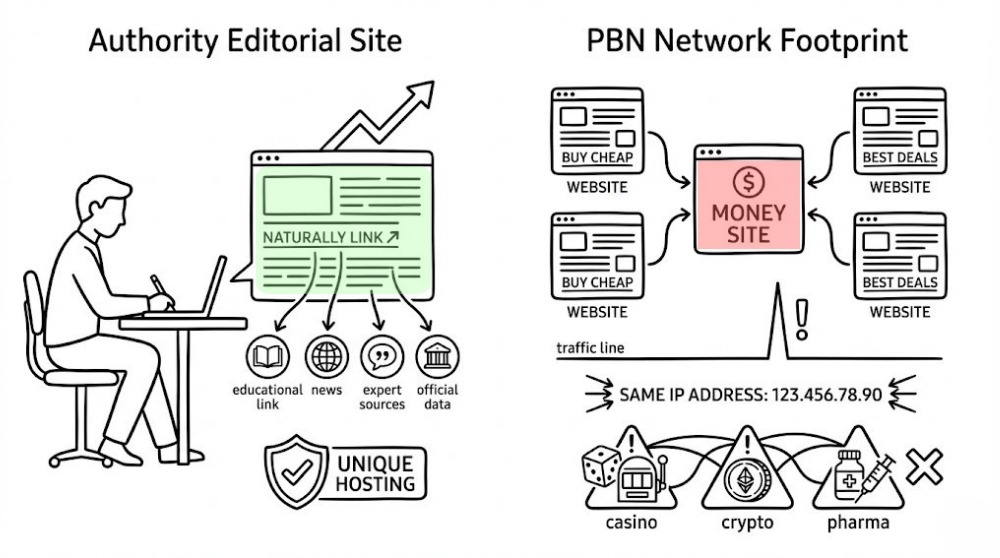
PBNs and Automated Spam Private Blog Networks (PBNs) are clusters of websites owned by a single entity, built specifically for the purpose of selling links and passing authority. They are often created using expired domains that still retain historical backlink power. Buying links on PBNs, or using automated software to blast thousands of links across forum profiles and blog comments, is highly manipulative. These tactics leave massive, obvious footprints for search engines to follow.
What Google Really Says About Paid Links
To buy links safely, you have to understand exactly how search engines police them. Google’s stance is strict, but their enforcement methods are highly calculated.
The Link Scheme Definition According to Google’s spam policies, any link intended to manipulate a site’s ranking in Google search results may be considered part of a link scheme. This includes exchanging money for links or posts that contain links, exchanging goods or services for links, or sending someone a product in exchange for them writing about it and including a link. By the letter of the law, nearly all transactional link-building violates their guidelines.
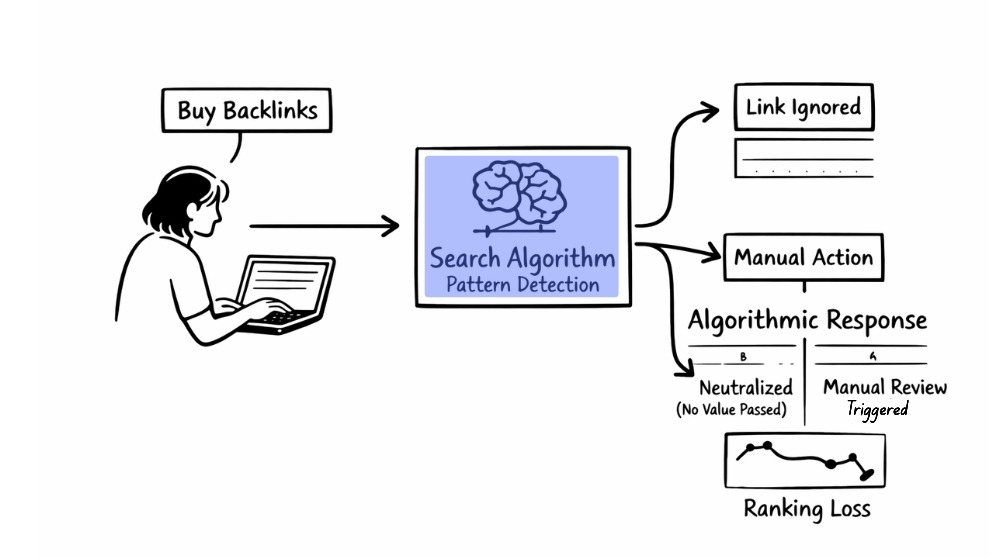
Manual vs Algorithmic Devaluation When a site gets caught manipulating links, there are two potential outcomes. A manual action occurs when a human reviewer at Google determines your site is in violation of spam policies. This results in a notification in Google Search Console and a direct, often devastating drop in rankings. Algorithmic devaluation, on the other hand, is handled automatically by Google’s systems, like SpamBrain.
Why Most Paid Links Do Not Trigger Penalties (They Get Ignored) Here is the reality check that most white-hat SEOs misunderstand. Historically, Google’s algorithms would aggressively penalize sites for having bad inbound links. However, negative SEO attacks, where competitors would build spam links to rival sites to tank their rankings, forced Google to change its approach.
Today, Google’s primary algorithmic response to a suspicious, paid, or low-quality link is simply to ignore it. The algorithm neutralizes the link so it passes absolutely no ranking value. The danger of buying cheap or poorly vetted links is rarely that your site will be penalized. Instead, the real risk is that you will waste thousands of dollars on links that search engines have already silently devalued.
Can You Buy Backlinks Without Getting Penalized?
So, can you buy backlinks without waking up to a manual action in Google Search Console? Yes, you absolutely can. The biggest players in highly competitive niches do it every single day.
However, if you are wondering if buying backlinks is a good idea for your specific business, the answer depends entirely on your budget, your SEO knowledge, and your risk tolerance. For a small local business with no SEO experience, diving into the link market is usually a terrible idea. But for a growing brand competing against giants, the question is rarely “should I buy backlinks.” Instead, the question is how to execute a paid link strategy without leaving a traceable footprint.
Before we dive into the mechanics of vetting, here is a quick look at the reality of the transaction.
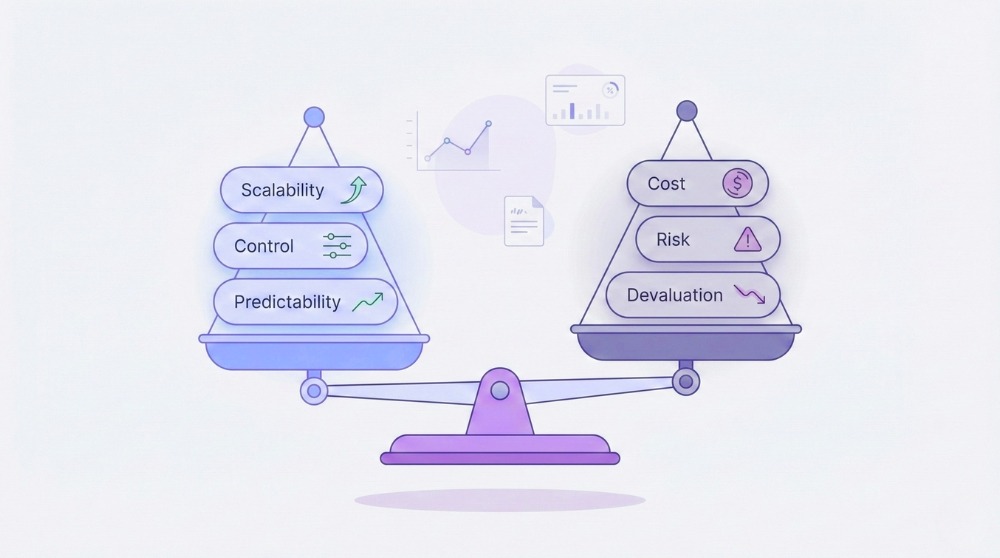
| Pros of Buying Links | Cons of Buying Links |
| Scalability: You can accurately forecast link growth and secure placements predictably. | Financial Cost: High-quality, safe placements are expensive and require a dedicated budget. |
| Guaranteed Placements: Unlike traditional outreach, you know exactly what you are getting and when. | Devaluation Risk: If you buy from the wrong vendor, the link will be ignored by Google’s algorithms. |
| Control: You often have more control over the target URL and the surrounding context. | Heavy Vetting Required: You must spend significant time analyzing metrics and traffic drops. |
The Real Risk Factors
When a website actually gets penalized for buying links, it is almost never because a Google employee intercepted a PayPal receipt. Search engines rely on algorithmic signals to detect manipulation. Here are the footprints that will get your site flagged.
Anchor Text Abuse
This is the fastest way to trigger a penalty. If your target keyword is “best CRM software,” and 80% of your inbound links use that exact phrase as the clickable text, you are waving a massive red flag. Natural backlink profiles are messy. They consist of branded anchors, naked URLs, and generic phrases like “click here.” Over-optimizing your anchor text is a dead giveaway of a paid link scheme.
Irrelevant Domains
A link must make contextual sense. If you run a real estate agency in Florida, a backlink from a high-authority cryptocurrency blog in Eastern Europe looks incredibly unnatural. Google evaluates the relevance of the linking neighborhood. If the topics do not align seamlessly, the link is heavily scrutinized.
Obvious Patterns
Search engines are excellent at pattern recognition. If every single backlink pointing to your site comes from a “Write For Us” page, a sponsored post tag, or an author bio box, the algorithm will connect the dots. Safe link building requires a diverse profile that mimics organic attention.
Sudden Link Velocity Spikes
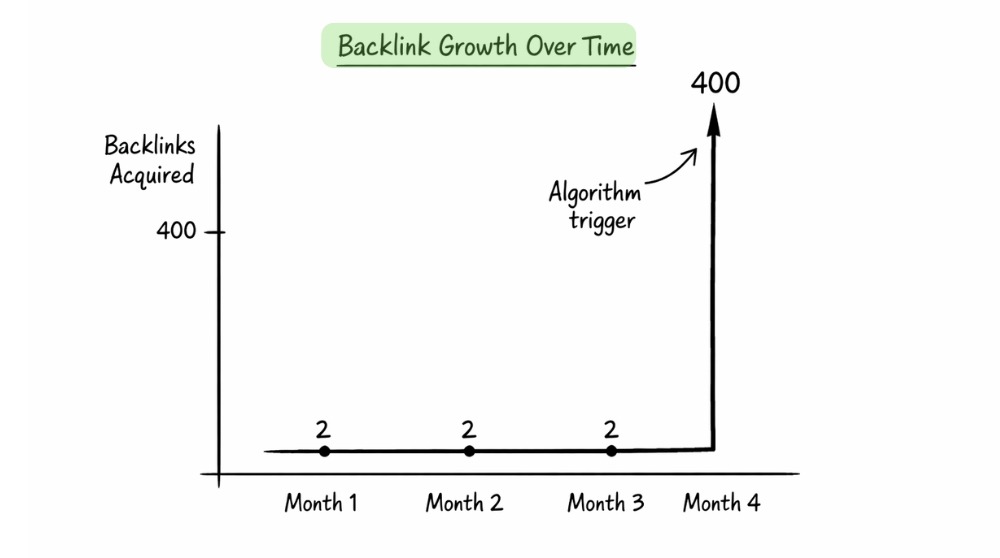
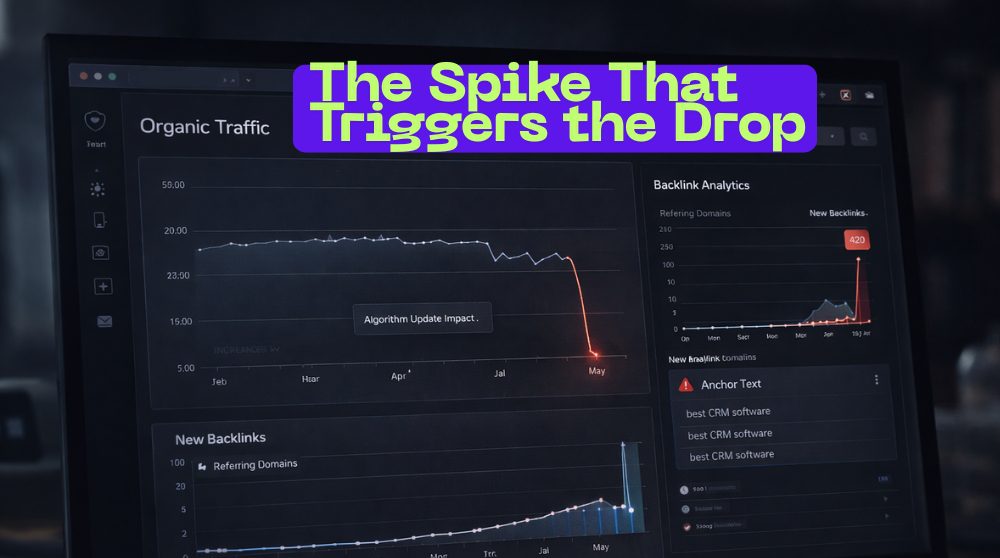
Link velocity refers to the speed at which you acquire new backlinks. If your site historically earns two backlinks a month, and suddenly you acquire four hundred links in three days, Google’s SpamBrain algorithm will immediately flag the activity as artificial.
Also read: How to use Reddit to find content ideas
Why Most Sites Get Penalized
Most penalties are not the result of a single bad link. They are the result of systemic, low-budget negligence. When site owners try to cut corners, they fall into the most dangerous traps in the industry.
Cheap Bulk Packages
You have probably seen the emails promising “100 High DA Backlinks for $50.” These packages are pure poison. High-quality websites do not sell placements for pennies. These bulk packages consist of hacked websites, scraped content, and completely unmoderated link farms.
Fiverr Gigs
While there are talented freelancers on Fiverr, the platform is notorious for automated link spam. Vendors use software to blast your URL across thousands of abandoned forum profiles, web 2.0 blogs, and comment sections. These links provide zero value and are heavily targeted by Google’s spam algorithms.
PBN Footprints
As mentioned earlier, Private Blog Networks are risky. But cheap PBNs are practically a death sentence for your organic traffic. Low-tier PBNs often share the same IP address, use identical WordPress themes, and have blocked web crawlers like Ahrefs or Majestic from crawling their sites. Google can easily spot these shared footprints and will devalue the entire network instantly.
Also read: Penalized by Google? Here Are 7 Steps to Recover Your Site from a Google Penalty
The Link Buying Risk Matrix
To summarize the danger levels, here is how you should categorize your link acquisition tactics:
| Risk Level | Link Acquisition Tactic | Expected Outcome |
| High | Fiverr blasts, automated profile links, cheap bulk PBN packages. | Algorithmic devaluation or manual penalty. A complete waste of money. |
| Medium | Public link brokers, mid-tier guest post farms, obvious “Write For Us” sites. | Links may pass some short-term value but are highly likely to be neutralized by future core updates. |
| Low | Vetted niche edits on real sites with organic traffic, digital PR campaigns, relationship-based sponsorships. | Blends naturally into your link profile, passes sustainable authority, and drives actual referral traffic. |
What “Safe” Backlinks Actually Look Like
This is the most critical concept to grasp. If you are going to pay for a placement, the final product must look utterly indistinguishable from an organically earned link. Search engines evaluate the anatomy of a link just as much as the source it comes from.
Contextual In-Content Links
A link shoved into a footer, a sidebar, or an isolated “resources” page carries very little weight and screams manipulation. A safe, high-value backlink lives within the body of a real editorial article. Furthermore, the sentences immediately surrounding your link must be highly relevant to the destination page. Google uses natural language processing to read the text around your link to confirm it makes logical sense for the user. If the placement feels shoehorned into an unrelated paragraph, it will likely be ignored.
Sites With Real Organic Traffic
Many buyers get blinded by third-party metrics and assume a high Domain Rating (DR) or Domain Authority (DA) guarantees a good link. This is a dangerous misconception. DR and DA are easily manipulated by spammy link sellers. A website can boast a DR of 60 while receiving zero actual visitors from Google.
When evaluating a potential link, traffic is infinitely more important than third-party metrics. If Google does not trust a website enough to send it organic search traffic, you should not trust it to pass any ranking power to your domain. Always check a site’s traffic trend in a tool like Ahrefs or Semrush before handing over your credit card. A steady or growing traffic graph is the ultimate proof of life for a website.
Topical Relevance Matters More Than Authority
Relevance acts as a massive filter for link quality. If you run a financial planning firm, a backlink from a DR 40 personal finance blog is vastly superior to a backlink from a DR 80 lifestyle magazine. The entire theme of the referring domain, or at the very least the specific category of the blog, needs to align with your industry. If the connection feels forced, the algorithm will easily spot the transaction.
Anchor Text Strategy That Doesn’t Trigger Spam Signals
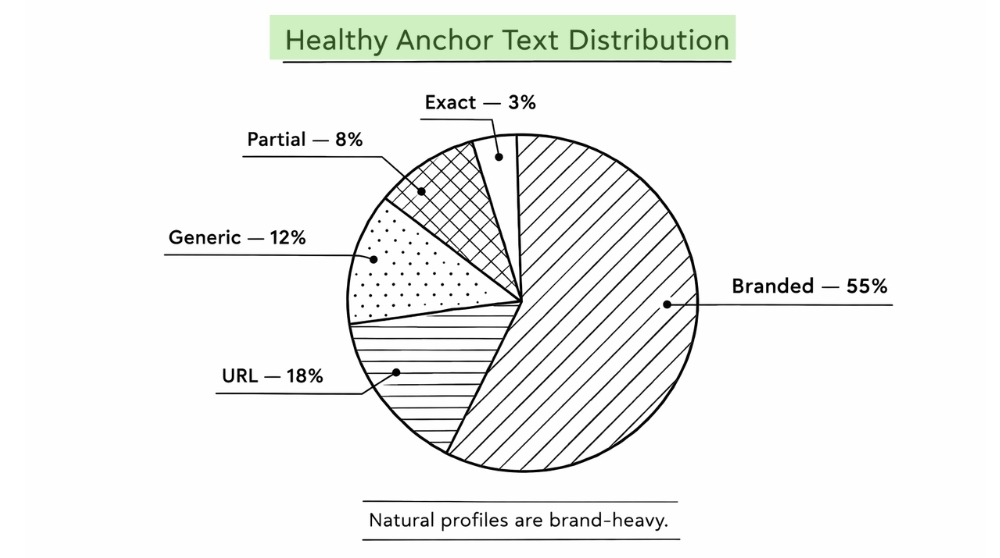
Your anchor text profile is the easiest way to get caught. A safe paid link strategy requires strict discipline over the clickable words pointing to your site. You need a highly diversified profile to look natural.
Branded Anchors Using your company name (e.g., “TechCorp” or “according to TechCorp”) is the safest and most natural way to build links. Most of your overall profile should consist of branded terms.
URL Anchors Naked URLs (e.g., “www.yourwebsite.com”) are extremely common in the real world and help dilute your exact match ratios safely.
Partial Match These anchors include your target keyword alongside other generic words (e.g., “read this guide on inventory management”). They provide excellent relevance without triggering over-optimization filters.
Minimal Exact Match Exact match anchors (e.g., “inventory management software”) pass the most direct ranking signal but carry the highest risk. You must use them sparingly and reserve them strictly for your absolute highest-quality, most expensive link placements.
Ideal Anchor Text Distribution (Visualized)
To fly under the radar, a healthy and manipulation-free backlink profile generally follows a distribution similar to this:
- Branded Anchors: 50% to 60%
- URL Anchors (Naked Links): 15% to 20%
- Generic Anchors (“click here”, “read more”): 10% to 15%
- Partial Match Anchors: 5% to 10%
- Exact Match Anchors: 1% to 5%
Step-by-Step: How to Buy Backlinks Safely
If you have the budget and understand the risks, the execution phase is where the battle is won or lost. Buying links safely is not about finding a secret vendor. It is about applying a rigorous, non-negotiable quality control process to every single transaction.
Here is the exact framework seasoned SEO professionals use to acquire links that actually move the needle.
Step 1: Define Your Link Goal
Do not just buy a link for the sake of having another link. Every dollar spent should be tied to a specific outcome.
- Ranking a Product Page: Product or service pages are notoriously difficult to build natural links to because they are highly commercial. Paid links are often the only way to push these money pages to page one. You will need highly relevant links with carefully selected partial-match anchor text.
- Supporting a Blog: If you have an informational piece of content that is stuck on page two of Google, a few strategic links can push it to the top. These links look incredibly natural and help build overall site authority.
- Boosting Domain Authority: Sometimes the goal is simply to raise the rising tide for your entire domain. In this case, you want high-authority homepage links or branded links from massive industry publications to build trust signals.
Step 2: Vet the Website (The Non-Negotiable Checklist)
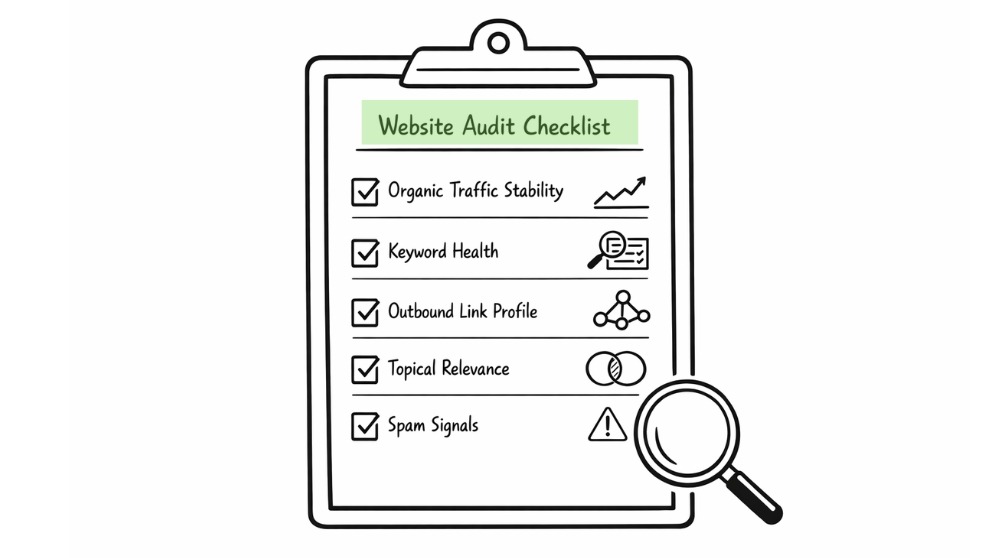
This is the most critical step. If a vendor presents you with a website, you must audit it yourself. Never trust a vendor’s spreadsheet metrics.
- Organic Traffic: Use tools like Ahrefs or Semrush to verify the site gets real, consistent traffic from Google. A minimum of 1,000 monthly organic visitors is a solid baseline. If the traffic graph looks like a rollercoaster or is flatlining, walk away.
- Ranking Keywords: What keywords is the site ranking for? If a tech blog is suddenly ranking for casino or pharmaceutical keywords, it has likely been hacked or repurposed as a spam network.
- Outbound Link Profile: Check the ratio of inbound to outbound links. If a site is linking out to thousands of different domains but has very few sites linking back to it, it is a link farm leaking authority.
- Relevance: Does the target site naturally align with your industry? A link from a cooking blog to a B2B SaaS company will trigger spam filters immediately.
- Spam Signals: Look for obvious footprints. If the site has a massive “Write For Us” page with a clear price list, or if every recent article is clearly a sponsored post, search engines already know what it is.
Step 3: Choose Your Placement Type
Once the site passes your vetting process, you need to negotiate the format of the link.
- Guest Post: You provide a highly valuable, well-researched article for the target site, and your link is included contextually within the body. This is safe, but requires significant effort to write the content.
- Niche Edit (Link Insertion): You pay the webmaster to insert your link into an existing, aged article that has already been indexed and is currently ranking. This passes authority quickly and looks very natural.
- Editorial Placement: The holy grail of paid links. You pay a PR agency or outreach specialist to pitch a story to a top-tier publication, resulting in a completely natural mention by a real journalist.
- Resource Inclusion: You find a relevant “best of” or “helpful resources” page in your industry and pay a “sponsorship fee” to have your tool or article added to the list.
Step 4: Control Anchor Text Distribution
As discussed in the previous section, you must maintain tight control over the clickable text. When you submit your order to a vendor or webmaster, give them exact instructions. Demand that they use a branded or partial-match anchor, and explicitly state that the sentence surrounding the link must provide logical context.
Step 5: Monitor After Placement
The transaction does not end when the link goes live. You need to verify that you actually got what you paid for.
- Link Indexation: A link only counts if Google knows it exists. Use Google Search Console to monitor your inbound links, or simply search the exact URL of the placement in Google to ensure the page is indexed.
- Ranking Changes: Track the target keyword for the page you built the link to. You should look for positive movement within three to four weeks.
- Check the Tags: Inspect the HTML of the live page to ensure the webmaster did not sneak a “nofollow” or “sponsored” tag onto your link without your permission. If you paid for a “dofollow” link to pass authority, you need to verify it stays that way.
Where to Buy Backlinks (Without Buying Junk)
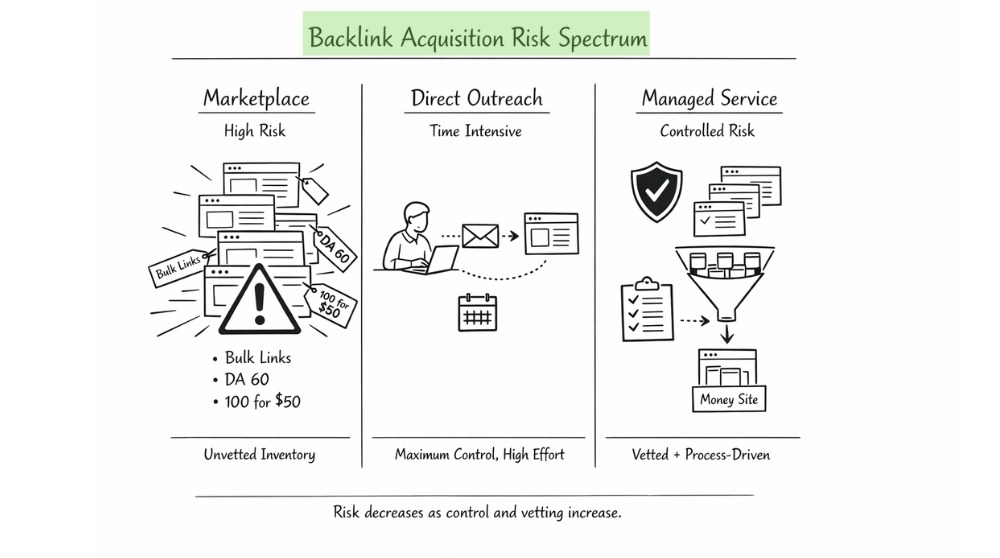
The internet is flooded with vendors selling links, but the quality spectrum is massive. Deciding where to allocate your link building budget ultimately comes down to a balance between time, risk, and financial cost.
Marketplaces (High Risk)
If you search for cheap backlinks, you will inevitably land on bulk gig platforms and open link marketplaces. These platforms operate strictly on volume. Anyone can create an account and list a website for sale.
The primary issue here is a complete lack of vetting. The vendors on these platforms are heavily reliant on Private Blog Networks (PBNs) and automated link farms to keep their margins high and their prices low. You might find a legitimate website buried in the thousands of listings, but the sheer amount of toxic inventory makes this a highly dangerous route for anyone who values their organic traffic.
Direct Blogger Outreach (Time Intensive)
This is the traditional, hands-on approach. Instead of using a middleman, you or your internal team manually prospect for websites, find the contact information for the editor, pitch a topic, and negotiate the placement fee directly.
This is the safest way to acquire links because you retain absolute control over every single variable. You know exactly who you are paying and where the link is going. However, it requires an enormous investment of time. The response rate for cold outreach is notoriously low. Building a predictable pipeline of links this way requires dedicated staff, premium SEO tools, and a massive volume of daily emails.
Managed Outreach Services (Controlled Risk)
For most growing businesses, the middle ground is the most practical solution. Managed outreach services act as a bridge between the high risk of open marketplaces and the exhausting labor of internal outreach.
Instead of buying a link from a public spreadsheet, you are paying a dedicated team to handle the prospecting, vetting, content creation, and negotiation on your behalf. Reputable services already have established relationships with real publishers and use strict quality control metrics to ensure the target sites have actual organic traffic and contextual relevance.
If you prefer managed placements on vetted sites with real traffic and contextual integration, Socioblend offers curated backlink placements focused on relevance and quality rather than bulk metrics. This approach shifts the heavy lifting off your plate while keeping your domain insulated from the algorithmic dangers of cheap link farms.
How Much Should You Pay for Backlinks?
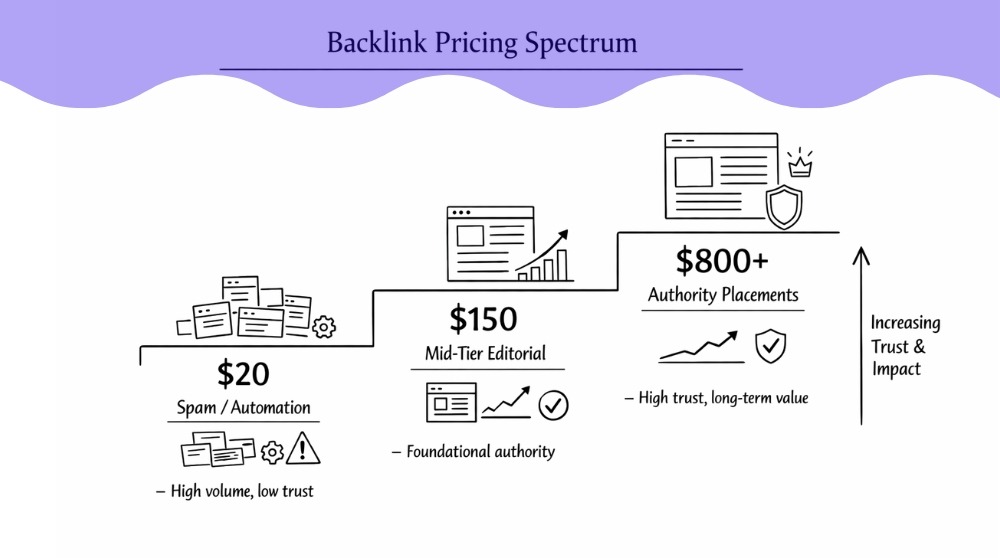
When you start shopping for links, you will immediately notice a massive discrepancy in pricing. You will see vendors offering hundreds of links for $20, while specialized agencies quote $1,500 for a single placement.
To determine a realistic budget, you need to stop thinking about backlinks as a commodity and start viewing them through an ROI perspective versus your traditional ad spend. If you spend $500 on Google Ads for highly competitive, long-tail commercial modifiers (like “best enterprise CRM software” or “affordable business tax accountants”), that budget might evaporate in a few days. A single, powerful $500 backlink, however, can elevate that page organically, delivering passive traffic and qualified leads for years without a recurring cost-per-click.
However, it is crucial to understand that price alone does not determine safety. A high price tag does not automatically guarantee a clean, powerful link. There are plenty of link brokers selling toxic PBN placements for premium prices to buyers who do not know how to check traffic metrics. You must always vet the domain. But generally speaking, the modern link-buying market breaks down into three distinct pricing tiers.
The $20 Illusion (Why Cheap Links Are Dangerous)
If you are paying $20 to $50 per link, you are almost certainly buying automated spam, neglected forum profiles, or low-tier Private Blog Network (PBN) placements.
Real website owners know the value of their digital real estate. No legitimate publisher is going to spend the time formatting an article, optimizing images, and permanently hosting your link for the price of a cheap lunch. These extreme budget links are generated by software or mass-produced on low-quality domains. Search engines are incredibly adept at identifying these footprints, meaning your $20 investment will either be silently ignored by the algorithm or trigger a penalty.
The $100 to $300 Sweet Spot (Mid-Tier Editorial)
This is the bread-and-butter tier for most growing businesses and SEO campaigns. In the $100 to $300 range, you are typically securing niche edits (link insertions into existing articles) or standard guest posts on mid-level domains.
These are real websites with modest but genuine organic traffic. While they might not be household names, they are contextually relevant to your industry. Links in this tier are perfect for building foundational domain authority, supporting long-tail informational blog posts, and creating a diverse, natural-looking backlink profile.
The $500+ Power Players (High Authority Placements)
When you are trying to rank a highly lucrative commercial page or competing in cutthroat niches like SaaS, finance, or legal, you need heavy artillery.
Links in the $500 to $1,500+ range are premium editorial placements on major industry publications, top-tier review sites, and domains with massive organic traffic footprints. At this price point, you are paying for strict editorial quality control, deep topical relevance, and the kind of trust signals that Google’s algorithms heavily favor. While the upfront cost is steep, just one or two of these links can often out-perform dozens of mid-tier placements.
Common Mistakes That Destroy Rankings
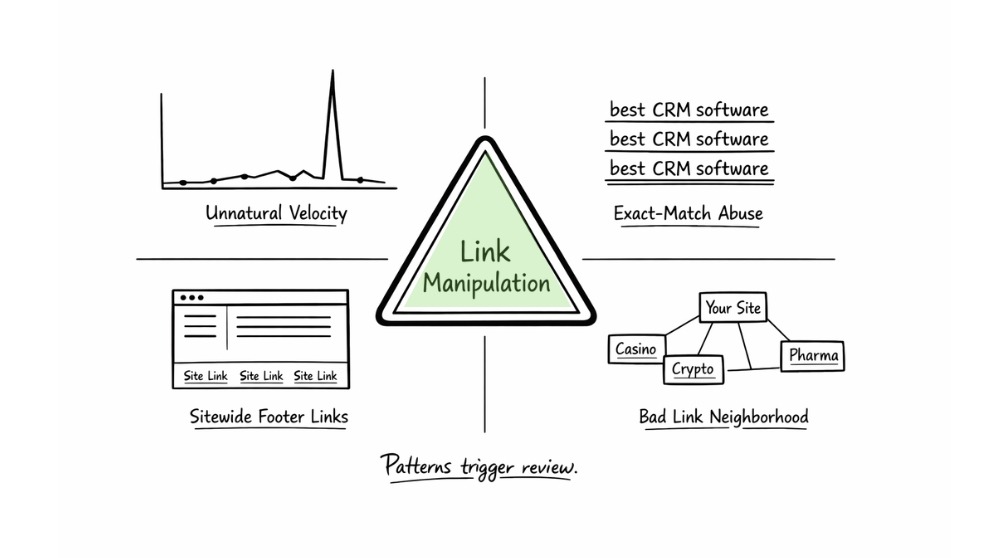
If you are going to buy links, you cannot afford to be sloppy. Google does not penalize you simply for exchanging money for a link. They penalize you for leaving a massive, amateur footprint that proves you manipulated the system. Here are the most common ways site owners accidentally torpedo their own organic traffic.
- Buying Too Many at Once (Spiking Link Velocity): This is a classic rookie error. If your website historically earns two backlinks a month, and you suddenly blast it with four hundred links in a single weekend, Google’s SpamBrain algorithm will immediately freeze your progress. You have to drip-feed your link acquisition to mimic steady brand growth.
- Exact-Match Anchor Abuse: We touched on this earlier, but it bears repeating because it is the absolute fastest way to trigger a penalty. If every paid link pointing to your homepage uses the exact phrase “affordable SEO services,” you are begging for a manual action. You must force your vendors to use branded terms, naked URLs, and conversational phrases to dilute your profile.
- Ignoring Relevance for Metrics: A high Domain Rating means absolutely nothing if the link comes from a completely unrelated industry. Buying a link on a recipe blog to boost your cryptocurrency exchange is a complete waste of budget. The algorithm reads the surrounding text and the overall theme of the linking domain. If the connection does not make logical sense to a human reader, the link is neutralized.
- Buying Sitewide Links: Paying a webmaster to stick your link in the footer, header, or sidebar of every single page on their website is an outdated tactic from a decade ago. It looks incredibly unnatural and passes zero contextual value. You want a single, powerful link embedded natively within the body of a relevant article.
- Not Auditing Outgoing Link Neighborhoods: Before you hand over your credit card, you must look at who else the website is linking out to. If they link to your legitimate SaaS company in one article and an illegal gambling or sketchy pharmaceutical site in the next, you are living in a bad digital neighborhood. Search engines will associate your domain with that spam and drag your authority down with them.
FAQs (Structured for Featured Snippets)
Is buying backlinks illegal? Buying backlinks is not a crime, so you will not face legal prosecution or go to jail for participating in the market. However, it is a direct and explicit violation of Google’s spam policies. While you are perfectly safe from the law, search engines act as judge and jury and can severely penalize your website’s visibility for using manipulative link schemes.
Can Google detect paid links? Google cannot read your bank statements or email receipts, but its algorithms are incredibly efficient at detecting the digital footprints left behind by paid links. Systems like SpamBrain look for unnatural patterns, such as sudden link velocity spikes, overly optimized exact-match anchor text, and links coming from known spam networks. If your paid placements do not look identical to organically earned links, the algorithm will catch them.
How many backlinks should I buy per month? There is no universal magic number because your target link velocity must mimic the natural growth rate of your specific website and industry. A brand new website acquiring fifty high-authority links in its first month will trigger algorithmic spam filters instantly. You should start slow with one to three high-quality placements per month, gradually scaling up only as your overall domain traffic and organic footprint increase.
What is the safest type of backlink? The safest paid backlink is a contextual, editorial placement within a highly relevant article on a website that receives real organic search traffic. These are often acquired through managed digital PR campaigns or highly vetted niche edits where the link naturally enhances the reader’s experience. When the surrounding text makes logical sense and the linking domain is a trusted authority, the backlink becomes indistinguishable from a natural endorsement.
Are PBN links worth it? Private Blog Networks are almost never worth the massive risk they carry for a legitimate, long-term business. While they might offer a temporary ranking boost, Google is aggressively efficient at identifying and deindexing these networks, which often results in a devastating manual action against your site. If you are building a real brand that you rely on for revenue, cheap PBN links are a toxic liability you should completely avoid.
