

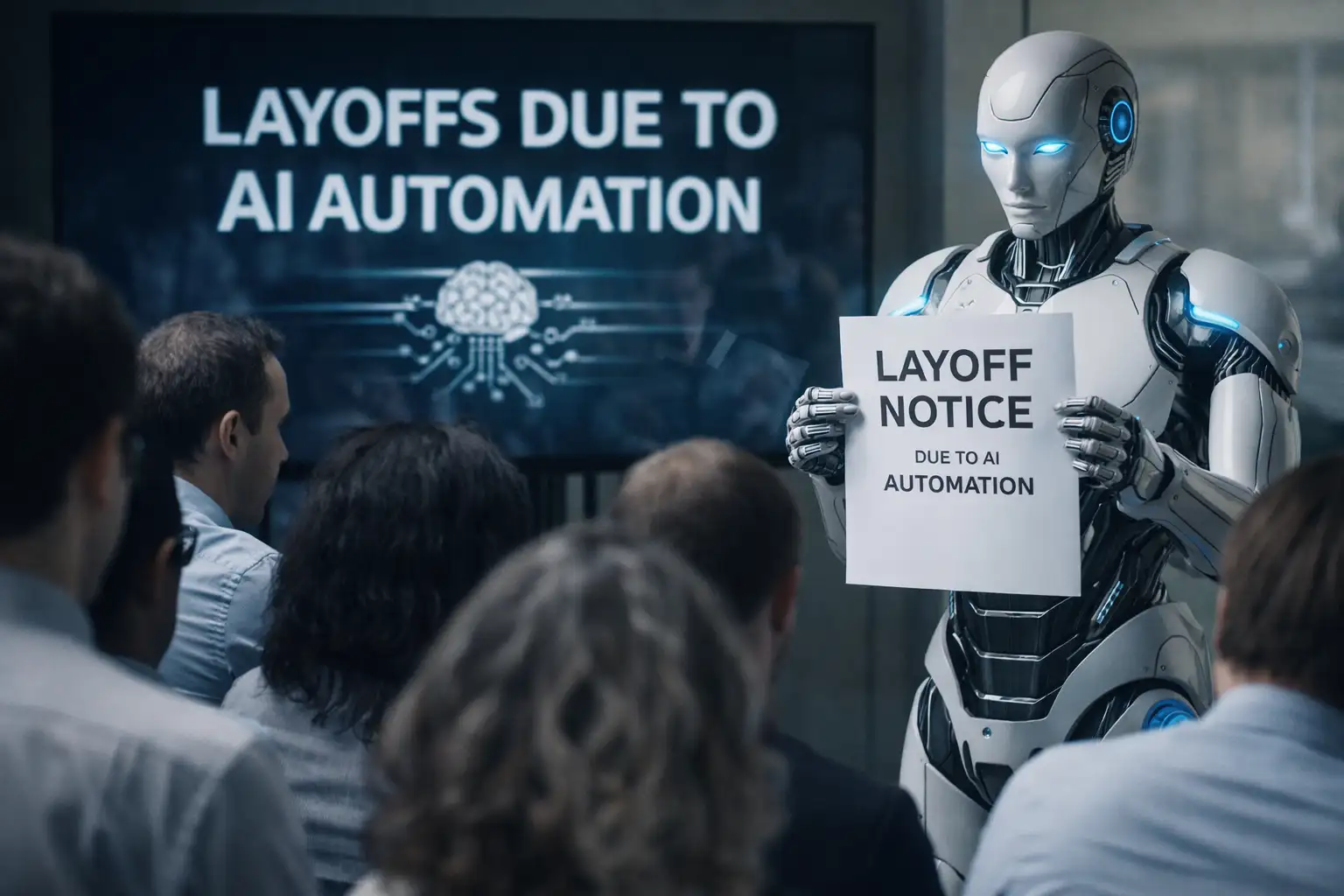
This week, Jack Dorsey cut more than 4,000 jobs at Block. Nearly half the company, removed in a single decision.
Not because Block is failing. Not because revenue collapsed. Not because customers disappeared.
Because it believes artificial intelligence allows it to operate with far fewer people.
Dorsey was clear. Intelligence tools combined with smaller, flatter teams are changing how companies function. In plain terms, software is now capable of absorbing work that once required layers of employees.
This is the part that should make people uneasy.
AI is no longer a side tool that boosts productivity. It is becoming a reason to reduce payroll. The justification is simple. If systems can draft, analyze, support, code, and coordinate faster than teams built to do those tasks manually, leadership will adjust the team.
And that adjustment will not favor headcount.
Profitable companies are now restructuring around AI capability, not human capacity.
That changes the equation entirely.
You are no longer competing only with other professionals. You are competing with the pace at which AI improves.
And AI does not ask for severance.
What makes this moment different is not just the scale. It is the message.
For years, layoffs were explained away as corrections. Overhiring during a boom. Market downturn. Missed targets. External shocks. There was always a culprit you could point to.
This time, the company pointed inward and said the quiet part out loud. We can run leaner because the tools are better.
When a healthy company cuts nearly half its workforce in anticipation of what AI can handle, it resets expectations across the industry. Every executive is watching. Every board is doing the math. Every CFO is asking the same question. If they can operate with 6,000, why are we carrying 12,000?
This is how norms change. Not slowly, but decisively.
The danger is not that AI will eliminate every job. The danger is that it will steadily shrink the number of people required to run highly profitable businesses. Fewer engineers. Fewer analysts. Fewer support layers. Smaller cores generating larger returns.
Productivity rises. Payroll tightens. Margins expand.
But trust erodes.
Because once employees understand that success does not secure them, loyalty becomes irrational. If growth no longer guarantees safety, then attachment becomes a liability.
And when attachment dies inside an organization, culture follows.
And here is the question nobody in leadership wants to confront publicly.
What happens to an economy where companies celebrate efficiency while steadily shrinking the number of people who share in that efficiency?
If AI allows a smaller workforce to generate larger profits, the upside concentrates. Shareholders win. Executives win. The company becomes lean, fast, optimized.
But workers become variable costs in a system designed to minimize them.
There is a long-term tension here that cannot be ignored. Businesses depend on customers. Customers depend on income. Income depends on jobs. If enough firms decide they need fewer people to generate more value, purchasing power does not magically expand. It compresses.
You cannot automate payroll across the economy and expect demand to stay untouched.
This is not an anti-technology argument. AI will make companies faster and more capable. It will unlock products that were impossible before. It will reduce waste and accelerate output.
but it will also narrow the circle of who gets paid.
That is the trade no one wants to spell out.
If AI lets companies generate more value with fewer people, then fewer people participate in that value creation. The wealth concentrates. The headcount shrinks. The dependency on human labor weakens.
And when labor weakens, bargaining power collapses with it.
We are entering an era where productivity gains will not automatically translate into broader opportunity. They may translate into tighter teams, higher margins, and thinner ladders.
The old tech dream promised abundance. More growth meant more hiring. More hiring meant more upward mobility.
Now growth can mean contraction.
This is not about one company or one CEO. It is about a precedent. A profitable firm just demonstrated that success is no longer tied to expanding opportunity. It can be tied to eliminating it.
That is the part that should unsettle people.
Because once efficiency becomes the dominant virtue, stability becomes optional.
And in a system that worships optimization, anything optional eventually gets cut.
The uncomfortable reality is that this will not be framed as a loss.
It will be framed as discipline.
Other CEOs will call it focus. Boards will call it responsible. Analysts will call it maturity. And quietly, the same conversations will begin inside other companies.
Where are we overstaffed?
Which layers can AI absorb?
How much leaner could we be?
No one wants to be the last company carrying “excess” headcount in a market that rewards efficiency.
This is how waves start.
Not with panic. With proof.
Once a profitable firm shows it can cut nearly half its workforce and continue operating, it resets what is considered normal. And what is considered normal spreads faster than any internal memo.
Employees will feel it first. Hiring will slow. Roles will blur. Expectations will rise. You will be asked to produce more with fewer colleagues beside you.
And when that becomes standard, something fundamental shifts in how people relate to work.
Work stops feeling like partnership.
It starts feeling like probation.
Always measured. Always compared. Always one improvement cycle away from redundancy.
That is the cultural cost of this moment. And it is only beginning.
If this were just Block, you could argue it was a one-off.
It’s not.
Look at the past few years.
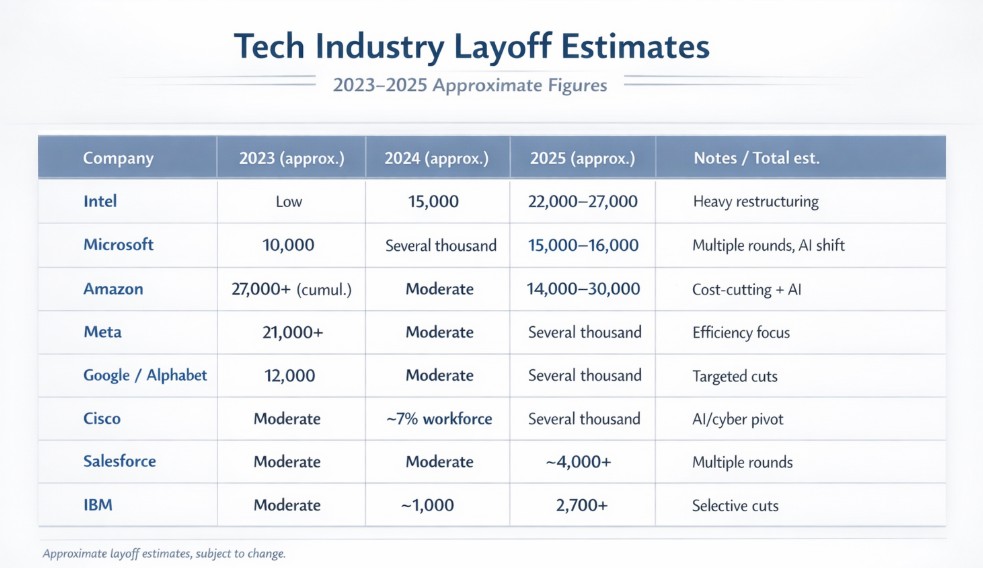
Intel has cut tens of thousands. Microsoft has run round after round while pouring billions into AI.
Amazon trimmed aggressively after its expansion spree. Meta wiped out more than 20,000 roles and called it the “year of efficiency.” Google, Cisco, Salesforce, IBM. Different wording, same result.
Big companies are getting smaller while their AI investments get bigger.
That matters.
Because when multiple industry leaders decide they can operate with fewer people and still grow, it resets the standard. Suddenly bloated teams look irresponsible. Suddenly the headcount looks like excess weight.
Layoffs at that scale mean this is not a short-term correction. It is companies rebuilding around AI, with fewer people, different roles, and work that once required teams now handled by systems.
