

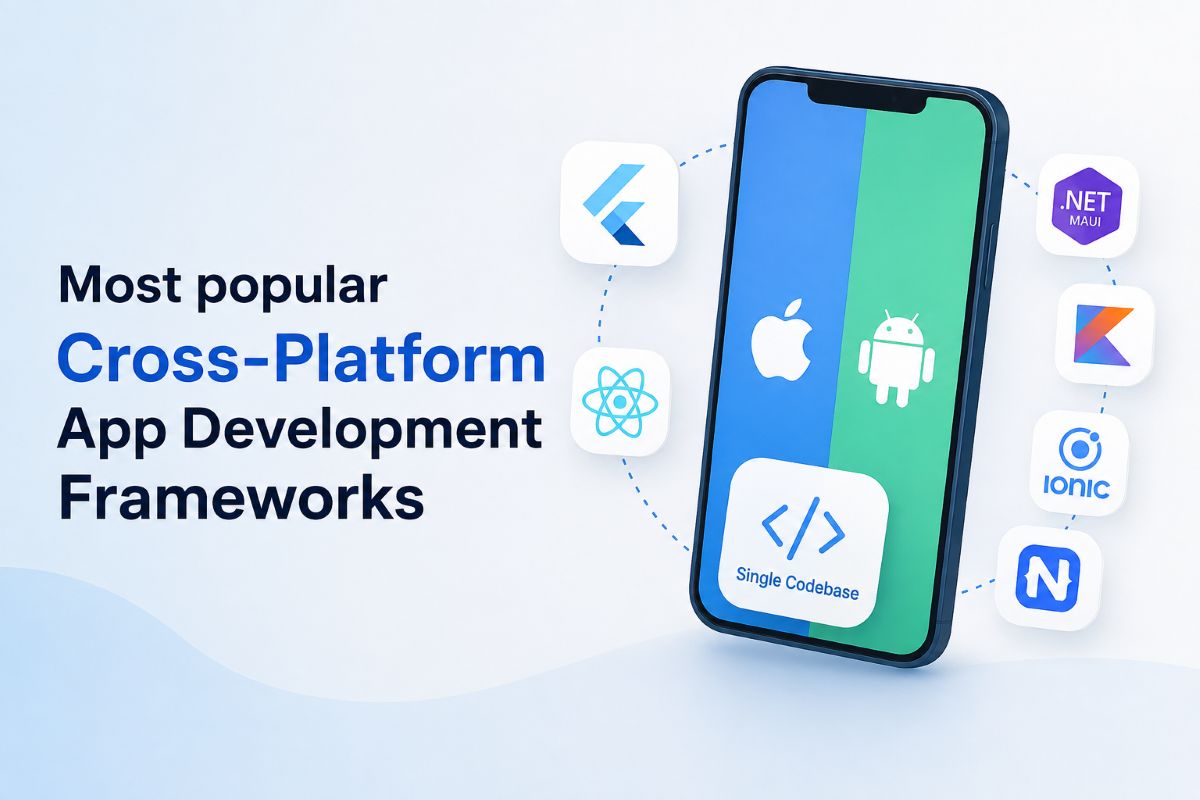
Cross-platform app development frameworks
Cross-platform app development means building mobile apps for both iOS and Android operating platforms that work on a single codebase. There is no need to build separate apps; instead, developers create one codebase, so users on iOS and Android can get the app at launch.
Depending on the tech stack, iOS and Android app development includes using their native components, following strict design rules, or a JavaScript/TypeScript runtime. Every other app development framework considers the app performance, access to native APIs, UI quality, integration with platform features, and how easy it will be to support the app’s future growth.
What is a cross-platform app development framework?
Cross-platform mobile app development frameworks support developers while building one app that runs on two OS at the same time. The fundamental thing they help to create is a single codebase that opens access to iOS and Android.
In their nature, the cross-platform frameworks provide specific tools for creating user interfaces, working with platform APIs, navigation, and other mobile app logic. By doing this, less code needs to be written and maintained separately for each platform, but the level of native functionality differs.
Key criteria for comparing cross-platform frameworks
The list of best app development frameworks was created based on:
– how well apps perform under different workloads;
– how naturally the UI works across platforms;
– how easily native APIs and device features can be accessed;
– how much code can be shared between platforms;
– how well the framework supports app scaling;
– the availability of libraries, plugins, and development tools;
– the quality of documentation and long-term support;
– the development and maintenance effort required.
Flutter — Best for high-performance, visually consistent applications
Flutter works as a universal tool that helps development teams create apps for iOS, Android, web, and desktop with one codebase. It is used for complex apps where stability and visual consistency are a top priority for businesses. Flutter renders the user interface on its own using its own engine and widget-based UI. This means the biggest interface part doesn’t depend on standard iOS and Android components. This gives developers precise control over the UI and keeps the app’s look and feel consistent across platforms.
React Native — Best for JavaScript-based mobile app development
With React Native, mobile app development experts build applications in JavaScript/TypeScript using React, keeping a single codebase for iOS and Android. Its components are displayed through the native UI of the specific platform, so the app can use standard iOS and Android mechanisms. For architecture creation, it uses JSI, Fabric, and TurboModules technologies, which reduce the cost of communication between JavaScript and native code.
Other popular cross-platform frameworks
Besides Flutter and React Native cross-platform frameworks, there are also other ones that help teams build outstanding apps, using a single codebase approach. They are .NET MAUI, Kotlin Multiplatform, Ionic, and NativeScript. They provide different levels of support and, accordingly, are designed for different app use scenarios. Nevertheless, they greatly assist teams and stand out as an extension of the core tech stack to boost app performance or feature set.
.NET MAUI, Kotlin Multiplatform, Ionic, and NativeScript
These frameworks are also good fits for cross-platform app development, with specific features and advantages. There is no need to choose them all, as they cover specific possibilities as an extension of the core tech stack.
– .NET MAUI lets developers build apps for mobile and desktop with one codebase.
– Kotlin Multiplatform provides the possibility to share business logic while keeping the UI native to each platform.
– Ionic is based on web technologies and is well-suited for developers with JavaScript experience.
– NativeScript supports developers writing JavaScript or TypeScript code that interacts directly with the native iOS and Android APIs.
Cross-platform framework comparison: Performance, cost, and use cases.
The core difference between cross-platform frameworks lies in the approaches they use to code writing, UI rendering, and engagement with native APIs.
Flutter perfectly fits for high-productivity mobile app development with a unified UI. React Native is a go-to choice for teams that work with JavaScript and React technologies and is used in most business apps. .NET MAUI works well specifically with the .NET ecosystem. Kotlin Multiplatform shows its advantages when teams need to share business logic while keeping the native app interface.
The development cost is typically lower than native development across all these frameworks. Flutter and React Native are primarily chosen for mobile apps only. NET MAUI works for building mobile and desktop apps within the .NET ecosystem. Kotlin Multiplatform is used when there is a need to reuse business logic while still using native UI elements.
How to choose the right cross-platform framework for your app
Start by analyzing the specific project needs. Evaluate the platforms and the strict requirements to follow (like design for iOS apps). Next, look at the amount of shared code, access to native APIs, and UI and performance requirements. React Native and .NET MAUI combine shared code with platform-specific implementations, while Kotlin Multiplatform gives the flexibility to define exactly what to share. Also, check the platforms’ stability, ecosystem, library support, and long-term maintainability. It’s a big scope of work, but it will cost you in the long run with a high-quality mobile app.
Conclusion
Cross-platform app development frameworks create a large ecosystem with a set of tools and technologies that help developers build responsive, attractive, and effective mobile apps. To get successful results, evaluate what your app requirements are and what each framework offers to see which one meets your needs best. As a big company’s practice shows, the most common choices are Flutter and React Native frameworks, as they provide more opportunities for effective and fast cross-platform app development.
