

Anyone who manages more than one social media account knows the quiet anxiety that comes with it. Platforms watch closely for anything that looks automated or coordinated, and the penalties – restricted reach, temporary locks, outright bans – can undo months of work in an afternoon. For agencies, marketers, and creators running multiple profiles, the challenge is not just creating good content; it is operating in a way the platforms read as normal and trustworthy. A surprising amount of that comes down to the IP address behind each account.
When several accounts log in from the same address, or when an account’s location keeps jumping around, platforms notice. Those patterns look like the behavior of bots or ban-evaders, even when the person behind them is entirely legitimate. This is where a static residential proxy becomes genuinely useful – not as a trick, but as a way to give each account a stable, authentic-looking home online.
Why social platforms flag account activity
Social networks invest heavily in spotting inauthentic behavior, and the IP layer is one of their strongest signals. A few patterns raise flags quickly:
- Shared addresses. Many accounts logging in from one IP suggests a single operator running a network of profiles, which platforms treat with suspicion.
- Location jumps. An account that suddenly appears to log in from a different country looks compromised or automated.
- Datacenter footprints. Logins from obvious datacenter IP ranges stand out as non-human and draw extra scrutiny.
- Constant IP changes. An address that changes on every session looks evasive rather than like a real person with a stable home connection.
None of these mean wrongdoing, but each nudges a platform’s trust score in the wrong direction – and lower trust means reduced reach or a higher chance of a lockout.
Why a static residential proxy helps
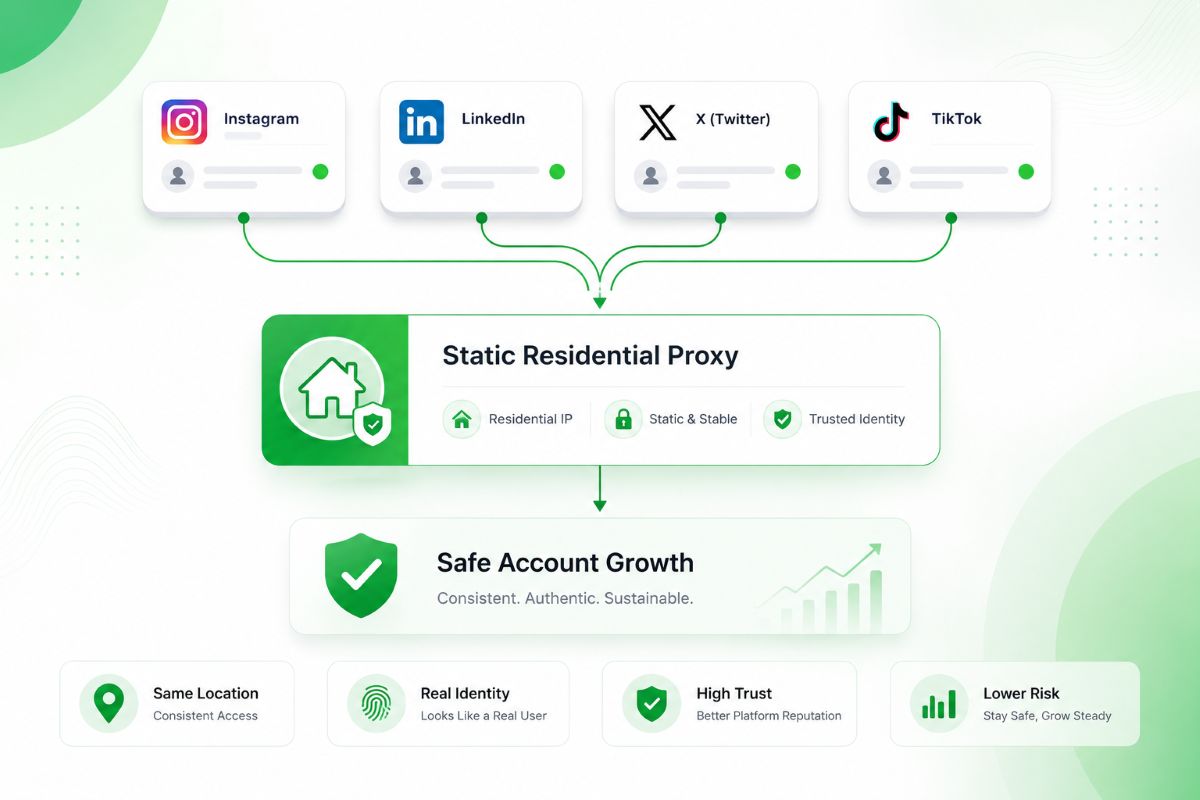
A static residential proxy is an IP address from a real internet service provider that stays assigned to you over time. For social account management, both halves of that matter. Residential means the address looks like an ordinary home connection, so platforms treat it as a genuine person rather than automated infrastructure. Static means it does not change, so an account keeps the same consistent location and identity session after session – exactly like a real user who logs in from home every day.
Assigning each account its own stable residential address lets each profile operate from a consistent, authentic-looking home base, which is far less likely to trigger the shared-IP and location-jump flags described above. Providers such as Proxy-Cheap offer a static residential proxy with long-lived IPs across many locations, which suits the steady, trustworthy presence that safe account growth depends on.
What this supports
- A consistent identity per account. Each profile keeps its own stable address, mirroring how a real person connects from one home.
- Location consistency. A fixed regional IP means an account does not appear to teleport between countries between logins.
- A genuine footprint. Residential addresses look like real users, avoiding the scrutiny datacenter ranges attract.
- Regional targeting. Managing an account aimed at a specific country from an IP in that country keeps the presence authentic.
Using proxies responsibly
A proxy is a tool for operating cleanly, not a shortcut around the rules. It helps most when the underlying activity is legitimate: real accounts, genuine content, and engagement earned honestly. It cannot make artificial or deceptive activity safe, and it is no substitute for following each platform’s terms of service. Think of a static residential proxy as giving your legitimate accounts a stable, trustworthy home online – it protects good work from being misread as automated, but the work still has to be real.
Setting it up sensibly
In practice, the approach is simple: assign each account a dedicated static residential IP, choose a location that matches the account’s intended audience, and keep that pairing consistent over time rather than swapping addresses around. Most account-management tools and browsers support proxy configuration directly, so applying this is straightforward. The goal throughout is consistency – each account should look like the same real person logging in from the same place, because that is what platforms trust.
Handled this way, the proxy fades into the background, and each account simply operates from a stable, believable home connection.
The bottom line
Growing social accounts safely is largely about looking like exactly what you should be: a real person, in a consistent place, behaving normally. Shared addresses, datacenter footprints, and jumping locations all undercut that impression and invite the restrictions every account manager dreads.
A static residential proxy restores it. By giving each account a genuine, stable residential identity, it lets legitimate profiles operate without tripping the signals platforms use to catch bad actors. Paired with real content and honest engagement, it is a practical foundation for managing multiple accounts safely and sustainably.
