

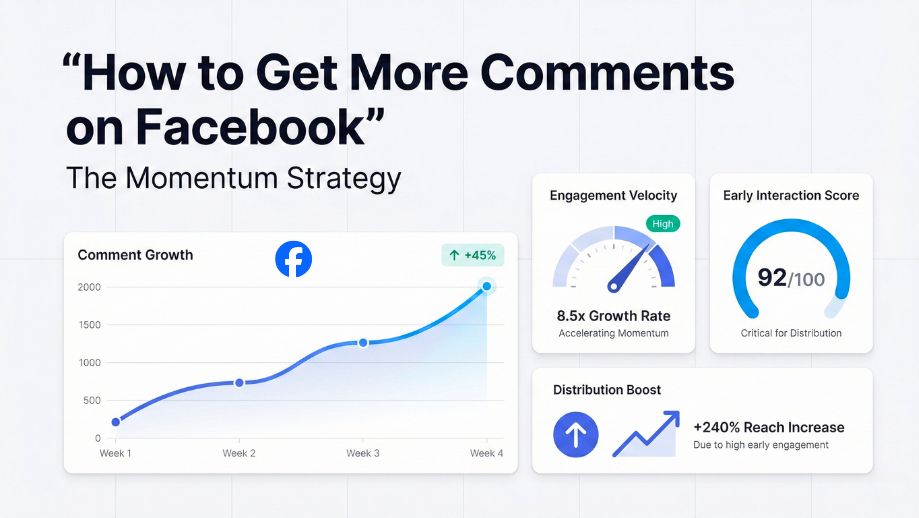
How to Get More Comments on Facebook Posts (Advanced Strategies That Actually Work in 2026)
Most Facebook posts don’t fail because they’re low quality, but rather because they never build early traction.
You can write something insightful, well-formatted, or even valuable, and still watch it disappear. This happens not because people didn’t like it, but because it didn’t generate enough initial interaction to stay visible. If you want to get more comments on Facebook, you need to understand one core principle: comments are distribution signals.
Facebook has publicly emphasized meaningful social interactions as a primary ranking factor, especially with the 2026 rollout of the Andromeda AI update, which reinforces the importance of active comment threads over passive reactions. Posts with visible back-and-forth discussion are far more likely to remain in circulation than posts with silent reactions, as the Facebook algorithm now prioritizes “engagement velocity” and conversation depth. This guide breaks down how to increase Facebook comments using platform mechanics, behavioral psychology, and strategic engagement velocity.
Why Facebook Comments Matter More Than Likes
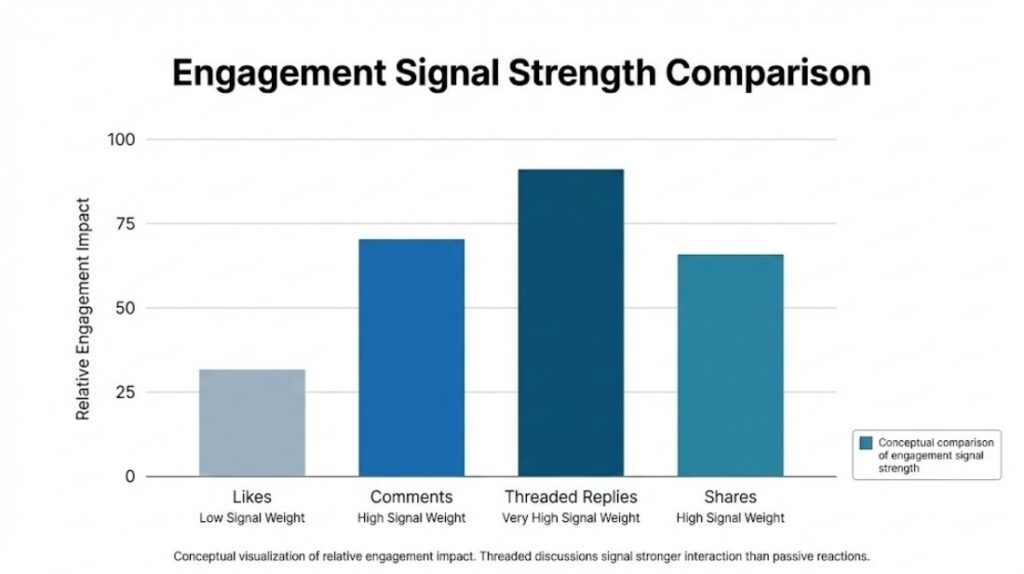
Likes are passive, but comments require effort. Because they demand a higher level of user intent, Facebook treats comments as a significantly stronger signal of relevance. When users comment, particularly when there are replies within the thread, the algorithm interprets that activity as a high-intent engagement signal.
Not all comments carry equal weight. A threaded discussion where users reply to each other signals stronger relevance than isolated one-word replies, especially since 2026 engagement benchmarks show that depth of interaction now outweighs raw quantity for organic reach. That’s why two posts with the same number of likes can perform very differently if one has an active comment section. If you want to increase Facebook post engagement, you should focus on building conversation density instead of merely collecting reactions.
The “Cold Start” Problem and Why Most Posts Die Early
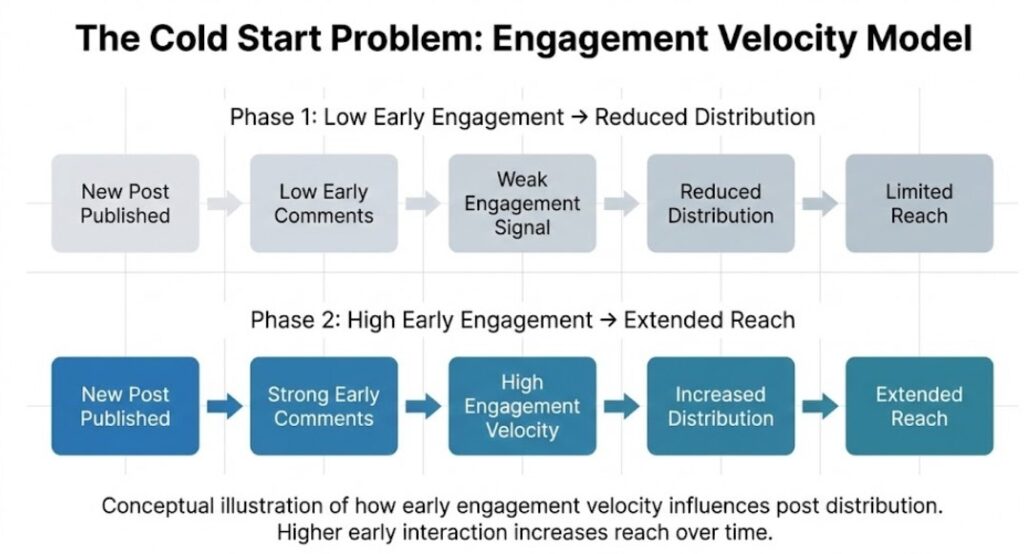
The first 30 to 60 minutes after publishing a post matter more than most creators realize. If a post receives no comments, minimal reactions, and no replies, it signals low interest, which causes distribution to slow. On the other hand, when a post generates early comments, particularly threaded replies, it signals engagement velocity. That early traction influences further reach, which is why posts with visible discussion attract more participation as social proof compounds.
A Quick Example
To visualize how early engagement compounds over time, here’s a simplified comparison based on modeled campaign data.
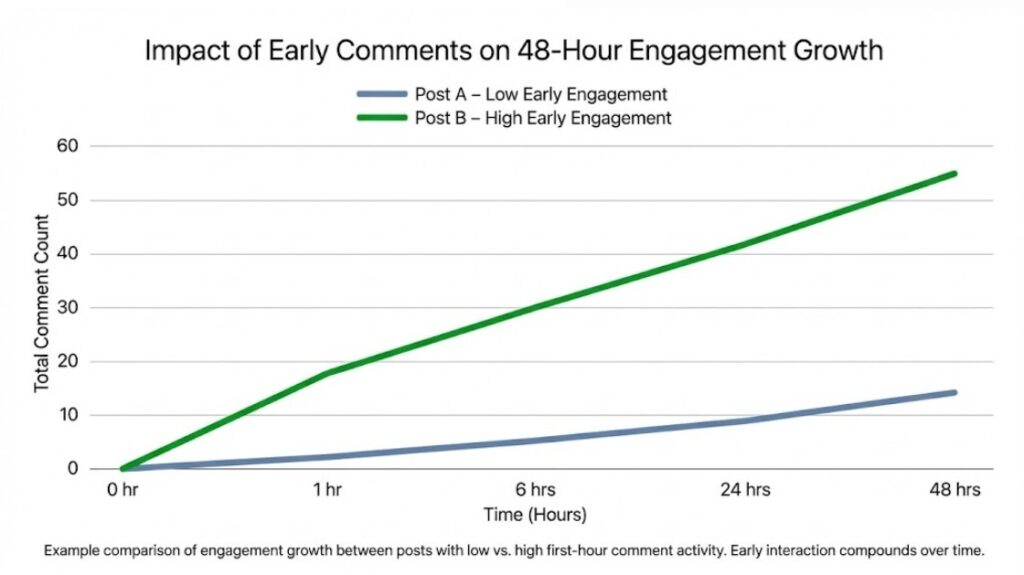
In multiple campaign tests across small business pages, two nearly identical posts were published with similar reach potential. Post A received two comments in the first hour, but Post B received 18 comments in that same period. Over the next 48 hours, Post B generated more than double the organic replies and significantly longer comment threads.
The difference wasn’t content quality, but rather early conversation density. Once a post appears active, participation increases naturally since silence discourages interaction while visible discussion encourages it. This phenomenon is frequently documented in behavioral engagement case studies, which show that users are significantly more likely to join an existing conversation than to start a new one.
Strategy 1: Design Posts for Comment Intent
Most posts are written for clarity, but if you want more Facebook comments, you must write for participation. Instead of finishing your point, leave space for positioning. For example, rather than simply stating that “hard work beats talent,” try asking if people honestly believe hard work beats talent or if talent still holds the advantage. By introducing contrast, you create an engagement trigger that fuels a lively comment section. Posts that invite positioning consistently outperform those that deliver closed conclusions, as they leverage the interaction gap to spark debate.
Strategy 2: Use Identity Triggers
People respond when they feel addressed directly, so the more specific your audience callout, the higher your response rate will be. Whether you are asking agency owners about their biggest client challenges or asking freelancers about their pricing models, specific targeting increases perceived relevance. While broad content attracts passive scrollers, targeted content attracts active participants, a concept backed by marketing segmentation data which highlights the power of personalized messaging.
Strategy 3: Reduce Cognitive Load
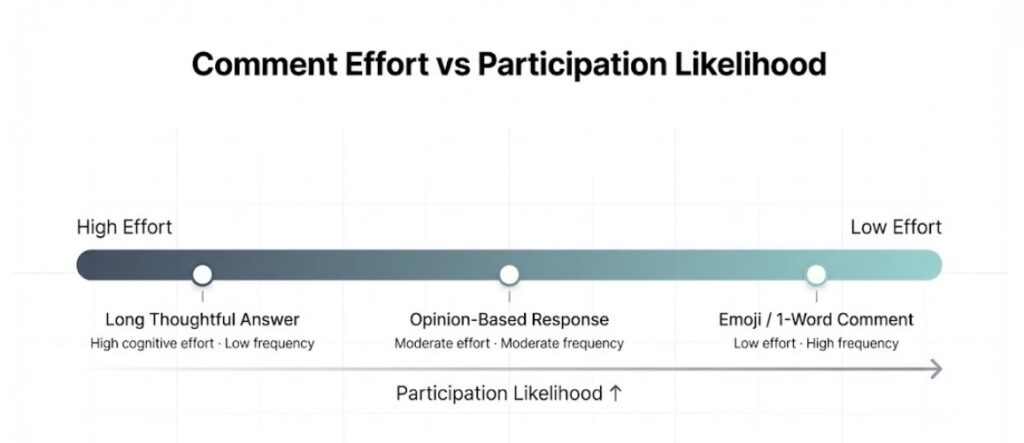
The easier it is to respond, the more likely someone will do so. Low-effort prompts, such as asking for an “agree or disagree” or a simple “1, 2, or 3,” reduce the mental effort required to participate. These micro-commitments lower hesitation, and once a user engages once, they are more likely to engage with your future posts as engagement momentum builds over time.
Strategy 4: Actively Manage the Conversation
If someone comments and you don’t reply, you are wasting distribution potential. Every reply extends the thread, reactivates the post in the feed, and signals continued engagement to the algorithm. You should ask follow-up questions and tag commenters to keep the discussion active. A post with 20 comments and no replies often performs weaker than a post with 10 comments and active back-and-forth interaction, as Facebook’s latest business guides emphasize that conversation depth is a critical metric for reach.
Strategy 5: Build Early Traction Intentionally
Early engagement influences perception because a post with zero comments feels ignored, whereas a post with visible discussion feels credible. In competitive niches, perception influences participation, and visible engagement significantly reduces user hesitation.
You can create early traction by posting during peak audience activity hours, sharing your content into relevant communities, and coordinating early engagement from your network. This strategic start ensures that your post reaches the necessary engagement threshold to trigger wider distribution within the feed.
Or, when launching something important, you can accelerate that process strategically.
For brands running paid traffic, launching time-sensitive campaigns, or promoting major announcements, waiting for organic interaction isn’t always practical. In those cases, creating visible engagement early can influence how the post is perceived and how others respond to it.
Also read: Is Facebook Dead? Search Interest Drops by 92% Since Its Peak
How to Increase Facebook Comments Using Socioblend (Strategic Momentum)
If you’re promoting a product, running ads to a post, or announcing something important, the comment section becomes part of your conversion environment.
An empty thread reduces credibility.
Socioblend provides Facebook comment packages designed to create visible engagement and avoid the cold-start effect.
Here’s how it works. Visit Facebook Comments services page on Socioblend.
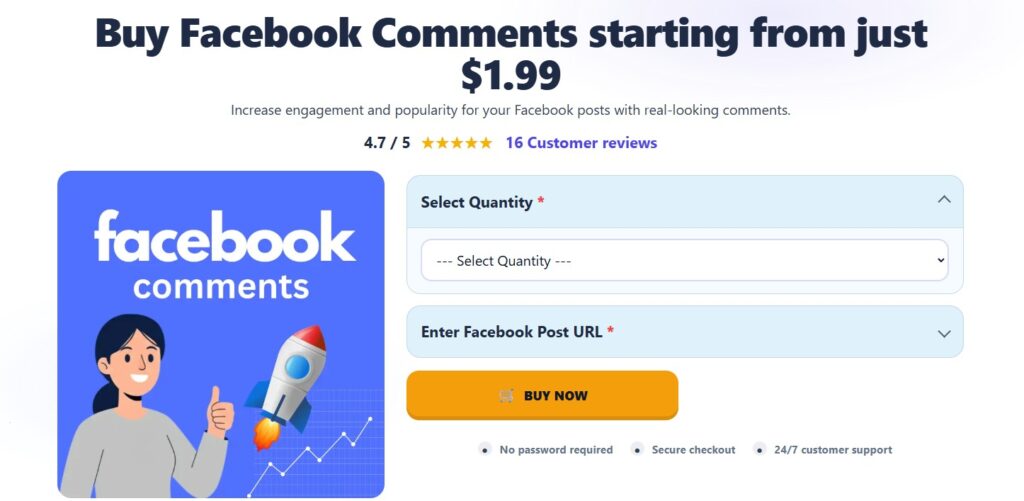
Step 1: Select a Comment Package
Choose based on your campaign size:
- 10 comments – light visibility boost
- 25 comments – moderate engagement baseline
- 50 comments – strong social proof
- 100 comments – high-impact launch support
The key is proportionality. Match engagement volume to your page size.
For example, if your page typically receives 5-15 organic comments, starting with 10 or 25 keeps the engagement looking natural. If your posts regularly generate higher interaction, a larger package may align better with audience expectations. The goal isn’t to overwhelm the post, it’s to create believable initial activity that encourages real users to join the conversation.
Step 2: Enter Your Facebook Post URL
Paste the direct link to the post.
No account access required.
No passwords needed.
Only the specific post receives engagement.
Step 3: Complete Checkout
After purchase, comments are delivered according to the selected package.
This helps:
- Avoid the appearance of low engagement
- Increase perceived credibility
- Encourage organic users to participate
The goal is not replacing real engagement — it’s accelerating visible interaction density.
When Buying Facebook Comments Makes Strategic Sense
This approach works best when:
- Launching a new offer
- Promoting a service
- Running paid ads
- Building initial social proof
- Avoiding low-engagement perception
It does not replace content quality.
It amplifies posts that already provide value.
Frequently Asked Questions
Does Facebook’s algorithm favor comments?
Yes. Comments, especially threaded discussions are considered meaningful interactions and can influence distribution.
How many comments are good for a Facebook post?
It depends on your page size. For smaller pages, even 10–20 comments can create strong perceived engagement. For larger pages, proportional engagement matters more than raw numbers.
Do comments increase Facebook reach?
Active conversations can contribute to extended visibility, particularly when replies continue over time.
Can increasing comments improve Facebook ad performance?
Posts with higher visible engagement can improve perceived credibility when used in paid campaigns, potentially influencing click-through behavior and trust.
Is buying Facebook comments safe?
Using reputable providers that do not require account access reduces risk. Comment boosting should always be used strategically and proportionally.
Final Thoughts
Facebook engagement is less about creativity and more about engineering participation.
The posts that perform best aren’t always the most polished. They’re the ones that invite response, trigger positioning, and build early interaction density.
If you design for participation, manage engagement intentionally, and understand how social proof influences behavior, you don’t just get more comments, you build sustainable engagement systems.
Sustainable engagement isn’t accidental.
It’s engineered.
