

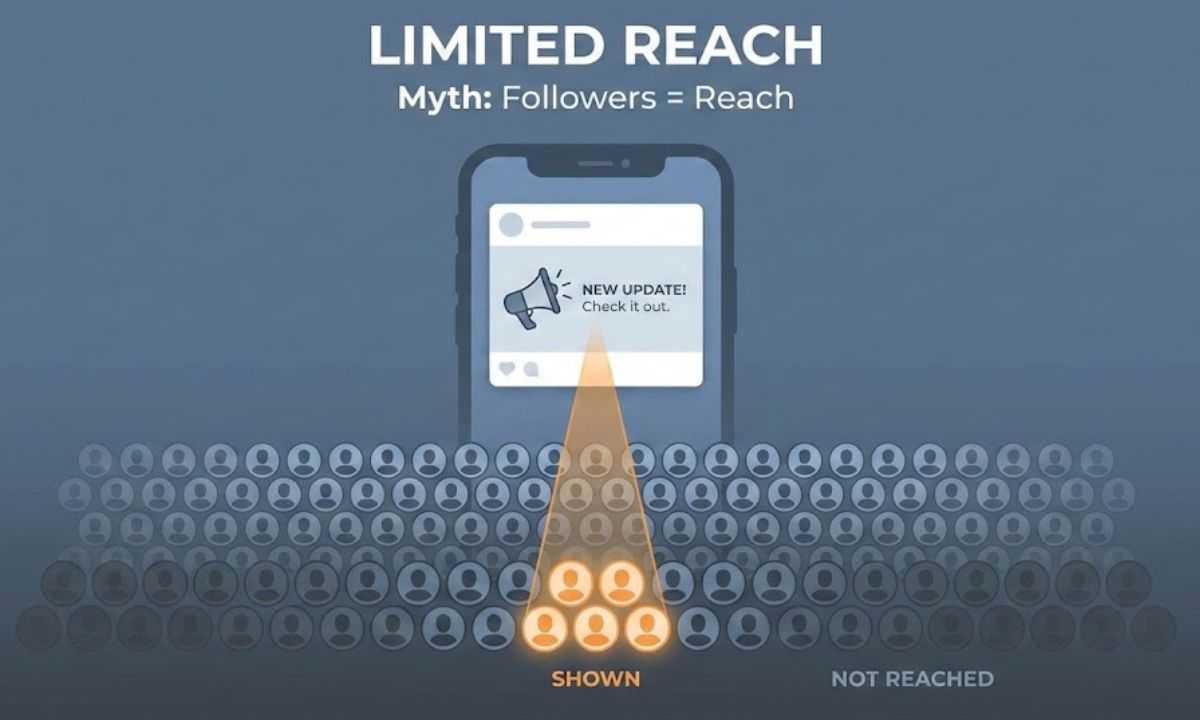
Most Facebook users assume that when they publish a post, it appears in the feeds of everyone who follows them. That assumption is incorrect.
In reality, Facebook uses a controlled distribution system that limits how widely a post is shown until it proves itself through user interaction. This system plays a decisive role in determining which posts gain visibility and which ones disappear unnoticed.
When a post is published, Facebook does not immediately distribute it to all followers. Instead, the platform shows it to a small test group. During this early phase, Facebook closely monitors how users respond to the content.
Signals such as reactions, comments, shares, link clicks, and time spent viewing the post help Facebook decide whether the content is worth pushing further. These signals are collected quickly, often within the first hour after publishing.
Also read: Is Facebook Dead?
If engagement occurs, Facebook treats the post as relevant and expands its reach. The content is shown to more followers and may also be recommended to users who do not follow the page or profile.
If engagement does not occur, distribution slows sharply. Even high-effort posts can lose visibility if users scroll past without interacting. In many cases, the post effectively stops appearing in feeds.
This explains why some posts gain traction rapidly while others fade almost immediately. The difference is not always content quality. It is early response.
Facebook’s ranking system does not consider the creator’s intent, the time spent producing the content, or its importance to the publisher. It evaluates behavior. Posts that trigger interaction are prioritized. Posts that do not are deprioritized.
For businesses, creators, and publishers, this means reach is no longer guaranteed. Having followers does not ensure visibility. Engagement has become the gatekeeper of distribution.
How Facebook’s system compares to other social platforms
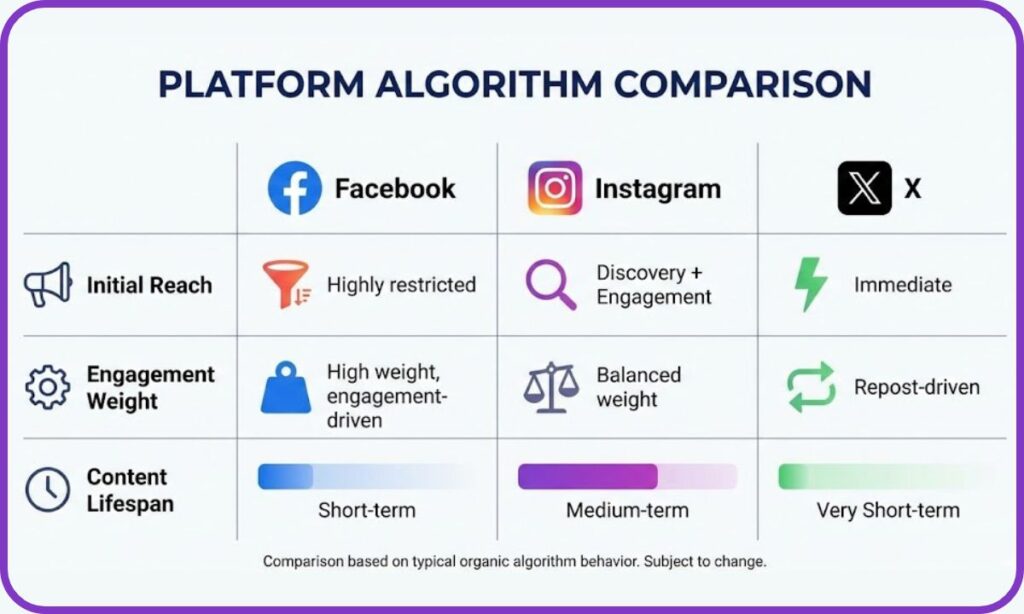
Facebook’s engagement-first model is not universal. Other major platforms use different approaches to content distribution, which affects how posts gain visibility.
X (formerly Twitter) operates on a more open and immediate distribution model. When a post is published on X, it is generally shown to a larger portion of followers almost instantly. Visibility is influenced by engagement, but initial reach is less restricted.
On X, recency plays a stronger role. Posts appear in chronological and algorithmic feeds, and content can spread quickly through reposts, replies, and quote posts. Even accounts with smaller followings can achieve high visibility if their posts are amplified by others.
However, content on X also has a shorter lifespan. Posts rise and fall rapidly, often within minutes or hours, making sustained visibility harder to maintain.
Instagram sits somewhere between Facebook and X. Like Facebook, Instagram uses algorithmic testing to determine distribution. New posts and Reels are shown to a limited audience initially, and engagement influences whether they are pushed further.
Instagram places a stronger emphasis on visual appeal, watch time, saves, and shares. Reels, in particular, can reach non-followers aggressively if early engagement is strong. However, follower feeds are still filtered, and not all followers will see every post.
Facebook differs in that it places heavier weight on sustained interaction, especially comments and shares, and tends to limit distribution more aggressively when early engagement is weak.
In comparison:
- Facebook prioritizes engagement as a strict distribution trigger
- Instagram balances engagement with visual performance and discovery
- X favors immediacy, reposting, and conversational spread
Each system rewards different behaviors, but Facebook remains the most restrictive when it comes to initial reach.
You can read this guide which shares proven ways to organically grow engagement on Facebook.
Why this difference matters
Creators who apply the same posting strategy across all platforms often struggle on Facebook. Content that performs well on X or Instagram may fail on Facebook if it does not prompt interaction quickly.
Facebook is less forgiving of passive consumption. Scrolling without reacting sends a negative signal to the platform. As a result, posts that do not spark immediate engagement are unlikely to recover later.
Understanding these differences is essential for anyone using Facebook as a marketing or publishing channel. Success depends not just on what is posted, but on how people respond.
In practical terms, engagement determines whether content travels further or stops at the starting line. On Facebook, engagement is not a vanity metric. It is the mechanism that decides visibility.
