


A small bakery in Ohio ranks on the first page of Google for “best sourdough near me.” A boutique clothing store in Texas has twelve thousand Instagram followers who actually buy from them, not just scroll past.
Neither business has a marketing department. Neither one spent five figures on an agency. What they have in common is that they treated SEO and social media as a single, integrated effort rather than two separate chores handled by two different people who never talk to each other.
That’s the part most small business owners get wrong. They hire someone to “do SEO,” post on Instagram whenever they remember, and wonder why neither one moves the needle. For owners who’d rather skip the guesswork, a directory such as designrush.com lists agencies ranked by verified reviews and pricing, though most of what actually moves the needle doesn’t require hiring anyone at all.
The two channels aren’t competing for the same budget. They’re two steps in the same customer journey, and once an owner understands how they support each other, a lot becomes possible on a limited budget.
Also read: How to Get High-Quality Backlinks with Zero Investment
Why SEO and Social Media Aren’t Separate Jobs
Search engines don’t rank pages in a vacuum. They look at signals such as how long people stay on a page, whether other sites link to it, and whether a brand shows consistent activity across the web.
Social media doesn’t directly boost rankings the way a backlink does, but it does something almost as valuable: it gets a business found, shared, and talked about, which eventually turns into links, reviews, and searches for the brand name itself.
Think about how people actually discover a new coffee shop or a local plumber. Someone sees a post shared by a friend, checks the profile, then searches the business name on Google to look at reviews and hours.
If the website is slow, the Google listing is outdated, or there’s no consistent activity, that curious visitor leaves and picks a competitor instead. More than half of mobile visitors abandon a site that takes longer than three seconds to load. SEO and social media aren’t fighting for the same budget. They’re two steps in the same customer journey.
Where a Small Budget Actually Makes a Difference
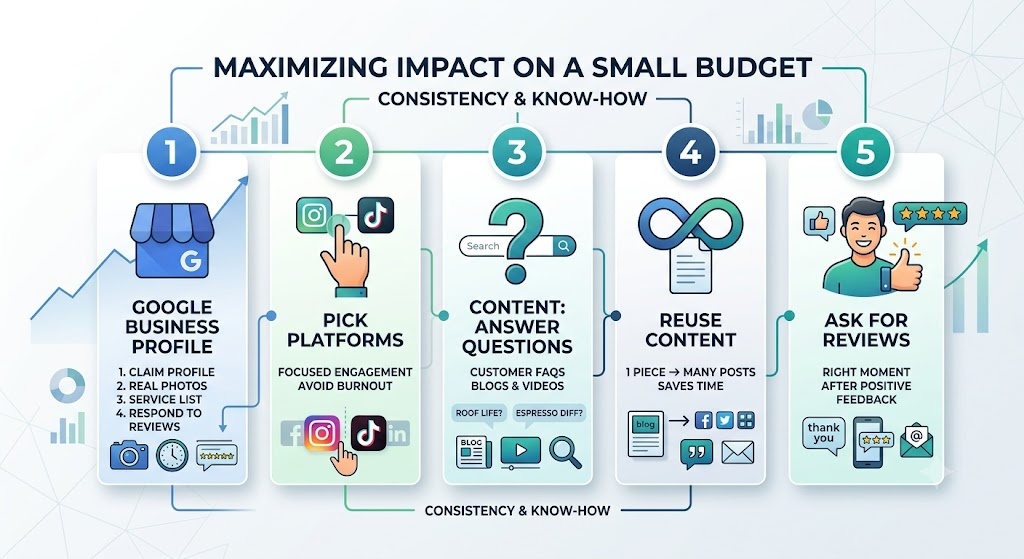
None of the steps below requires a big team or a big spend, just consistency and a bit of know-how.
1. Fix the Google Business Profile first.
Before spending a dollar on ads or tools, claim and fully complete the Google Business Profile. Add real photos, correct hours, a full list of services, and respond to every review, good or bad. This alone often does more for local visibility than months of blog posts, because it directly affects whether a business shows up in the map results when someone nearby searches.
2. Pick one or two platforms, not five.
A shop trying to post daily on Instagram, TikTok, Facebook, LinkedIn, and Pinterest without help will burn out within a month and produce weak content across the board. Look at where the actual customers spend time. A B2B consulting firm probably gets more from LinkedIn than TikTok. A clothing brand aimed at teenagers should skip LinkedIn entirely.
3. Write content that answers real questions.
Instead of guessing what to post, search the actual questions customers ask, “how long does a roof replacement take,” “what’s the difference between espresso and drip coffee,” and build both a blog post and a short social clip around the answer. This one habit solves two problems at once. It gives Google something specific to rank, and it gives social media something worth sharing beyond a product photo.
4. Reuse everything.
A single blog post can become a carousel, a short video script, a handful of quote graphics, and an email newsletter. Small teams waste time creating five separate pieces of content when one solid piece, broken into parts, could cover a month of posts.
5. Ask for reviews at the right moment.
Reviews affect both local search rankings and how trustworthy a brand looks on social media. The best time to ask isn’t after a random purchase. It’s right after a customer says something positive unprompted, in person, over email, or in a comment. That’s the moment they’re most likely to say yes.
What Doesn’t Work, No Matter the Budget
Buying followers, using generic engagement pods, or stuffing a website with keywords that don’t match how people actually talk are all shortcuts that used to work and now mostly backfire.
Search engines and social platforms have both gotten better at spotting fake activity, and customers can usually tell too. A profile with ten thousand followers and twelve likes per post signals something is off long before anyone reads the caption.
The Real Advantage Small Businesses Have
Big brands often struggle to sound like an actual person, but a small business doesn’t have that problem. The owner can answer a comment personally, mention a supplier by name, or admit when something sold out.
That kind of specificity is exactly what both search engines and social audiences reward now. Growth without a big budget isn’t about doing more. It’s about being harder to ignore in the few places that actually matter.
