

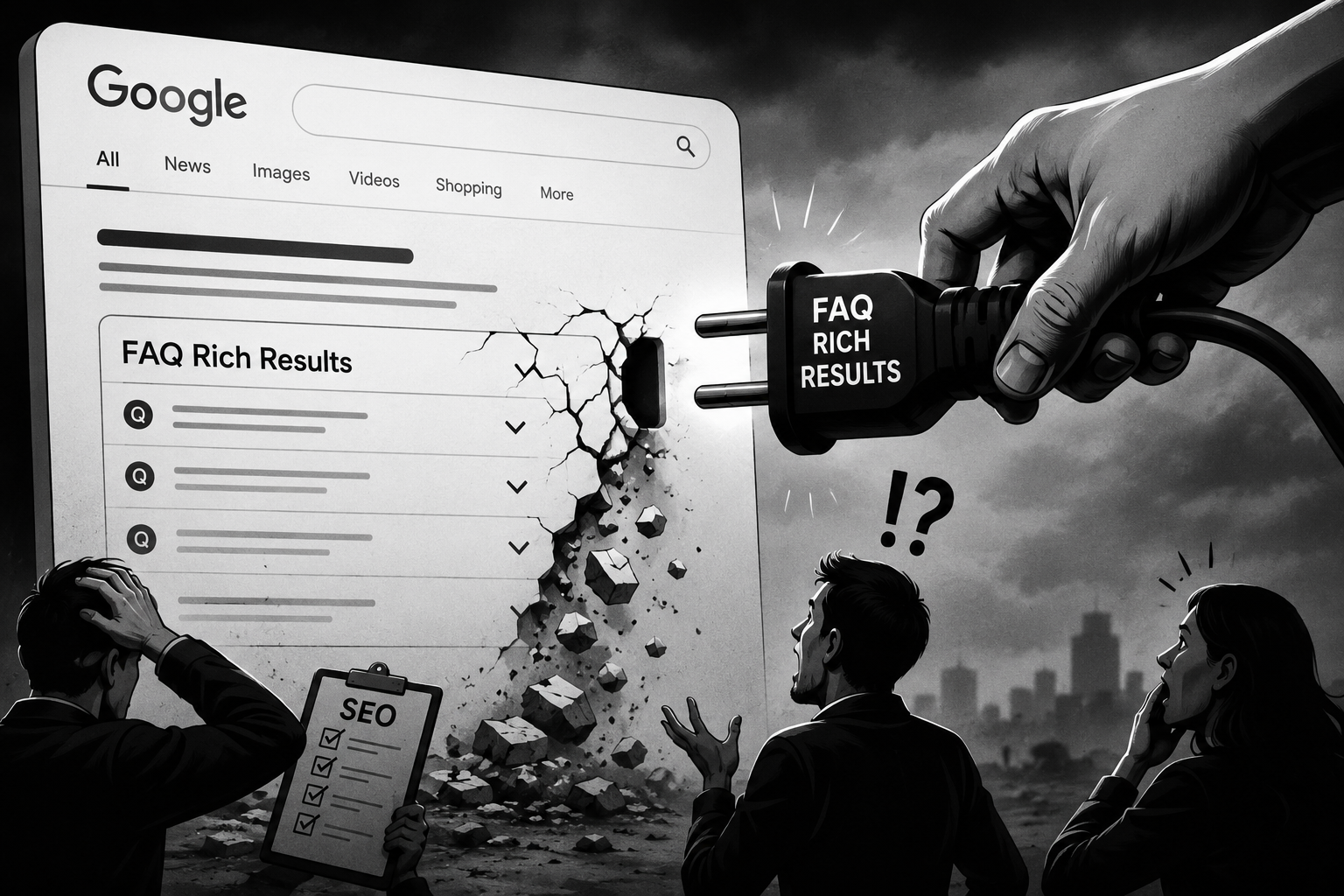
Why Google Removing FAQ Rich Results Matters
Table of Contents
When Google first introduced FAQ rich results years ago, the SEO industry treated them like a major opportunity. Suddenly, websites could occupy more space inside search results by displaying expandable questions and answers directly under their listings. Naturally, everybody wanted them.
Very quickly, FAQ schema became one of those “standard SEO tasks” that almost every website owner was told to implement. WordPress plugins added one-click FAQ schema generators, SEO audits started flagging missing FAQ markup as an issue, and agencies began treating it as part of proper optimization.
At the time, it made sense. The feature was highly visible in Google Search, and many websites benefited from the extra real estate on the results page. The problem is that the industry never really adjusted after Google slowly reduced the importance of FAQ rich results over the last few years.
Now Google has officially confirmed that FAQ rich results are disappearing entirely from Search appearances and reporting. On the surface, this sounds like a simple feature removal. But after reading through a huge Reddit discussion about the update, I honestly think this story reveals a much bigger problem inside SEO itself.
The real issue is not the death of FAQ rich results. The real issue is how easily the SEO industry turns assumptions into unquestioned truths.
Also read: How to Get High-Quality Backlinks with Zero Investment
FAQ Content vs FAQ Schema: The Difference Most People Missed
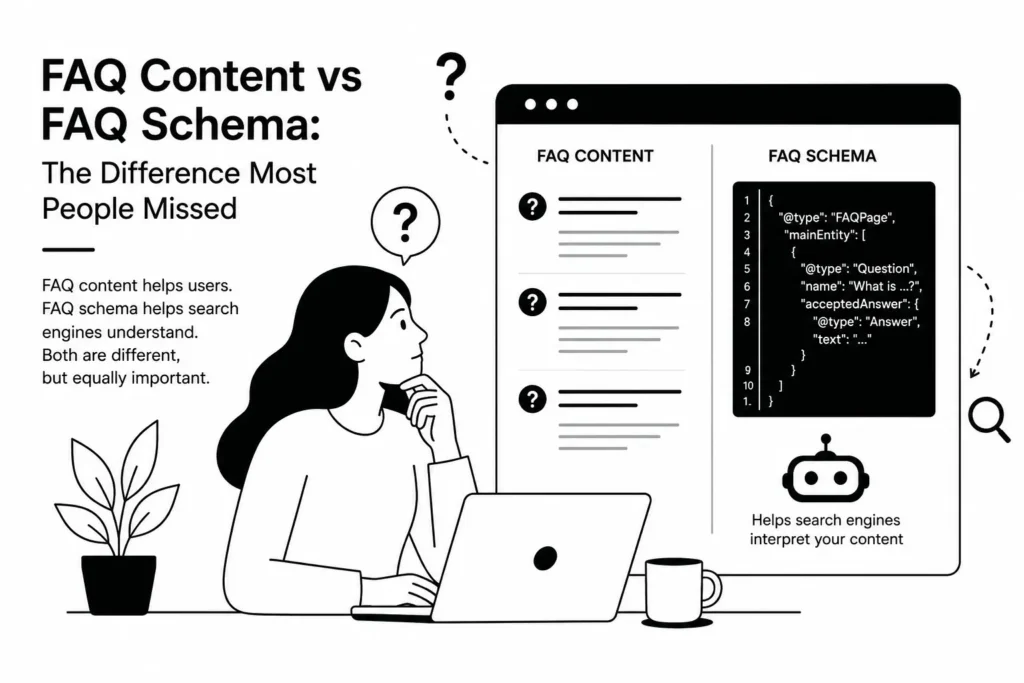
One thing I noticed immediately while reading the discussion was that many people were confusing FAQ content with FAQ schema markup. Those are not the same thing at all, but somewhere along the way they became blended together in people’s minds.
FAQ content still matters a lot.
If a page contains genuinely useful questions and answers that help visitors understand a topic better, that content can still improve user experience, strengthen topical relevance, target conversational search queries, and even help AI systems understand the context of a page more clearly. None of that suddenly disappeared because Google removed a visual search feature.
What disappeared is the enhanced presentation layer that used to appear in Google Search results.
That distinction matters because many website owners spent years optimizing for the visual reward rather than the actual usefulness of the content itself. Once Google stopped showing those rich FAQ listings for most websites, people suddenly began asking whether FAQs were worth creating anymore. To me, that reaction says a lot about how modern SEO often operates.
The Rise of “Checkbox SEO” in the Industry
Too many tactics survive because they feel measurable and easy to package.
Schema markup is a perfect example of this. It feels technical, structured, and concrete. You can validate it in testing tools, generate reports around it, and include it inside deliverables. Clients can see it. Plugins can automate it. Agencies can sell it. Because of that, it slowly became one of those checkbox activities that everybody repeated without revisiting whether the practical impact still justified the attention.
What fascinated me about the Reddit thread was how emotional the conversation became once people started questioning the value of FAQ schema. Some commenters argued very aggressively that schema markup was always overhyped, while others insisted that AI crawlers and modern search systems still depend heavily on it.
That emotional reaction tells me something important. Many SEO tactics eventually become industry beliefs rather than continuously tested strategies.
Also read: How to Index Backlinks Faster: 7 Proven Methods That Actually Work
Does AI Actually Use FAQ Schema?
The AI part of the discussion was especially interesting because this is where a lot of confusion exists right now across the entire SEO industry.
Over the past year, there has been a massive rise in discussions around AI SEO, answer engine optimization, and LLM optimization. Because nobody fully understands how AI retrieval systems work internally, people are trying to create new “best practices” very quickly. That uncertainty has created an environment where theories often spread faster than evidence.
Inside the Reddit discussion, several people confidently claimed that FAQ schema remains critical because AI systems supposedly rely on it heavily. But whenever someone asked for official documentation proving this, the conversation became vague very quickly.
And honestly, I think that skepticism is reasonable.
Large AI companies have not clearly stated that FAQ schema markup is a major ranking signal for AI-generated answers. At the same time, modern language models are already extremely capable of understanding page structure naturally. They can recognize questions, answers, headings, entities, and relationships directly from normal content without needing explicit FAQ markup wrapped around everything.
Is Schema Markup Still Useful for SEO?
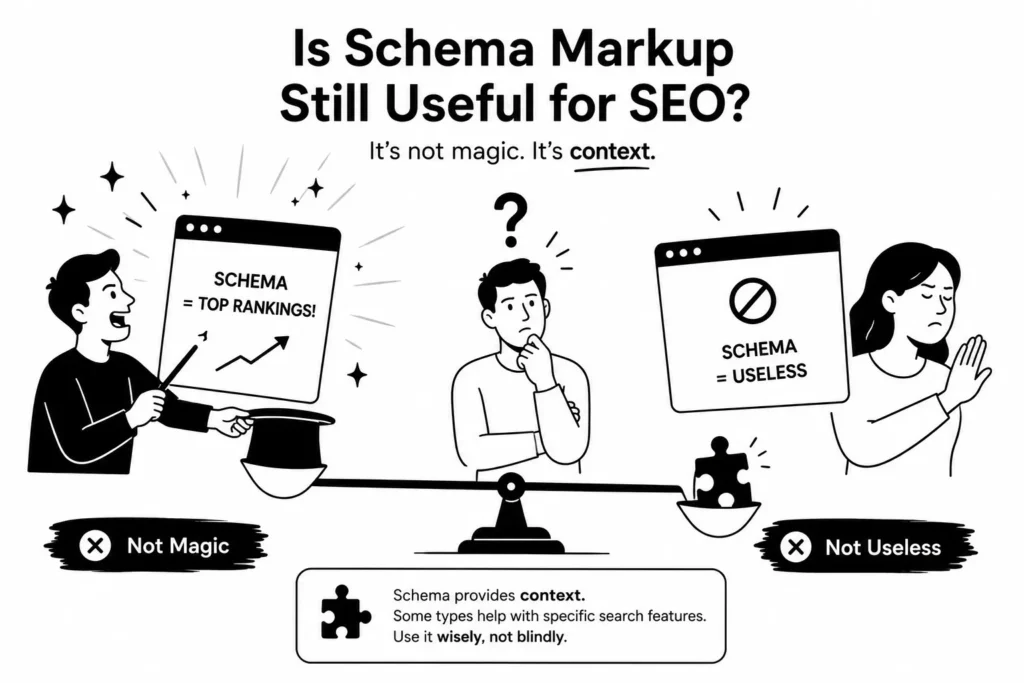
That does not mean schema markup is useless. I think this is where many conversations become too extreme on both sides.
Some schema types absolutely still matter. Product schema, recipe schema, local business schema, and event schema can still affect eligibility for specific search features. Structured data can also help search engines interpret information more consistently in certain situations.
But I also think the SEO industry developed an unhealthy habit of treating schema as a magical ranking ingredient rather than what it actually is: additional context.
Over time, schema became symbolic inside SEO culture. Many people started treating its presence as proof that a website was professionally optimized, even when there was very little evidence showing meaningful ranking improvements for most websites using FAQ schema specifically.
That mindset creates a bigger long-term problem because SEO slowly shifts away from outcome-driven thinking and becomes ritual-driven instead. People continue repeating tasks simply because those tasks became industry tradition.
I think this explains why the Reddit thread became so heated. For some people, questioning FAQ schema almost felt like questioning years of accepted SEO advice itself.
Also read: Reddit for SEO: Find Real Topics People Actually Want
Why Helpful FAQ Content Still Matters
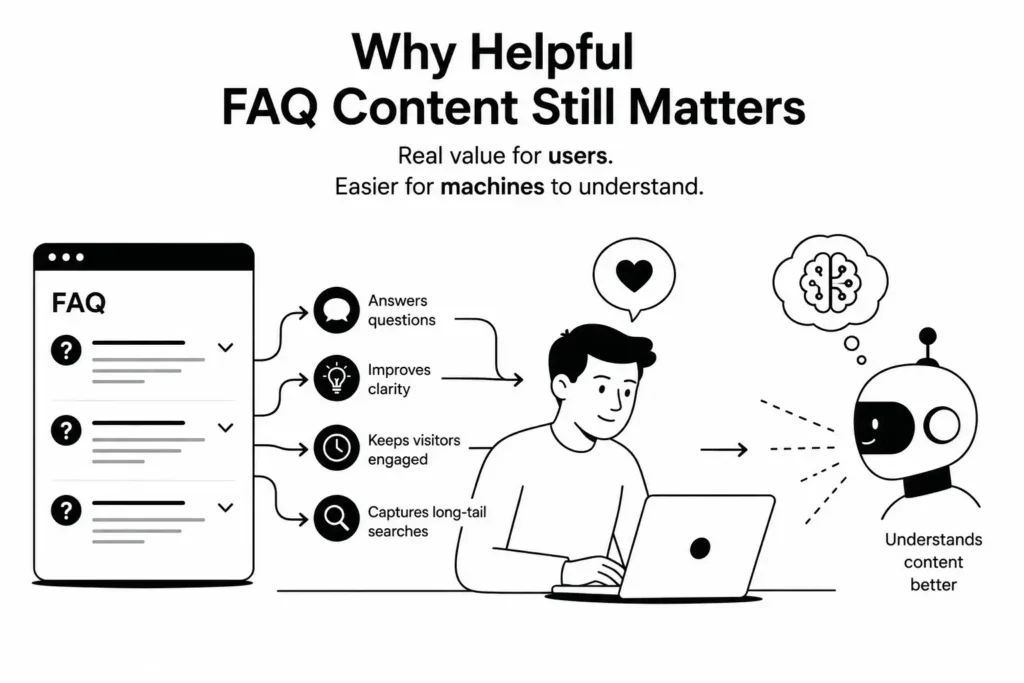
There was another important pattern I noticed while reading through the discussion. The people who sounded the most grounded were usually the ones separating user value from search engine incentives.
For example, several commenters correctly pointed out that FAQ sections can still be incredibly useful for readers even if Google no longer displays them as rich results. A good FAQ section helps answer objections, improves clarity, keeps visitors engaged longer, and creates opportunities to cover highly specific search queries naturally.
That is real value.
And honestly, I think that direction matters more than ever now because search engines and AI systems are becoming increasingly capable of understanding content semantically rather than depending entirely on technical signals.
In other words, machines are getting better at interpreting naturally structured human content.
The Future of SEO Is Becoming More Human
For years, SEO revolved heavily around helping machines interpret webpages through technical hints and structured markup. But modern systems are becoming much better at understanding meaning directly from the content itself. That means clarity, organization, readability, and topical depth may become more important than obsessing over whether every possible schema type has been perfectly implemented.
After spending time analyzing this discussion, my biggest takeaway is actually very simple.
FAQ content is not dying.
What is dying is the belief that adding technical markup automatically creates SEO value by itself.
And honestly, that might be a healthy change for the industry.
