

Getting your posts seen on Facebook in 2026 is no longer a numbers game. Having thousands of followers does not guarantee an audience if those followers do not actually talk to you. The platform now ignores passive clicks and instead hunts for real conversations. To understand why some posts take off while others fail, you have to look at how much effort a user puts into interacting with you. The most powerful tool for growth is no longer the “Like” button; it is the thoughtful, back-and-forth conversation happening in your comments.
1. Why Ranking Still Matters
Most people use Facebook like a digital billboard. They post a photo or a link, walk away, and then wonder why only a tiny fraction of their followers ever sees it. In 2026, the platform acts as a filter. If your content does not prove its value to the system immediately, it stays hidden. To reach an audience today, you have to understand that visibility is earned through action, not just by hitting “Post.”
2. Inside the Machine
The “Algorithm” is often discussed like a mystery, but it is actually a visible machine learning framework. Meta currently utilizes models like Andromeda and UTIS to process billions of data points in real time. Instead of just counting total likes, these systems focus on predicting a user’s next specific action.
3. The Value of the “Deep Reply”
If a “Like” is a quick nod from a stranger, a “Comment” is a handshake from a friend. Facebook’s latest updates place massive weight on Meaningful Social Interactions (MSI).
However, not all engagement carries the same weight.
- Low-Value Signals: Single emojis or generic “Great post!” replies. The system now filters these as low-effort interactions.
- High-Value Signals: “Deep Replies” or threaded conversations where users actually debate or discuss the topic.
4. Why Facebook Comments are the Primary Signal
A comment provides two pieces of data that a “Like” cannot:
- Active Dwell Time: The user stopped scrolling long enough to formulate a thought and type it out.
- User Intent: They didn’t just consume the content; they chose to participate in it.
When a comment thread gains momentum, it triggers Engagement Velocity. This tells the system that your post is a community hub, which fast-tracks it to the top of the feed for followers and non-followers alike.
5. How Facebook’s Algorithm Actually Works (High-Level)
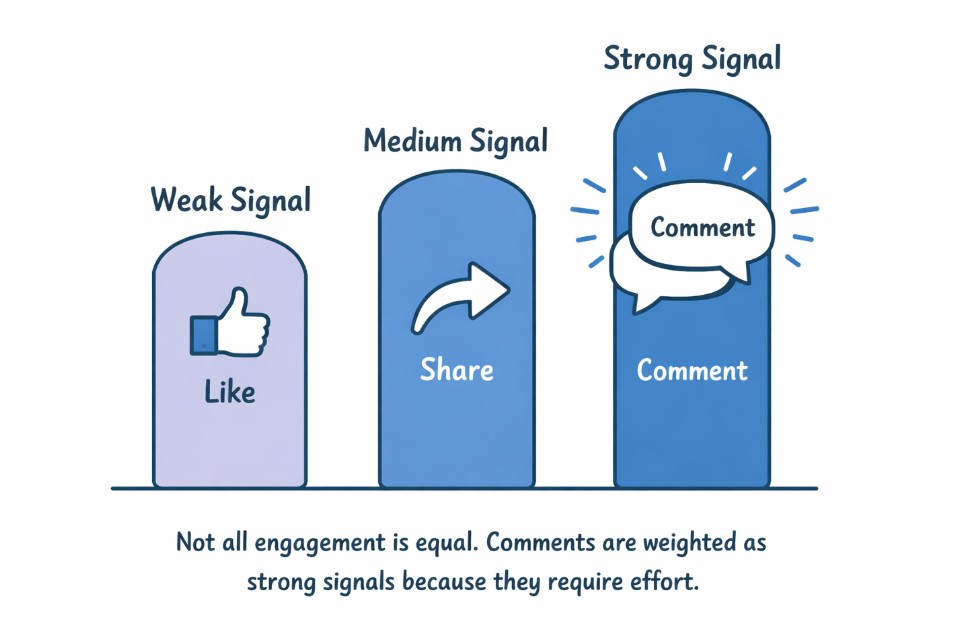
The days of the simple, chronological Facebook feed are long gone. Today, your feed is a curated environment managed by a sophisticated machine learning system. This system does not just display content in the order it was posted. It makes a series of complex predictions about what you are most likely to engage with and ranks every available post accordingly.
Facebook sorts these interaction data points, known as signals, into three primary categories: strong, medium, and weak. While a “Like” is a quick, low-effort action, a comment requires a user to stop and contribute. Because of this, the algorithm categorizes comments as a strong engagement signal. This weighting ensures that posts sparking actual discussion are pushed to the top of the “Inventory” for a wider audience.
6. What Engagement Signals Are
In the context of social media, an engagement signal is any measurable action a user takes that indicates interest in a post. These signals act as the primary “fuel” for the Meta Discovery Engine.
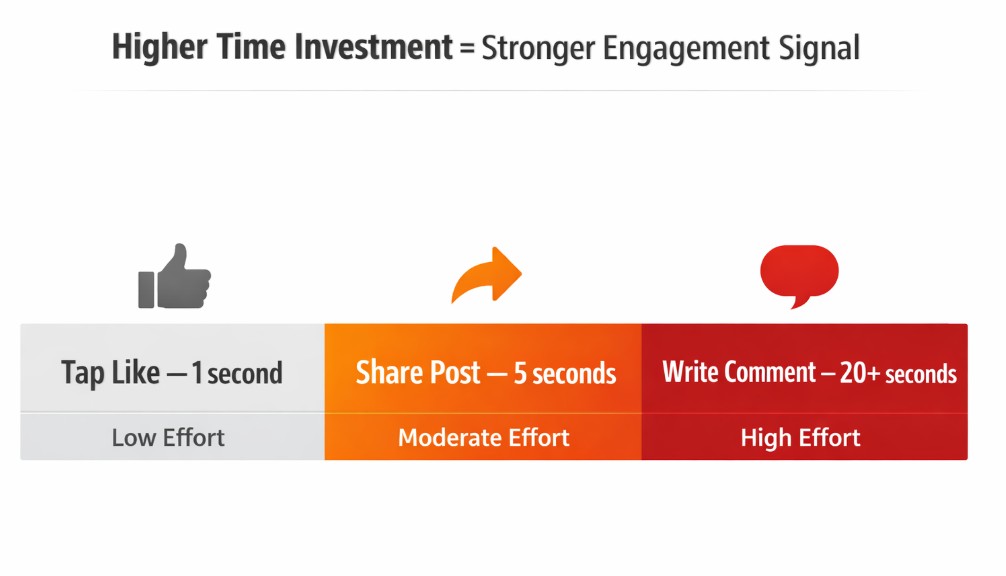
Facebook differentiates between various types of interactions based on the effort required:
- Likes and Reactions: These are considered weak-to-medium signals. They show a basic level of approval but do not necessarily indicate deep interest.
- Shares: This is a strong signal because it implies the user wants to vouch for the content to their own network.
- Comments: These are consistently treated as very strong signals.
The reason comments receive more weight than likes is simple: they represent a higher “cost” of time. A user who comments has moved beyond passive consumption and into active participation.
Comments as an Engagement Signal
Meta’s internal data suggests that comments are the most reliable indicator of deeper user involvement. To leave a comment, a person must pause their scroll, think of a response, and physically type it out. This process is far more intentional than a reflexive “like” while passing by.
Facebook treats high comment activity as a proxy for three critical metrics:
- Relevance: The content is hitting a topic that people feel strongly about.
- Conversation Starter: The post is serving as a digital “water cooler.”
- Community Interest: The content is fostering a Meaningful Social Interaction (MSI), which has been a core priority for the platform since 2018.
Qualitative vs. Quantitative Comment Value
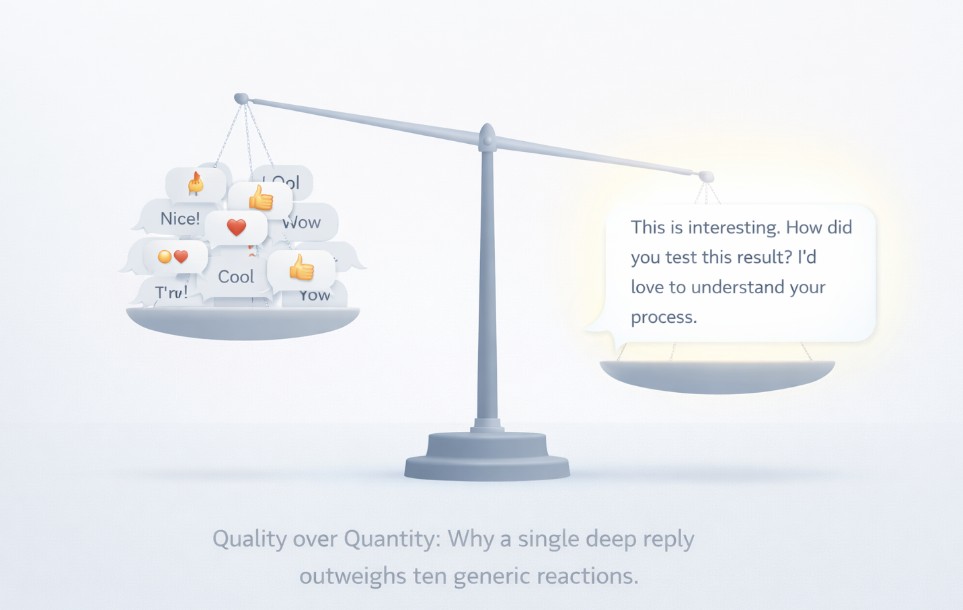
The algorithm has become increasingly adept at distinguishing between a “good” comment and a “useless” one. Quantity alone is no longer the goal.
There is a significant difference in how the system weighs a single “Nice!” versus a detailed, three-sentence reply. Long, substantive comments signal that the post has real depth. Furthermore, the algorithm tracks comment threads. When users begin replying to each other within your comment section, it signals a self-sustaining conversation. This creates a massive boost in ranking. Additionally, comments from “Close Friends” or accounts you interact with frequently are weighted much higher than those from strangers.
Dwell Time: The Silent Amplifier
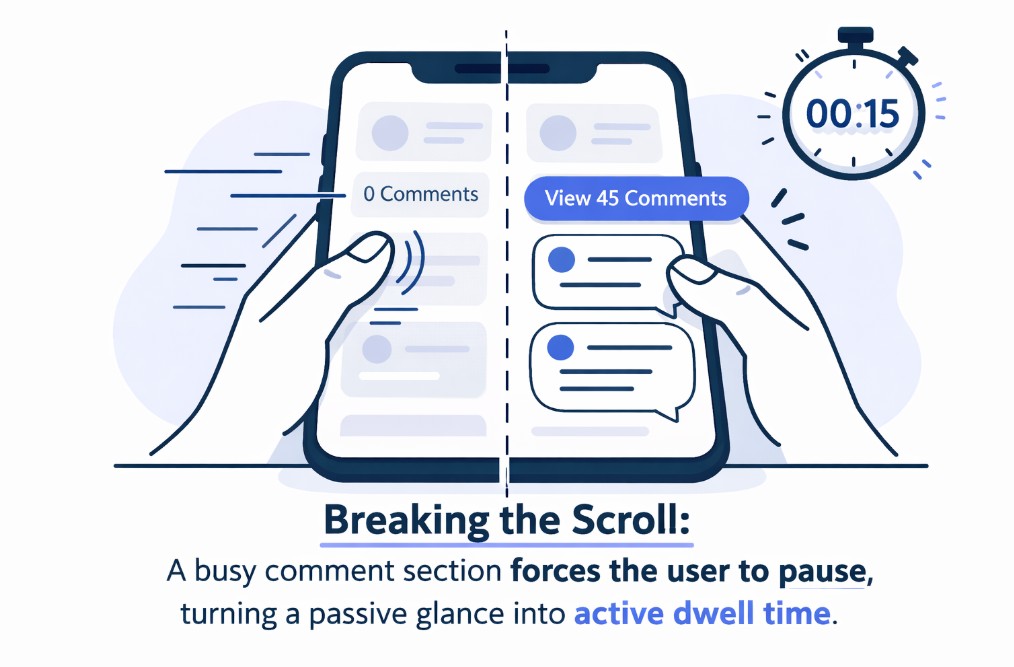
Dwell time refers to the amount of time a user spends looking at a specific post before moving on. Facebook uses this as a “silent” signal to measure interest, even if the user never clicks a button.
Comments are the ultimate tool for increasing dwell time. When a post has a busy comment section, users spend more time reading through the different perspectives. Longer threads essentially trap the user’s attention, causing them to stay on your post for a longer session. The algorithm rewards posts that hold attention because it helps keep the user on the Facebook app longer.
Interaction Quality Signals
The algorithm does not treat all engagement as equal. Facebook employs filters to distinguish between genuine conversation and low-quality noise. Spammy or repetitive comments, such as “Follow for follow” or “Check my profile,” are systematically down-weighted and often hidden from the main view.
The system also looks for specific context signals to determine a comment’s value:
- Keyword Matching: Comments containing keywords that align with a user’s known interests can actually boost the post’s visibility for that specific person.
- Relationship Strength: If a comment comes from a user you interact with frequently, it carries significantly more weight in your personal ranking.
- Recency: A fresh comment is more valuable than one from three days ago. The Meta Ranking System prioritizes “Engagement Velocity,” which tracks how quickly new interactions are occurring.
If other users engage with a specific comment by “Liking” it or replying to it, that comment and the parent post receive a secondary boost in the feed hierarchy.
How Comment Activity Affects Ranking
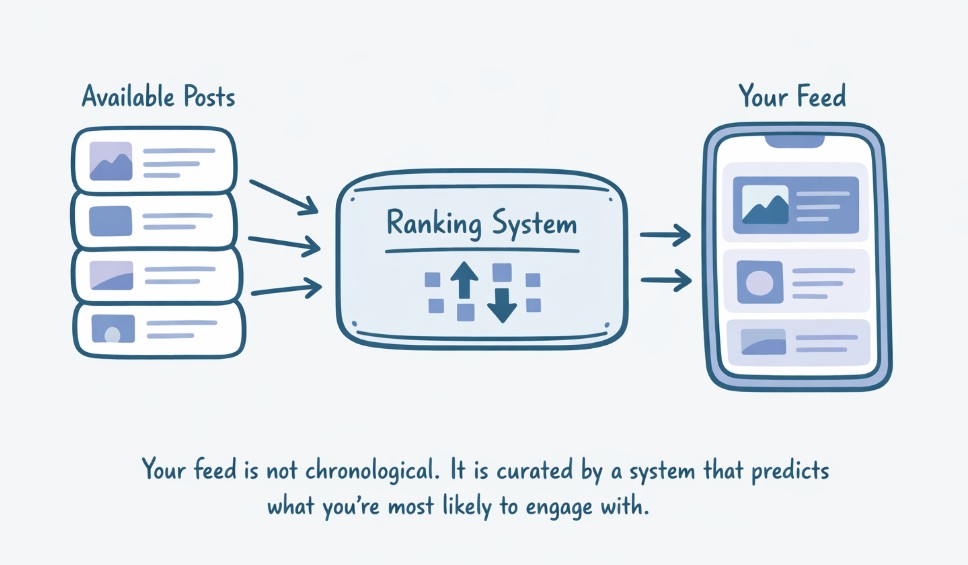
When a post achieves a high comment rate, it triggers a series of positive shifts in the Facebook ecosystem. The system views a high volume of interaction as a signal of high quality. Consequently, these posts are more likely to appear at the very top of your followers’ feeds rather than being buried under newer content.
The impact of comment activity extends beyond the primary news feed:
- Extended Reach: High engagement levels can push your content into the “Suggested for You” or “Discovery” sections, reaching users who do not follow you yet.
- Notification Surfaces: Active threads often trigger notifications for people who have already commented, drawing them back into the conversation and further boosting the post’s relevance score.
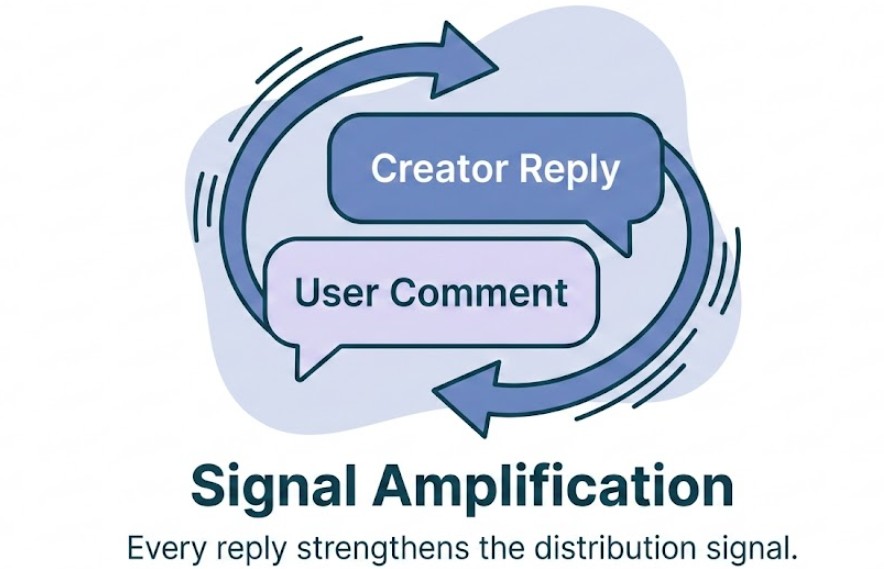
- The Feedback Loop: This creates a cycle where more visibility leads to more comments, which in turn leads to even greater visibility.
By maintaining a steady flow of conversation, you essentially convince the Ranking Models that your content is a vital part of the platform’s current ecosystem.
Strategies Based on This Understanding
Understanding the mechanics of the algorithm allows you to move from passive posting to active engagement engineering. If the goal is to trigger high-weight signals, your copy must be designed as an open invitation rather than a closed statement.
- Ask a Specific Question: Instead of a generic “thoughts?” at the end of a post, ask for a specific preference. Questions that offer two clear options create a lower barrier to entry and invite quick, punchy replies.
- Encourage Opinions: Humans are naturally inclined to share their perspectives. By framing a post around a debatable topic or a “hot take,” you encourage users to leave longer, substantive comments that the algorithm prioritizes.
- The Reply Strategy: Do not let a comment sit unanswered. When you reply to a follower, you effectively double the comment count and signal to the Facebook Engagement Model that an active conversation is happening.
- Avoid One-Word Prompts: Use prompts that require a sentence to answer. This increases the “Dwell Time” for other users who stop to read the nuanced responses.
For those looking to jumpstart a new page or a stagnant post, some creators choose to → buy facebook comments to establish initial social proof. This can signal early “Engagement Velocity” to the algorithm, provided the comments are relevant to the content.
Pitfalls & Misconceptions
A common mistake is assuming that any comment is a good comment. While the algorithm craves activity, it is also designed to detect and penalize manipulation. Relying on “vanity metrics” or low-quality engagement can actually damage your long-term reach.
- Quality over Quantity: A hundred “great post” comments from bot accounts do not carry the same weight as five detailed responses from real, active users. Meta’s integrity systems are increasingly effective at identifying artificial engagement spikes.
- The “Engagement Bait” Penalty: Explicitly asking people to “Comment ‘YES’ if you agree” can trigger a shadow-demotion. Facebook’s Engagement Bait Policy specifically targets posts that try to “game” the system without providing actual value.
- Irrelevant Accounts: Comments from accounts that have no topical relevance to your niche are often ignored by the ranking system. The algorithm looks for “contextual authority,” meaning it prefers interactions from people who typically engage with similar content.
If your comment section becomes a magnet for spam or irrelevant bot noise, the system may classify your page as low-quality, making it harder for your future posts to break into the primary feed.
Meta Insights: Behind the Scenes
The mechanisms driving Facebook’s feed are not static. Meta’s ranking models undergo frequent updates to better align with real-world human behavior. As of 2026, the platform has largely moved away from rule-based sorting in favor of predictive behavioral AI.
Recent updates highlight several key shifts in how the “machine” thinks:
- The Andromeda and UTIS Integration: Meta currently utilizes advanced models like Andromeda for broad behavioral prediction and UTIS for fine-tuning based on direct user feedback. These systems prioritize “high-intent” signals over generic popularity.
- The MSI Priority: Facebook publicly maintains that its primary goal is to foster Meaningful Social Interactions (MSI). This means the algorithm is specifically tuned to favor content that starts conversations between real people rather than content that is merely consumed passively.
- Human Behavior Prediction: Instead of simply counting interactions, the latest models attempt to predict a user’s “post-click satisfaction.” A post that generates a long, thoughtful comment thread is seen as a high-satisfaction outcome, leading to a significant ranking boost.
Ultimately, the optimization of the algorithm is trending toward more “human” metrics. The system is learning to value context, tone, and the quality of the connection over the raw volume of clicks.
Conclusion
Facebook algorithm has evolved from a simple sorting mechanism into a highly sophisticated AI Discovery Engine. While the platform’s technology has changed, its core objective remains the same: to prioritize content that fosters real-world connection. Comments remain one of the most powerful signals at your disposal because they represent a level of intentionality that passive “likes” simply cannot match.
By focusing on deep conversation, encouraging diverse perspectives, and maintaining high engagement velocity, you can effectively navigate the complexities of modern ranking. Success in this ecosystem requires a move away from “broadcast” posting and toward “community engineering.” When you produce content that holds attention and sparks dialogue, you turn the algorithm from a gatekeeper into a growth partner.
The most effective strategy is to combine these technical insights with high-quality, authentic storytelling. Understanding these mechanics allows you to produce posts that are both visible to the masses and valuable to the individual.
