

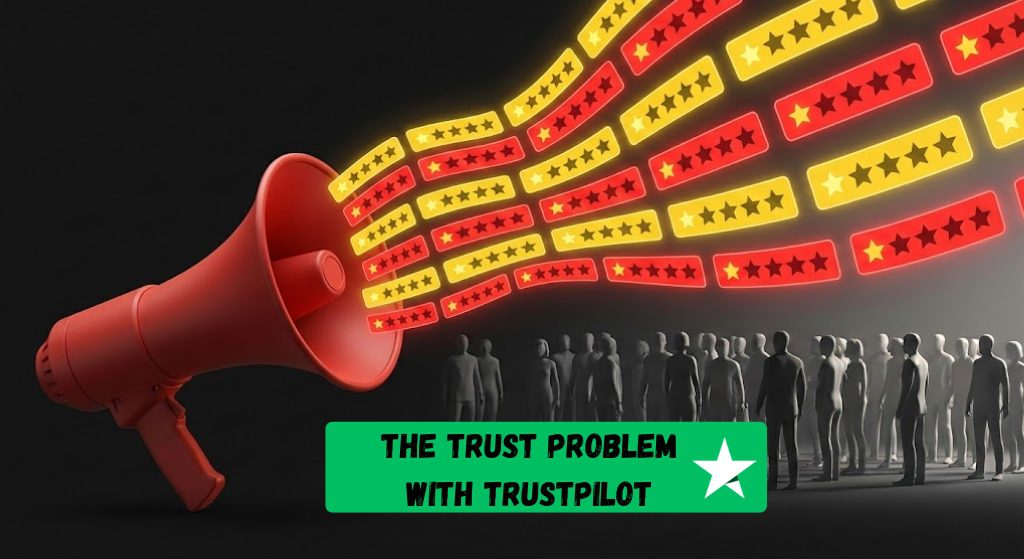
I was browsing through Trustpilot recently and noticed a pattern that almost seemed like a technical glitch or a coordinated prank. When you look up some of the most successful and dominant companies in the world, the ratings are shockingly low. Amazon often hovers around two stars, while major global airlines frequently struggle to stay above a 1.7, and the big telecom giants usually bottom out at a miserable 1.4 stars. It creates this bizarre paradox where the companies we rely on for almost everything appear to be hated by everyone who uses them.
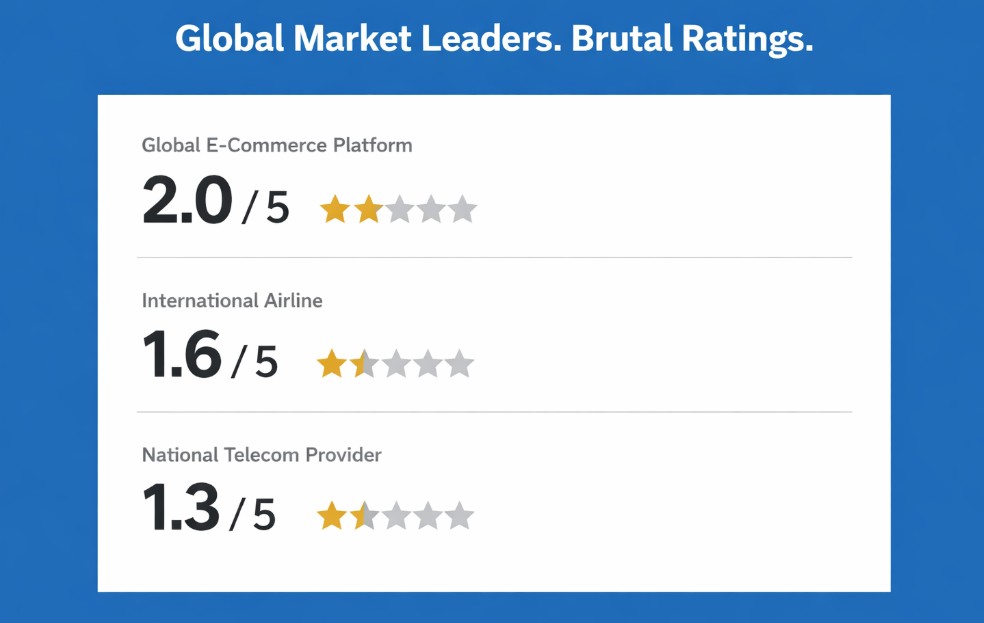
If these businesses were truly as broken as their profiles suggest, they would have been replaced by better competitors a long time ago. The fact that they continue to dominate their industries suggests that these ratings aren’t actually measuring the average customer experience, but are instead providing a massive megaphone for the loudest and most frustrated voices.
To understand how this happens, we have to look at the specific way humans decide whether or not to leave a review in the first place.
The Silent Majority Problem
The root of this paradox lies in a basic quirk of human psychology that I like to call the “emotional threshold” for taking action. Most of us don’t go about our day looking for ways to praise the companies that simply do what they are supposed to do. When your Amazon package arrives on time, or your flight lands safely, you don’t feel a sudden surge of adrenaline that compels you to log into a review site and write three paragraphs about how everything went exactly as expected. A smooth experience is the baseline; it is what we paid for, so we generally remain silent.
However, the moment a package is stolen or a flight is cancelled, that neutral state is replaced by an intense emotional spike. Anger and frustration are much more powerful motivators for action than quiet satisfaction. This is why you will see one angry customer write a seven-hundred-word essay detailing every minor slight, while 99 satisfied customers say absolutely nothing at all. Trustpilot isn’t necessarily a map of how a company performs on average, but rather a collection of the times they failed most spectacularly.
According to a Spiegel Research Center study on online review behavior, shoppers who have had negative experiences are far more motivated to go through the effort of writing a review than those who had a routine, satisfactory interaction with a company.
For a massive corporation, this selection bias becomes an impossible hurdle to clear. If you serve 10 million people a day, even a near-perfect success rate of ninety-nine percent still leaves you with a hundred thousand people who had a miserable experience. Those hundred thousand people are the ones filling up the comment sections, while the other nine point nine million are busy living their lives. At this scale, the volume of outrage becomes so visible that it completely drowns out the reality of the business.
Scale Punishes Success
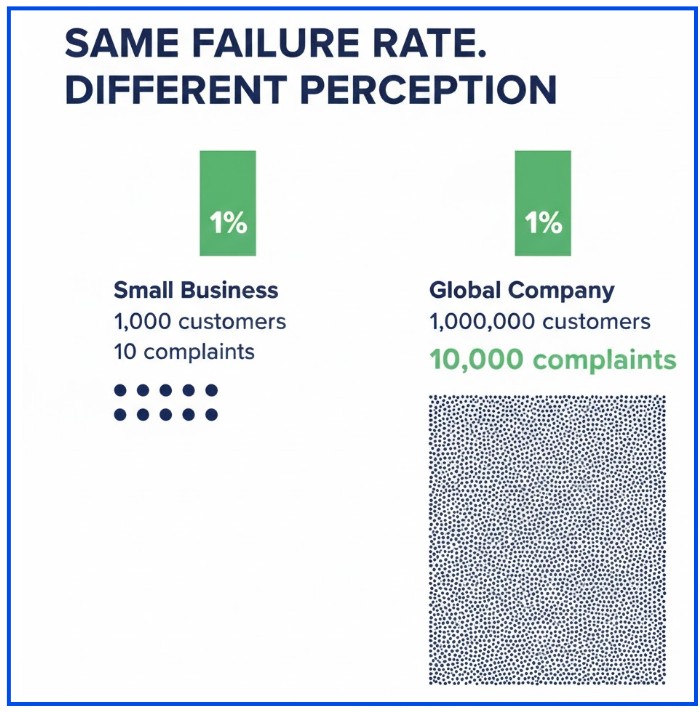
It is important to realize that for these global giants, the problem isn’t just about how people feel, but also about the sheer math of their operations. If you are a small local shop with a thousand customers and you have a bad day, you might end up with ten unhappy people. That is a small enough number to stay under the radar and out of the spotlight. But when a company like Amazon or a major airline handles millions of transactions every single day, the scale of the noise changes completely even if their service is technically better.
Even if a large company manages to get everything right 99% of the time, that 1% failure rate looks very different when you have a million customers. In that scenario, you are generating ten thousand bad experiences every single day. While the percentage of success is technically the same as the small shop, the actual volume of complaints is high enough to fill up dozens of pages on a review site every week. This creates a situation where Trustpilot ends up reflecting the total number of incidents rather than the actual success rate of the business.
It is a mathematical reality that the bigger you get, the more your mistakes will define your public image. We tend to look at a sea of negative comments and assume the company is failing its mission, but usually, we are just seeing the inevitable byproduct of doing business at a massive scale. It is a matter of math rather than morality. A giant company doesn’t have to be “bad” to look terrible on paper; it just has to be big enough that its 1% of failures is louder than everyone else’s success.
What Reviews Actually Measure
We often look at a star rating and assume it works like a grade on a school report card where a four is a “B” and a two is a “D.” We treat these numbers as objective metrics for quality or reliability, but that is not really what is happening behind the scenes. In reality, a Trustpilot score is much closer to an emotional intensity map than a measure of how well a company actually functions. The system is naturally tilted toward the extreme ends of the human experience because nobody feels the need to leave a review when their expectations are simply met.
This creates an environment where these platforms act as public venting spaces rather than balanced feedback tools. The algorithms and the way we browse the internet both tend to reward the most detailed grievances and the loudest outrage narratives. If someone writes a thousand words about how a customer service representative ruined their week, it feels “authentic” and “detailed,” whereas a simple “the shoes fit well” doesn’t provide any entertainment value for the reader. The system effectively pays a premium for strong negative emotions while offering almost no incentive for the millions of people who had an uneventful Tuesday afternoon.
Because of this, we are looking at a record of how many people felt wronged rather than a statistical indicator of overall satisfaction. It is a tracker for frustration visibility. We have to stop thinking of these ratings as a stamp of approval or a sign of failure and start seeing them as a reflection of how many people were angry enough to find their keyboard that day. The stars don’t tell you if a company is good; they only tell you how many people were motivated enough to complain about them in public.
Third-Party Seller Complexity
I have noticed that most people treat a giant like Amazon as if it is a single shop with a single warehouse, but that is rarely the case. In reality, these companies are massive collections of different moving parts including independent sellers, logistics partners, and delivery contractors. When someone leaves a negative review because a third-party seller sent the wrong item or a delivery driver left a package in the rain, all of that frustration ends up being dumped into one single Trustpilot score.
The platform effectively flattens all of this complicated reality into a single 1-star rating. This means that a customer might be furious about a specific product from a seller halfway across the world, but their review looks like a direct hit on the entire company’s reputation. It is almost impossible for a business that acts as a marketplace to maintain a high rating because they are being held responsible for the actions of thousands of people who do not actually work for them.
This creates a situation where the data becomes very messy and difficult to interpret. You are not just looking at how well a company performs its primary job, but instead you are seeing a combined score for every possible thing that could go wrong in a massive supply chain. By the time all of those different failures are added up, the final number tells you very little about the actual quality of the service provided by the brand itself.
The Monetization Tension
I have always found the business model behind these review sites to be one of the most interesting parts of the whole story because it adds a layer of tension that most people do not consider when they are clicking through the stars. We often think of these platforms as public utilities or neutral watchdogs, but at the end of the day, Trustpilot is a for-profit company that has to make money to keep the lights on. They do not just host reviews for the sake of it, but instead they sell a suite of tools and services to the very businesses that are being criticized on their pages.
These products include things like automated review invitation systems, reputation management software, and marketing integrations that allow a company to display their best reviews on their own website. This creates a bit of a strange dynamic where a brand might be paying a monthly fee to the same platform that is hosting thousands of angry complaints about them. While Trustpilot is very clear about the fact that paying for a subscription does not allow a company to delete honest negative reviews, it still creates a perceived conflict of interest that is hard for the average user to ignore.
In an era where we are already skeptical of almost everything we see online, this perception of a conflict matters just as much as the reality of how the site is moderated. Even if the platform is completely fair, the mere fact that money is changing hands between the referee and the players makes some people feel like the game might be a little bit tilted. It adds another layer of complexity to the situation because it forces us to wonder if we are looking at a genuine public forum or a carefully managed corporate storefront where the loudest voices are the only ones left to speak.
The AI and Fake Review Problem
As if the math and the psychology weren’t complicated enough, we now have to deal with the fact that many of the reviews we read might not even be written by humans. I have noticed more and more that some comment sections have started to feel a bit “uncanny,” with hundreds of reviews that use the exact same phrasing or sound like they were generated by the same generic script. We have entered an era where AI can churn out thousands of convincing grievances or glowing praises in a matter of seconds, making it nearly impossible for the average person to tell what is genuine and what is a bot.
To its credit, Trustpilot acknowledges this challenge openly. In its latest transparency report, the company outlines how millions of reviews are flagged and removed each year using a combination of automated detection systems and human moderation.
This isn’t just about companies trying to boost their own scores with fake positive feedback, although that definitely happens. There is also a darker side where competitors or coordinated groups might launch “review bomb” campaigns to intentionally tank a rival’s rating. When you combine this with the sheer volume of real human outrage, the signal-to-noise ratio becomes almost unusable. It creates a level of skepticism where you find yourself questioning not just the company you’re researching, but the entire review system itself.
The result is a total dilution of credibility for everyone involved. If I can’t be sure that the person complaining about a broken toaster actually exists, then the one-star rating loses its power to inform my decision. We are reaching a point where the platforms themselves are struggling to keep up with the tide of automated content, and as a user, it feels like you’re constantly trying to filter through a layer of digital noise just to find a shred of truth. It has turned the act of checking a rating into a detective project rather than a quick way to gauge trust.
So… Is Trustpilot Useless?
I often hear people say that Trustpilot is a waste of time because the numbers are so skewed, but I think that is taking the argument a bit too far. The platform isn’t actually useless; it is just widely misunderstood by the people who use it. We have been trained to look at a star rating as a final verdict on a company’s worth, but we should really be looking at it as a specialized tool for finding specific points of failure. If you go into it expecting a fair and balanced statistical average of every customer’s experience, you are always going to be disappointed by what you find.
Instead of seeing it as a satisfaction score, I have started to view it as a “complaint concentration index.” It is a place where you go to see exactly what happens when things go wrong, and that information can be incredibly valuable if you know how to read it. It doesn’t tell you the probability of a good experience, but it gives you a very clear picture of what the worst-case scenario looks like. Used blindly, these ratings are completely misleading, but used with a bit of context, they can actually tell you a lot about the hidden friction points in a massive organization.
How to Actually Use Trustpilot Intelligently
I have found that the best way to handle Trustpilot is to essentially ignore the big orange or red star rating at the top and go straight for the specific patterns in the comments. Instead of worrying that a company has a low score, I look for a particular problem that keeps appearing over and over again in the last few months. If twenty people are all complaining that a certain airline loses luggage at one specific airport, that is a useful warning, but if the complaints are all over the place and disconnected, it usually just means the company is massive and its failures are random.
Another trick I use is to look at how the company actually responds to the people who are upset. A canned, robotic response that doesn’t address the issue is usually a bad sign, but a company that seems to be genuinely trying to fix the problem in public is often more trustworthy than one that stays silent. I also make it a point to check other platforms like Google Reviews or specialized industry forums because different sites attract different kinds of energy and demographics.
It is also vital to focus only on the most recent reviews because a company that was terrible two years ago might have completely overhauled their customer service or logistics since then. If the last month of reviews looks significantly better than the ones from three years ago, the overall star rating is effectively lying to you about the current state of the business. In the end, a star rating without this kind of context is just a shallow number that doesn’t tell you the whole story.
Even businesses that struggle to generate reviews find ways to do it ethically and transparently. For example, a guide on increasing Trustpilot reviews without breaking platform rules lays out sensible practices, which aligns with best practice recommendations from Trustpilot itself.
Closing Thought: Trust Is Hard to Measure
I have started to think that trust in the modern age is becoming almost impossible to measure with a single number. We live in a time where massive scale, AI-generated noise, and our own emotional internet culture have turned every minor inconvenience into a loud, public event. I have realized that trust isn’t a binary thing where a company is either “good” or “bad,” but is instead something much more probabilistic. I don’t look at a giant company and expect them to never make a mistake; I just look at the odds of them actually helping me when the inevitable happens.
The biggest companies on the planet do not look terrible on Trustpilot because they are failing their customers every hour of every day. They look terrible because outrage scales much faster than satisfaction ever will.
Socioblend delivers some of the highest-quality Trustpilot reviews in the market.
Every review is thoughtfully written to strike the perfect balance between emotion and authenticity, using clear, practical language that feels natural and not exaggerated or overly theatrical. The result is feedback that reads like it came from real customers, not scripted copy.
