


Most online stores share the same frustrating reality: traffic is coming in, but sales aren’t following. Someone lands on a product page, browses for a minute, then disappears – no purchase, no email, nothing. The gap between a visitor and a customer often isn’t about pricing or product quality. It’s about personalization. People don’t know where to start, and a generic homepage doesn’t help.
That’s exactly what an e-commerce lead generation quiz is designed to fix. Instead of giving every visitor the same static experience, a quiz meets them where they are – asking a few targeted questions and guiding them toward the product that actually fits. It’s the closest thing to an in-store sales assistant an online shop can offer.
Why Quizzes Outperform Traditional Lead Magnets
A standard pop-up offering a 10% discount gets ignored. A well-crafted quiz earns attention because it promises something genuinely useful: a personalized answer.
According to Outgrow’s analysis of 50,000+ interactive forms, interactive experiences – including quizzes – achieve an average conversion rate of 47.3%, compared to just 2.8% for traditional static forms. Epsilon research explains why: 80% of consumers are more likely to purchase from a brand that personalizes – a figure that has held up consistently across industry surveys. Quizzes are one of the most direct ways to deliver that without a large tech infrastructure.
McKinsey puts the upside in concrete terms: personalization can lift revenue by 5–15% while improving marketing-spend efficiency by 10–30%. A quiz exploits exactly this mechanism – using what customers voluntarily share to show them something relevant.
There’s also a privacy angle. With third-party cookies increasingly unreliable, zero-party data is becoming the foundation of effective targeting. According to Demand Gen Report’s 2026 B2B Trends Research, 68% of marketing leaders are now increasing investment in interactive content like quizzes and assessments – precisely because they collect declared preference data that’s both valuable and privacy-compliant.
What Makes a Quiz Actually Convert
Not every quiz pulls its weight. The ones that consistently convert share a few common traits:
- A clear value promise – the visitor understands upfront what they’ll get (a product recommendation, a personalized plan, a category match)
- Short, specific questions – usually 5–8; anything longer causes drop-off
- Segmented results – each outcome leads to a tailored recommendation, not a one-size-fits-all page
- An email gate just before the results – this is where opt-in rates peak; the user has invested time and wants to see the outcome
Asking for an email before the quiz starts feels like a toll. Asking just before revealing the results feels like a fair trade.
A Real-World Example: How Plum Deluxe Uses a Tea Finder Quiz
Plum Deluxe, a loose-leaf tea subscription brand, places a “Find Your Perfect Tea” quiz front and center on its homepage. It asks about flavor preferences, caffeine tolerance, and mood – then recommends a specific blend from their catalogue.
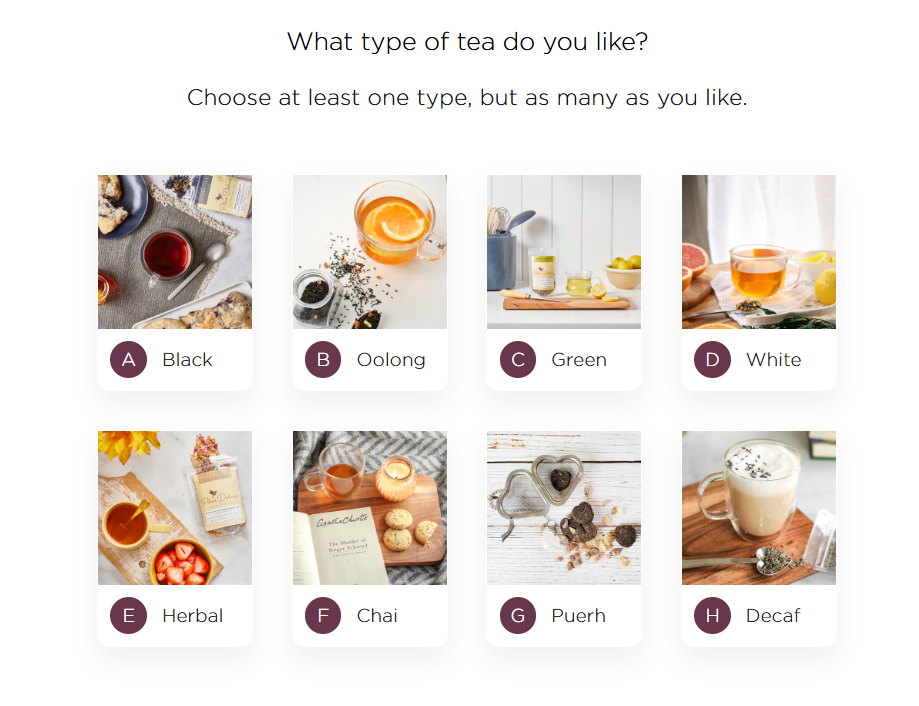
Rather than dropping someone into dozens of options with no guidance, the quiz narrows the choice to something personal. That’s the quiz funnel lead generation model working as intended: guided discovery that builds trust before the purchase, not after. For a subscription business, where retention matters as much as acquisition, that kind of early match-making pays off well beyond the first transaction.
Building a Quiz Funnel That Generates Real Leads
A quiz that entertains but doesn’t capture leads is just a distraction. The goal of a quiz funnel lead generation strategy is to move visitors along a clear path – from engagement, to opt-in, to purchase:
Step 1: Hook With a Specific Promise
“Take our quiz” doesn’t cut it. “Find the right skincare routine for your skin type in 60 seconds” is specific and worth clicking. The intro copy must answer one question: What’s in it for me?
Step 2: Ask Questions That Segment, Not Just Entertain
Every question should keep the visitor engaged and gather data that informs the recommendation. Questions about lifestyle, preferences, or pain points outperform generic personality-style questions with no commercial relevance.
Step 3: Gate With Context
When presenting the email field, remind the visitor what they’re about to receive. “Enter your email to see your personalized match” converts better than a cold, unexplained form.
Step 4: Deliver a Recommendation That Links to a Product
The results page is where the conversion happens. Link directly to the recommended product or collection, and consider a time-sensitive incentive – a small discount or free sample – to push the visitor toward checkout.
Step 5: Follow Up With a Targeted Email Sequence
Quiz leads are warmer than most. Three to five follow-up emails tied to the visitor’s quiz profile significantly outperform generic drip sequences that ignore what the quiz revealed.
Quiz Types That Work Best for E-Commerce
| Quiz Type | Best For | Key Benefit |
| Product Recommendation Quiz | Stores with broad catalogues | Reduces decision fatigue |
| Skin / Hair / Body Type Assessment | Beauty, wellness, personal care | High personalization, strong opt-in |
| Style Preference Quiz | Fashion, home décor | Visual engagement, gift-buying use cases |
| Subscription Match Quiz | Subscription boxes, meal kits, and tea | Long-term customer fit, reduces churn |
| Problem-Identification Quiz | Supplements, tools, software | Educates while qualifying the lead |
For complex or high-consideration products, a problem-identification quiz often outperforms a simple product recommendation quiz – it validates the need before offering the solution, which makes the recommendation feel earned rather than pushed.
How to Build Your Quiz Without Starting From Scratch
Building a functional quiz no longer requires a development team or a big budget. Tools like Visual Quiz Builder let e-commerce brands create branded, conversion-optimized quizzes that integrate directly with their store and email platform – no code required. For brands that want to launch an e-commerce lead generation quiz quickly, a purpose-built tool does the job far faster than building something custom.
A well-built quiz is an asset, not just a campaign – capturing leads, personalizing recommendations, and feeding segmented data back into email and retargeting workflows long after it goes live.
Salesforce’s State of the Connected Customer report makes the stakes clear: 73% of customers now expect better personalization as technology advances, and 65% expect brands to adapt experiences to their changing needs. A static homepage cannot meet that bar. A quiz can.
According to Interact’s 2026 Quiz Conversion Rate Report,the overall conversion rate from quiz start to lead capture has held steady at 40.1%, based on data from over 80 million leads. For brands used to seeing 2–3% on traditional opt-in forms, that number speaks for itself.
Three Things That Kill Quiz Performance
Even a well-designed quiz funnel lead generation strategy can underperform if these mistakes aren’t addressed:
- Too many questions – More than 10 questions causes a significant drop-off before completion. Keep it focused.
- Vague or irrelevant results – If the result page doesn’t reflect the specific answers given, trust evaporates, and visitors won’t act on it.
- No follow-up sequence – Sending a generic welcome email after capturing a quiz lead wastes the segmentation data the quiz just collected.
Where to Embed Your Quiz for Maximum Visibility
Placement matters. The highest-performing spots tend to be:
- Homepage hero section – above the fold, as a primary CTA
- Category or collection pages – for visitors browsing but not yet clicking into a product
- Exit-intent pop-up – shown to visitors about to leave, framed as a helpful nudge rather than a last-ditch discount
- Paid social landing pages – quiz-as-landing-page consistently outperforms static pages for cold traffic from Facebook and Instagram ads
Each placement targets a different intent stage. Homepage quizzes catch early curiosity; exit-intent quizzes recover abandoners; social ad quizzes introduce the brand through personalization rather than a hard sell.
Frequently Asked Questions
Q: What is lead generation for e-commerce, and how does a quiz fit in?
Lead generation is collecting contact information from potential buyers before a purchase. A quiz makes that opt-in feel useful – visitors exchange an email for a personalized recommendation rather than a generic discount, which is a far more compelling trade.
Q: What are the biggest challenges in e-commerce lead generation, and can quizzes help?
High competition, ad fatigue, and poor lead quality are the core problems. Quizzes address all three – they stand out from pop-ups, engage rather than interrupt, and naturally attract higher-intent visitors.
Q: Can an e-commerce business use lead generation to actually increase sales?
Yes – collecting emails is step one, but the real value is what follows. Quiz leads carry declared preference data that makes follow-up relevant, turning first-time buyers into repeat customers.
Q: What’s the best way to use quizzes for lead generation?
Gate the email just before the results page, ask questions tied to real purchase decisions, and follow up with a sequence that references the outcome. Buying-intent questions consistently outperform generic personality formats.
Q: How should e-commerce brands approach lead generation in general?
Layer multiple entry points – quiz funnels for top-of-funnel personalization, exit-intent tools for abandoners, and early-access sign-ups for launches. The common thread: offer genuine value in exchange for contact details, not blanket discounts that train customers to wait.
