

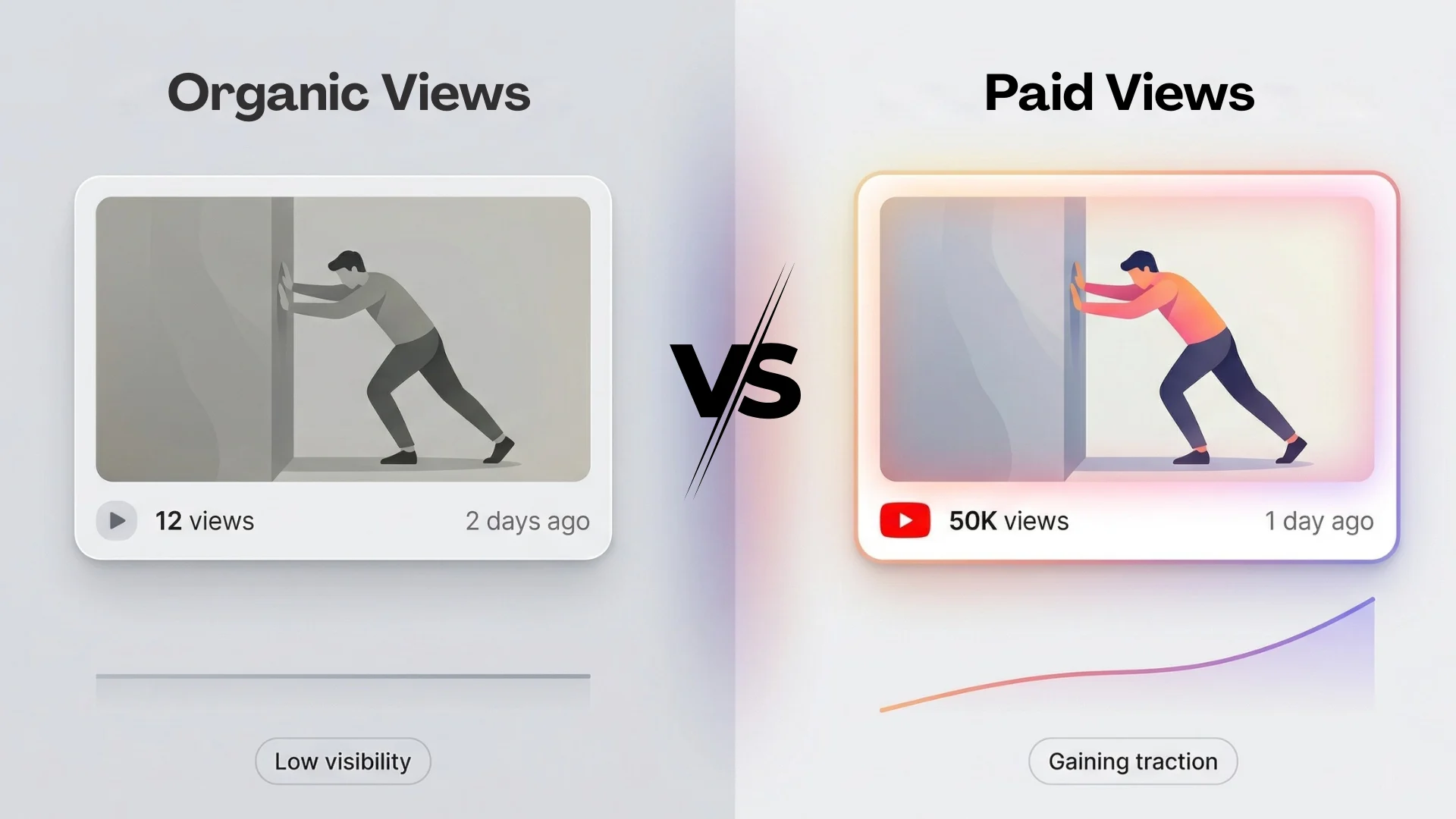
Did you know:
Over 500 hours of video are uploaded to YouTube every minute.
That means every video you publish competes with thousands of others almost instantly.
A large share of views on YouTube comes from recommendations like the home feed and suggested videos, not just search. If your video does not perform well early, it often loses the chance to reach a wider audience.
This is where things start to feel frustrating, and where most creators get stuck.
You’re posting consistently, putting effort into your videos, optimizing titles and thumbnails, and still not seeing results. Growth feels slow, and it is not always clear what is missing. If you are trying to figure out practical ways to improve your reach, this guide on how to get YouTube views fast breaks down both organic and immediate strategies you can apply.
At some point you come across two completely different approaches.
One suggests relying entirely on organic growth and letting the algorithm take its course. The other promotes paid methods as a way to gain visibility faster.
Most advice tends to lean heavily toward one side, without explaining how the platform actually behaves today.
The reality is more balanced than it seems.
Organic growth builds long-term stability, consistent traffic, and a real audience around your content.
Paid promotion plays a supporting role by helping your videos reach people earlier, especially when they might otherwise struggle to get noticed.
Understanding how these two approaches work together is what separates slow, uncertain growth from a more deliberate and controlled strategy.
What Are Organic YouTube Views?
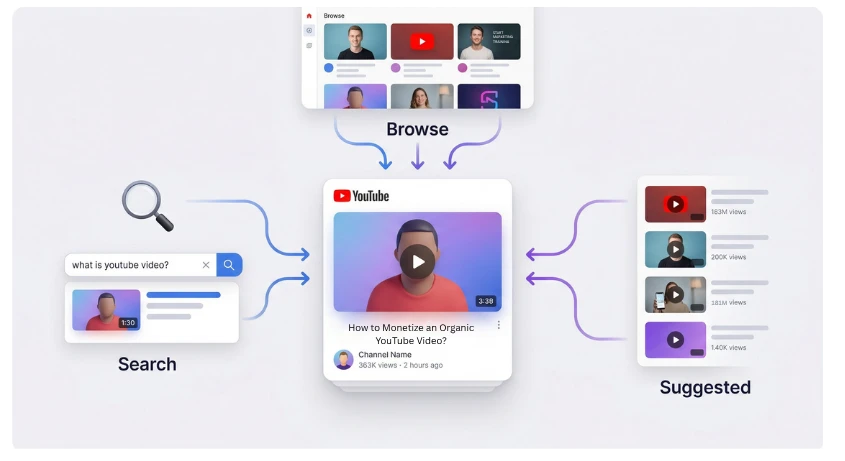
Organic YouTube views are the views your videos receive naturally on the platform, without any paid promotion.
These views typically come from three main sources within the platform:
- Search results when users actively look for specific content
- Suggested videos that appear alongside or after other content
- Browse features such as the home feed and subscription feeds
In simple terms, organic views happen when YouTube decides your content is worth showing to a wider audience.
How YouTube Counts Organic Views
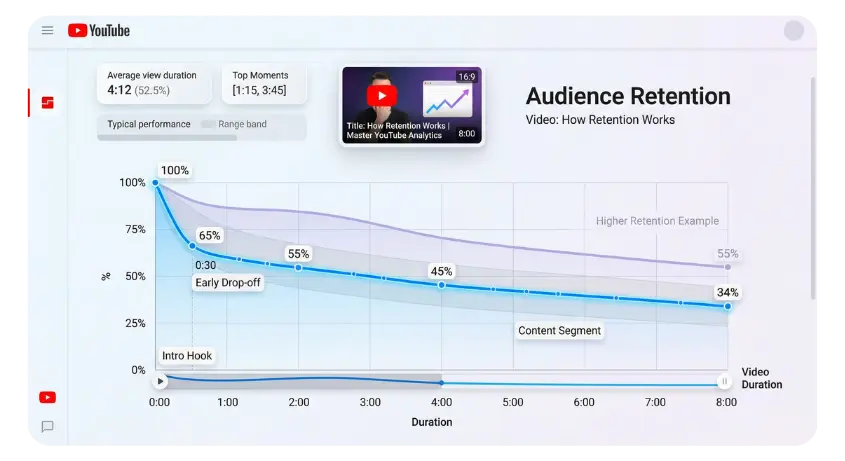
A view is counted when a real user intentionally watches your video and spends enough time on it.
It is not just about getting clicks. The platform evaluates whether that view reflects genuine interest.
This is important because YouTube is designed to prioritize viewer satisfaction, not just raw numbers. If people click but leave quickly, that signal is weaker than someone who watches a large portion of the video.
This is why a higher number of views does not always translate into better performance if viewer behavior is weak.
Key Ranking Factors Behind Organic Growth
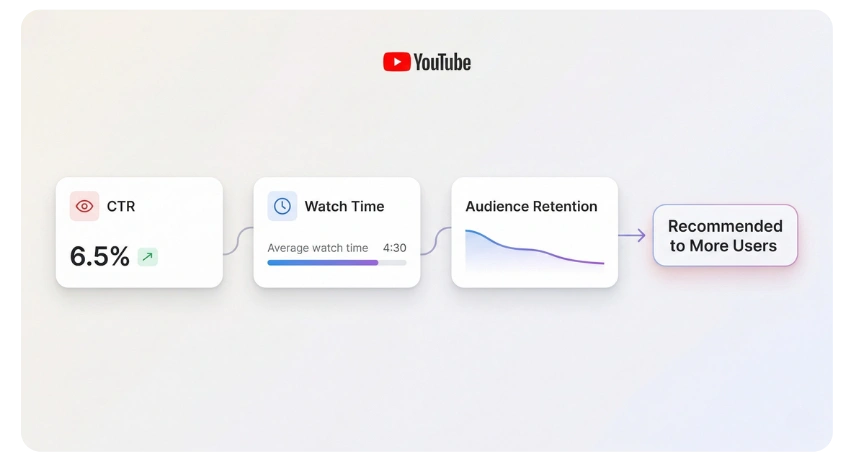
Organic reach is driven by performance signals, not luck. The algorithm evaluates how viewers respond to your content using a few core metrics:
- Click-Through Rate (CTR)
This measures how many people click on your video after seeing the thumbnail and title. A higher CTR indicates strong initial interest. Optimizing these elements properly is essential, and following a structured YouTube SEO checklist can help ensure your videos are set up for better visibility from the start. - Watch Time
This reflects the total amount of time people spend watching your video. Longer watch time signals higher value. - Audience Retention
This shows how much of your video viewers actually watch. Consistent retention tells YouTube that your content holds attention.
Together, these signals determine whether your video gets pushed to a wider audience.
Why Organic Growth Feels Slow
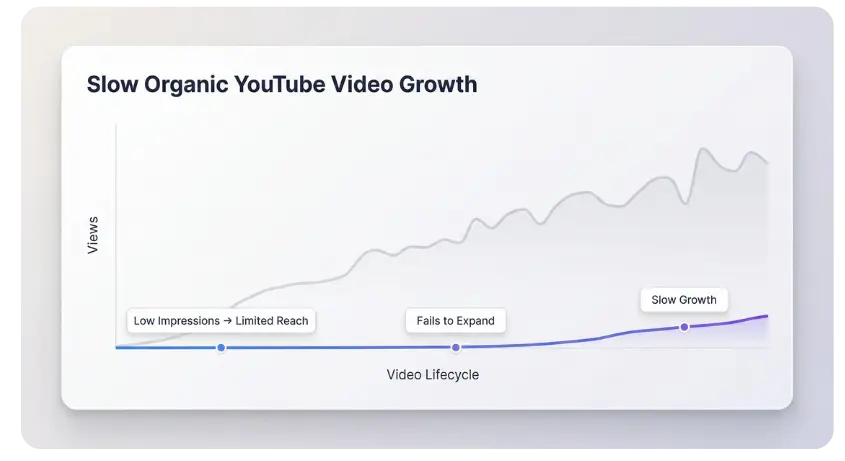
Even with good content, organic growth can take time. There are a few structural reasons behind this.
Limited initial impressions
New videos are first shown to a small group of users. In many cases, a video may receive only a few hundred impressions in the beginning. If the early response is not strong enough, it often stops there, regardless of the effort put into the content. Timing also plays a role in early performance. Publishing when your audience is most active can improve initial engagement, which is why understanding the best time to post on YouTube can make a noticeable difference.
High competition
With hundreds of hours of content being uploaded every minute, standing out is increasingly difficult. Even well-made videos can get overlooked. It is common to see two similar videos where one gains traction early and continues to grow, while the other never moves beyond a few dozen views.
Algorithm testing phase
Every video goes through a testing period where YouTube evaluates performance. If it does not meet certain engagement thresholds early on, its reach may stall.
This is why many creators feel stuck. It is not always about content quality. This is the part nobody explains clearly. Often, it is about not getting enough early visibility to generate the signals needed for growth.
Organic vs Paid YouTube Views (Full Comparison)
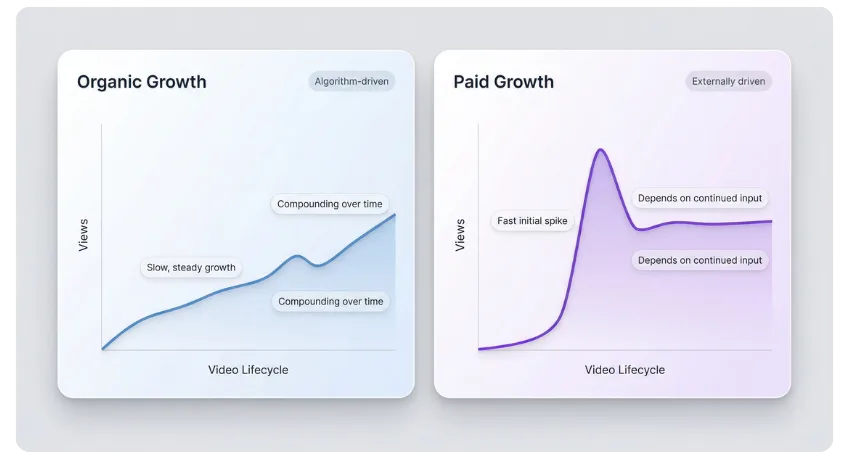
When you put organic and paid YouTube views, side by side, the differences become clearer. They operate on different inputs, produce different types of outcomes, and serve different stages of growth.
Here is a direct comparison to understand how each one works.
Comparison Table
| Factor | Organic Views | Paid Views |
| Speed | Slow and gradual | Immediate visibility |
| Cost | Time, effort, consistency | Financial investment |
| Ranking Impact | Direct influence on algorithm | Indirect influence through signals |
| Sustainability | Long-term and compounding | Depends on continued input |
| Risk | None | Depends on provider quality |
What This Actually Means
Organic growth builds over time. Each video contributes to your channel’s overall authority, and strong performance signals help future videos perform better.
Paid views, on the other hand, are more controlled. You can generate visibility quickly, but the long-term impact depends on how those views translate into engagement.
The key difference lies in how YouTube evaluates performance. Organic signals such as watch time and retention directly influence distribution, while paid exposure mainly increases the chances of generating those signals.
This is why comparing them as substitutes often leads to confusion.
Organic decides if you grow, while paid influences how quickly your content gets the opportunity to grow.
How the YouTube Algorithm Treats Both
To understand the difference between organic and paid views, you need to look at how the system behind YouTube actually evaluates videos.
The algorithm is not designed to reward views alone. It is built to measure how viewers respond after they click.
At its core, the platform prioritizes three things:
- Watch time
How long people stay on your video - Audience retention
How much of the video they watch - Engagement
Likes, comments, shares, and overall interaction
These signals tell YouTube whether your content is worth recommending to more people.
Views alone do not rank videos.
A video with high views but poor retention will often perform worse than a video with fewer views but stronger engagement. For example, a video with 1,000 views and strong retention can outperform a video with 10,000 views where most viewers leave within the first few seconds.
Why Paid Doesn’t Directly Boost Rankings
Paid promotion operates outside the organic recommendation system.
When views come from ads or external promotion, they are not automatically treated as strong ranking signals. This is because they are driven by targeting and budget, not by user intent within the platform.
In simple terms, ads are not the same as organic discovery.
If the viewers coming from paid sources do not watch for long or engage with the content, those views add very little value from an algorithm perspective.
Where Paid Actually Helps
Even though paid views do not directly improve rankings, they can still play a useful role in growth when used correctly.
Initial testing phase
Every video goes through an early stage where it is shown to a limited audience. Paid exposure can help you gather data faster during this phase.
Early traction
Getting initial views can prevent your video from sitting at very low numbers, which often limits further distribution.
CTR influence through social proof
Higher view counts can make a video appear more credible, increasing the chances that new viewers will click. This can improve click-through rate, which is a key ranking factor.
The important distinction is this. Paid views do not replace organic performance signals, but they can create conditions where those signals are more likely to develop.
Why Most Channels Fail With Organic Alone
For many creators, the problem is not a lack of effort. It is the way growth works in the early stages.
Organic reach depends on performance signals, but those signals only exist after people start watching. That creates a difficult situation where your video needs traction to grow, but it cannot get traction without being seen first.
The Slow Start Problem
When you publish a video, YouTube does not immediately push it to a large audience. It starts by showing it to a small group of users and observes how they respond.
If the initial response is average or weak, distribution slows down. Even if the content has potential, it may not reach enough people to prove it. This is why good videos still fail.
This is why growth often feels delayed, even when you are doing things correctly.
The “0–100 Views” Trap
One of the most frustrating phases for new or smaller channels is getting past the first few views.
When a video sits at very low numbers, it tends to get ignored. Fewer impressions lead to fewer clicks, and fewer clicks mean less data for the algorithm to work with.
It becomes a loop that is difficult to break. Many creators experience this phase where multiple uploads fail to cross even a few hundred views, despite improving thumbnails and titles.
You improve your content, optimize your titles, and still see little movement. Over time, this starts to feel like a dead end.
Lack of Initial Data
The algorithm relies on data to decide whether a video should be promoted further. Without enough views, there is not enough information to evaluate performance properly. This is why some videos never reach the stage where the algorithm can properly evaluate their potential.
That gap between publishing and gaining meaningful data is where many channels struggle the most.
It is not always about content quality. In many cases, it is about not getting enough early visibility to generate the signals needed for growth.
The Smart Strategy (Organic + Paid Combined)
Relying on a single approach often leads to slow or inconsistent results. The more effective way to grow on YouTube is to combine both organic and paid methods with a clear sequence.
Instead of treating them as separate paths, it helps to think in terms of how they support different stages of a video’s lifecycle.
A Simple Framework That Works
1. Upload an optimized video
Start with the fundamentals. Strong title, clear thumbnail, and content that holds attention. Without this, neither organic nor paid efforts will deliver meaningful results.
2. Push initial views
Give the video early visibility. This helps avoid the situation where your content sits with very low impressions and never gathers enough data. When a video starts with zero views, it often struggles to gather enough data. Even a small push in the early stage can change how the video is evaluated.
3. Let the algorithm test performance
Once the video starts getting views, the platform begins evaluating how viewers respond. Watch time, retention, and engagement start to shape its reach.
4. Organic growth builds from there
If the performance signals are strong, distribution increases. The video starts appearing in suggested feeds and reaches a wider audience naturally.
Why This Approach Works
Organic growth provides the foundation. It is what sustains your channel over time and builds credibility with the algorithm.
Paid promotion supports that process by helping your content reach people earlier, especially during the stage where visibility is limited.
A useful way to look at it is this.
Organic growth functions like the engine of your channel. It determines how far you can go in the long run. Paid promotion acts as an accelerator that helps you reach that momentum faster, particularly in the early phase where most videos struggle to gain traction.
When both are used with intent, growth becomes more predictable and less dependent on chance.
Are Paid YouTube Views Safe?
This is one of the most common concerns, and it is valid.
The safety of paid views depends less on the idea itself and more on how those views are delivered. There is a clear difference between low-quality manipulation and legitimate promotion methods.
Where the Risk Comes From
Problems usually arise when views are generated artificially rather than through real user behavior.
Fake views
These are inflated numbers that do not reflect actual people watching your content. They often come with little to no watch time, which weakens your video’s performance signals.
Bots
Automated traffic can create sudden spikes in views without engagement. This kind of activity is easy for YouTube to detect and may lead to views being removed or ignored in performance evaluation.
In both cases, the issue is not just safety. It is also effectiveness. These views do not contribute to watch time, retention, or engagement, which means they offer little real value.
When Paid Views Are Considered Safe
Paid promotion becomes far more reliable when it aligns with how real users behave on the platform.
Gradual delivery
Views that increase steadily over time appear natural and give the algorithm space to evaluate performance properly.
Real users
When actual people watch your content, even if they come through paid channels, their behavior generates meaningful signals such as watch time and interaction.
This distinction matters.
Paid views are not inherently unsafe. The risk comes from poor-quality sources that try to simulate growth without real engagement.
When done correctly, paid promotion should support your content, not replace the need for quality.
When You Should Use Paid Views
Paid views are not something you need for every video. They are most effective in specific situations where visibility is the main constraint, not content quality.
Understanding when to use them makes the difference between wasted spend and meaningful growth.
New Channel
When you are starting out on YouTube, your channel has little to no history. That means limited impressions and almost no data for the algorithm to work with.
Paid views can help you get those initial signals so your content has a chance to be evaluated properly.
Launching New Videos
The first phase after publishing is critical. This is when YouTube tests your video with a small audience.
If your video gets early traction, it is more likely to be pushed further. Paid views can help ensure your content does not get stuck with minimal exposure during this stage.
Breaking the Low-View Barrier
Videos that sit at very low view counts often struggle to attract clicks. People are naturally more likely to engage with content that already appears popular. A video with 20 views is far less likely to get clicked than one with 2,000 views, even if the content quality is similar.
A boost in early views can help your video move past that initial barrier and improve its chances of getting organic clicks.
Promoting High-Quality Content
Paid views should never be used to compensate for weak content. They work best when your video already has strong fundamentals such as a good hook, solid retention, and clear value.
In this case, promotion helps more people discover content that is already worth watching, increasing the likelihood of positive engagement signals.
Used in the right situations, paid views act as a support tool. They help your content reach the stage where it can perform, rather than trying to force results on content that is not ready.
Organic vs Paid: Which Should You Choose?
Framing this as a choice between one or the other often leads to the wrong decision.
Organic and paid approaches solve different problems within the same growth process. Organic growth is what builds your channel over time. It strengthens your content performance, improves your reach, and creates a consistent flow of viewers.
Paid promotion serves a different purpose. It helps you gain traction earlier, especially when your videos are not getting enough visibility to generate meaningful data.
When you rely only on organic growth, progress can be slow and unpredictable in the early stages. When you rely only on paid views, results may not sustain without strong content performance.
A more practical approach is to use both with intent. Focus on building content that performs well organically, and use paid promotion to support visibility where it is lacking.
Want Faster Results Without Waiting Months?
If your content is already optimized and you are still struggling to get initial traction, the issue is often visibility rather than quality.
If your videos are getting some engagement but not enough reach, the issue is often visibility rather than content quality. In that situation, using a reliable service to buy YouTube views can help your videos reach a wider audience during the critical early phase.
The key is to focus on quality over volume. Real viewers, gradual delivery, and consistent engagement signals matter far more than inflated numbers.
If you are looking for a structured way to accelerate growth, you can explore options to get real YouTube views that align with how the platform evaluates performance.
Final Verdict
Organic growth is what builds a channel that lasts. It creates stability, improves content performance, and compounds over time.
Paid promotion supports that process by helping your content get noticed sooner, especially when early visibility is limited.
When used together with a clear strategy, they create a more balanced and effective path to growth than relying on either one alone.
