

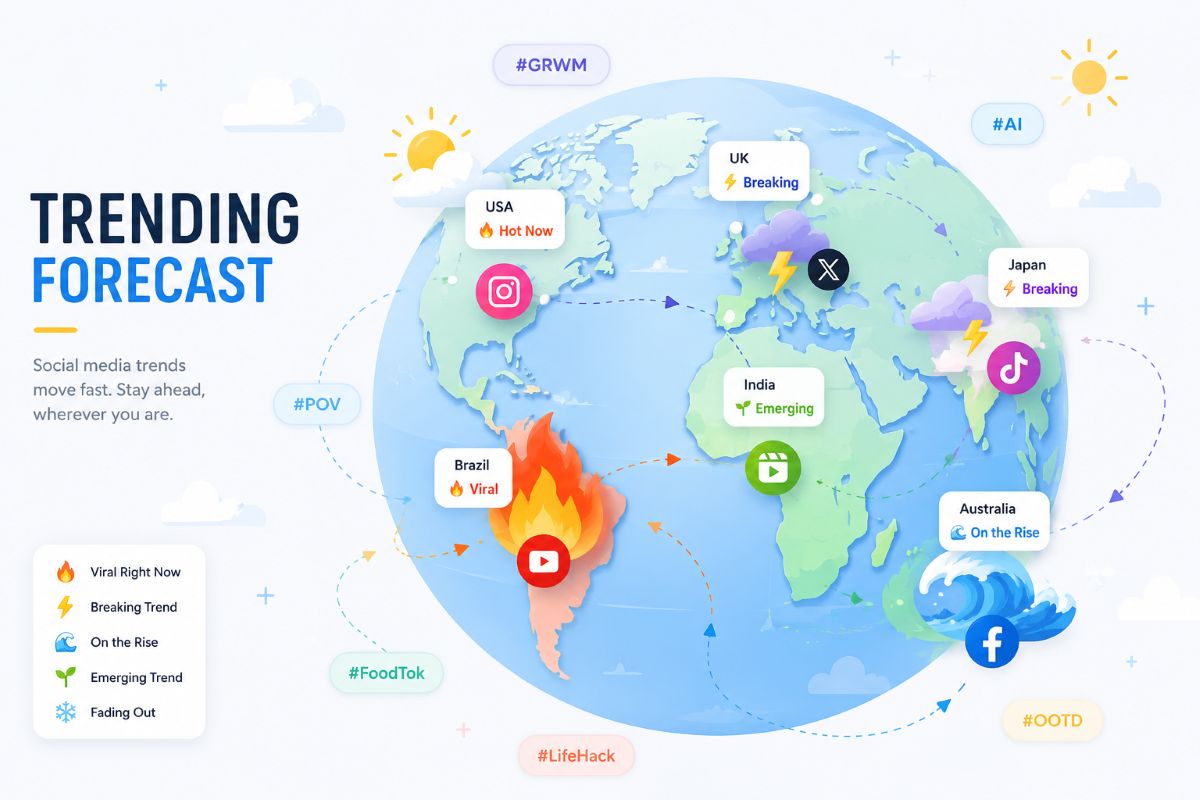
Every SMM specialist has one thing they think about day and night. It’s not the publication schedule or the problem of creating an image. It’s precisely the search for successful social media trends in different regions. It’s these small newsbreaks that catch on and make your account popular.
However, there’s an important point: social media trends that peaked in São Paulo may not yet reach Sydney. If you miss the time and relevance, it is likely to be late to the wildest party. Ultimately, the time spent on a publication will be useless.
Therefore, monitoring social media trends in different regions is now more relevant than ever. And yet, SMM managers and renowned content creators remain on top of things. We’ll explore how they do this in this article.
Also read: How to See Who Shared Your Instagram Post – A Beginner’s Guide
Why Regional Tendencies are Harder to Track Than It Seems
A single global dashboard sounds efficient in theory. In practice, it flattens everything into one blended average that doesn’t reflect what happens anywhere in particular. A popular hashtag in the UK carries completely different cultural weight in the Philippines. Slang shifts, meme formats age at different speeds, and even platform preference varies wildly. TikTok might dominate one market while X or a local app runs the conversation somewhere else.
This is where social media analytics tools earn their keep, but only if they’re set up with region-specific filters from day one. Managers who skip this step end up chasing social media trends that already peaked three days ago. So, they lose markets that actually matter to them.
Workflow for Multi-Region Monitoring and How to Build It
Most experienced managers don’t rely on one tool. Specialists who build a workflow for different geo try a few of them. Managers stack digital marketing tools and do their job from the following list.
Native Platform Insights, Checked Daily
Instagram, TikTok, and X all surface regional popular topics if you know where to look. And, critically, if your account is set to browse from the right location. This is where a lot of teams get stuck. Platforms serve content based on the IP location of whoever’s checking. It means a manager in one country may get a distorted view of what’s actually popular in another.
Location-based Browsing for Accurate Research
To see social media trends the way a local audience sees them, some teams route online research through location-specific connections. They don’t rely on VPN-style shortcuts that platforms increasingly flag. In this case such tools as best proxies on Proxy-Seller lets researchers pull region-accurate search without triggering the geo-mismatch warnings. It’s a small operational detail. However, it’s the kind of thing that separates trend research that’s actually reliable from research that just looks plausible.
Dedicated Trend-monitoring Platforms
Tools built specifically for monitoring aggregate signals across platforms and regions simultaneously. They’re not perfect, nothing catches everything. However, they cut down the manual scrolling considerably.
Manual Spot-checks, Still
Automation misses nuance. A tool might flag a hashtag as “promising one” without telling you it’s tied to a controversy your brand shouldn’t touch. Human eyes still matter here, especially for anything culturally sensitive.
Regional Strategy Built with Raw Tendency Data
Step one is to spot hype things. However, the harder part is to decide whether it’s worth it to act. That’s where audience insights and local context come in.
A few questions experienced managers ask before they jump on anything:
- Does this tendency fit our brand voice, or are we forcing it?
- Is it already declining in its origin market?
- What’s the local sentiment, is it playful, political, or polarizing?
- Do we have the creative resources to move fast enough to matter?
This is also where regional marketing decisions get made. A popular meme that works for a US audience might need a completely different execution before it lands anywhere else.
Find Out What Actually Works with Engagement Metrics
It’s easy to get excited about a viral dance and forget to check whether jumping on it actually moved the needle. Smart teams treat every exciting post as a small experiment. They watch engagement metrics closely for the first 24-48 hours: saves, shares, comment sentiment, not just likes. Vanity numbers can mask a post that’s technically viral but doing nothing for brand perception.
Over time, this data feeds back into content strategy. Patterns emerge about which trend categories a given region responds to. Also, which ones consistently flop no matter how well-executed the content is.
Influencer Signals Based on Hashtag Research
Hashtag research remains one of the most underrated parts of regional social media trends. Regional hashtags often surface a meme or hype phrase days before it hits a global platform’s rating. Pairing that with influencer marketing monitoring. Watch which creators in a given region gain traction and what they post about. It gives a fuller picture than either signal alone.
Some teams also lean on brand monitoring software to catch mentions that hint at an emerging conversation before it’s officially popular anywhere.
Points Where Local SEO and Social Tendencies Intersect
There’s an overlap between social trend-spotting and local SEO work. What people search for and what they post about tend to move together. Especially around events, product launches, or seasonal moments. Teams that treat these as separate functions often miss opportunities that a combined view would catch immediately.
Learn a broader look at how businesses approach this kind of market intelligence and stay ahead across digital channels. This piece on digital tools for staying ahead of trends is worth a read. It covers a wide range of tools that go beyond just social platforms.
People Preferences Determine the Entire Process
Underneath all the tools and dashboards, the goal is simple. You should understand audience behavior well enough to know what a specific regional audience actually cares about. Not what’s assumed to be universal. Consumer insights gathered from one market rarely transfer cleanly to another. It is exactly why the “one global strategy” approach fails brands that try it.
Never Stop: Make Campaign Optimization Regularly
Trend monitoring isn’t a task you finish. It’s a loop. Spot a signal, test it regionally, measure the response, adjust, repeat. Campaign optimization built on this cycle tends to outperform static, pre-planned content calendars by a wide margin. It’s simply because it can react to what actually happens instead of what was predicted three weeks ago.
Conclusions Each SMM Specialist Should Do
Viewing social media marketing solely in a global sense is a dead end. Successful managers, bloggers, and content creators succeed only because they clearly understand their regional audiences and target them specifically.
Therefore, global marketing is good, but each region needs to be viewed as a separate ecosystem. Even topics for discussion can be different. Some tools can be very helpful. However, only you can decide when to respond to viral memes and when to ignore it. Keep an eye on social media trends and react to them promptly!
