

I still remember the first time I tried setting up a free Minecraft server for my friends.
It sounded simple enough. Search for a free hosting provider, create a server, copy the IP address, and start building.
That fantasy lasted about thirty minutes.
The server refused to stay online, one friend could not connect, another complained about lag, and when we finally managed to get everybody inside the world, the server shut itself down because nobody had moved for a while. At that point, I realized something most “best free Minecraft hosting” articles do not tell you upfront.
Free Minecraft hosting can absolutely work, but not all free hosting is actually usable.
Some providers bury you in startup queues. Some advertise 24/7 hosting but quietly put your server to sleep. Others struggle the moment you install mods, invite more than a handful of players, or try to run a larger world.
So instead of simply listing providers based on marketing promises, I spent time comparing popular free Minecraft server hosts to see which ones genuinely work, what problems they solve, and where they start falling apart.
Before getting into the hosting options themselves, it helps to understand the problems most players run into. Because once you know what usually goes wrong, choosing the right server becomes much easier.
Table of Contents
The Problems I Kept Running Into With Free Minecraft Hosting
The 24/7 Server That Was Never Actually Online
This was the problem that annoyed me the most.
When most people search for free Minecraft server hosting, what they really mean is: I want a server that my friends can join whenever they want, without needing me to babysit it.
That sounds reasonable.
Unfortunately, many free hosts handle things differently.
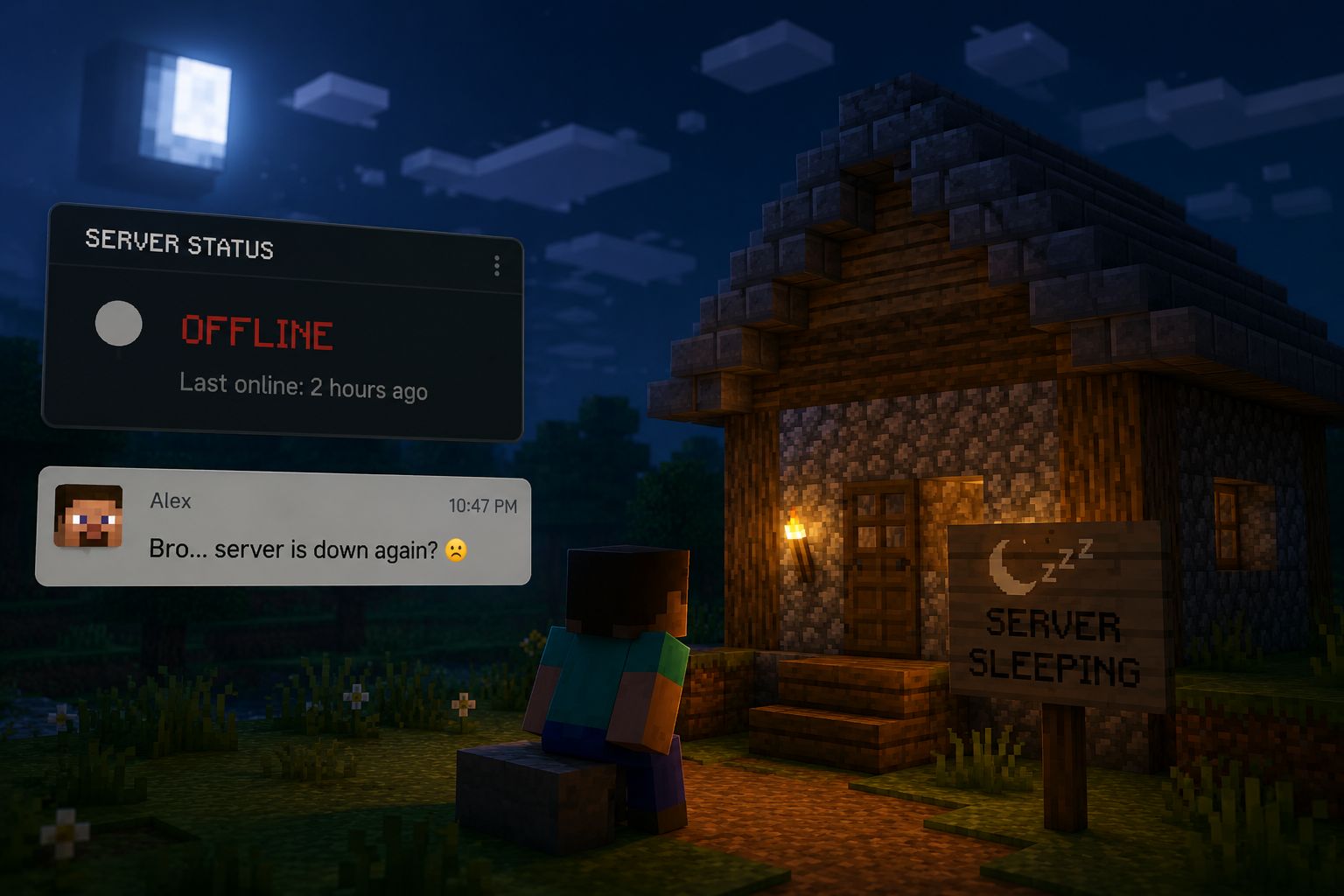
I would share the server IP with friends, assume everything was working, and then get messages hours later saying, “The server is offline again.”
What actually happened was simple. The host had automatically paused or slept the server after inactivity.
From the provider’s perspective, this makes sense. Free hosting costs money to run, so servers that are not actively being used often get suspended to save resources. From a player’s perspective, though, it defeats the whole point of having a multiplayer server.
If your group plays casually, this becomes frustrating very quickly. Somebody has to manually restart the server, wait for it to boot, and only then can everyone join.
That is why free Minecraft server hosting 24/7 is such a heavily searched term. Players are not looking for luxury features. They just want a server that behaves like a server.
Startup Queues Can Kill The Mood Faster Than Lag
I did not expect this one to bother me as much as it did.
You gather your friends. Everyone is ready. Somebody wants to continue building the castle from yesterday.
You log into the hosting dashboard.
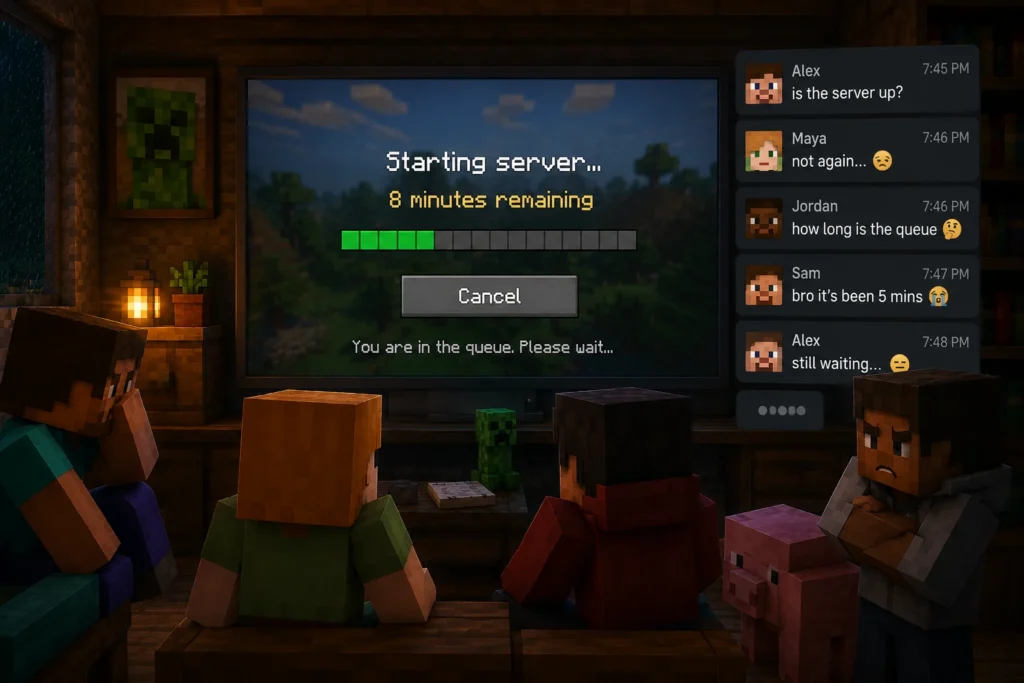
Then you see a queue.
Maybe it is two minutes. Maybe it is ten.
Either way, the excitement disappears fast.
Some free hosting providers place servers into startup queues because thousands of users share the same infrastructure. When demand spikes, your server simply waits its turn.
This might sound like a small inconvenience on paper, but in real use, it changes the experience completely.
Minecraft works best when multiplayer sessions happen naturally. Somebody gets online, sends a message, and everyone jumps into the world. Long waiting times interrupt that rhythm.
After dealing with enough startup delays, I realized something important: speed matters more than most comparison tables acknowledge.
A server that launches quickly often feels more reliable, even if its specs are not technically superior.
Mods Sound Fun Until Your Server Starts Breaking
Vanilla Minecraft is relatively forgiving.
The moment you step into mods, everything changes.
I learned this the hard way after deciding our server needed “just a few improvements.”
Maybe a minimap. Maybe some performance tweaks. Maybe a content mod or two.
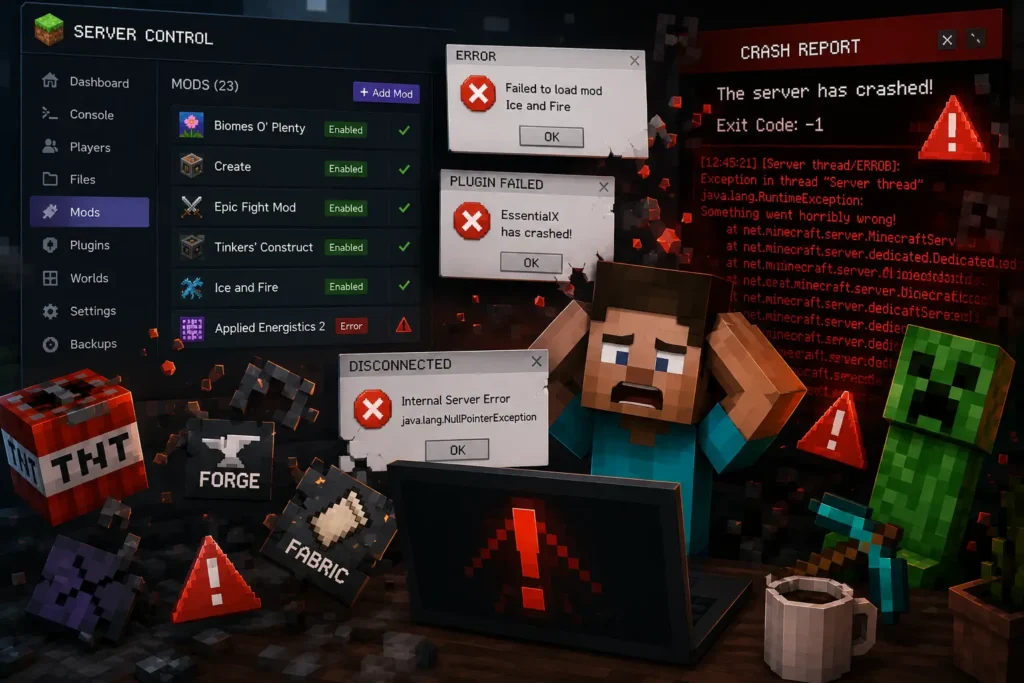
That innocent plan quickly turned into crashes, version conflicts, missing dependencies, and error messages that looked like they belonged inside a programming textbook.
Free hosts vary massively when it comes to mod support.
Some make installing Forge, Fabric, Paper, or plugins surprisingly easy. Others technically support mods but struggle once you push beyond lightweight setups.
For beginners, this can be confusing because hosting pages often advertise “mod support” without explaining what that actually means.
Supporting a small plugin is one thing. Running a heavy modpack with multiple active players is an entirely different challenge.
If you plan to play modded Minecraft, this should be one of your first filtering criteria, not an afterthought.
Lag Does Not Always Mean Your Internet Is Bad
For a long time, I blamed my internet connection.
That turned out to be wrong.
The lag came from the server itself.
Blocks would break late. Chunks loaded slowly. Players snapped backward after moving forward. Combat felt inconsistent. The world technically worked, but everything felt slightly delayed and unpleasant.
This is where free hosting limitations become very visible.
Many providers operate on shared resources. That means CPU power, memory, and hardware performance are distributed across large numbers of users.
When the system becomes overloaded, your gameplay experience reflects it.
Beginners often focus heavily on RAM because hosting plans love advertising memory numbers. RAM matters, yes, but server performance is more complicated than simply chasing bigger numbers.
Processor performance, server load, software configuration, player count, and world complexity all influence how smooth your gameplay feels.
A lightweight survival world with three friends might run perfectly on a free plan.
A heavily explored modded world with automated farms and plugins is a very different story.
Learning this changed how I evaluated free hosts. I stopped asking, “How much RAM do they give?” and started asking, “Can this thing stay smooth during actual gameplay?”
What I Looked For While Testing Free Minecraft Hosts
After enough failed setups, confusing dashboards, and servers that behaved beautifully for one day and terribly the next, I decided to evaluate providers using criteria that actually matter in real use.
Not marketing checklists.
Not flashy homepage promises.
Real-world usability.
Here is what I focused on:
- How easy the setup process feels for beginners
- Whether the server stays available without constant manual restarts
- Startup speed and queue experience
- Mod and plugin compatibility
- Gameplay performance under normal multiplayer use
- Ease of management and dashboard usability
- Hidden limitations, restrictions, or upgrade pressure
Because at the end of the day, the best free Minecraft server hosting is not necessarily the one offering the biggest numbers.
It is the one that lets you spend more time playing Minecraft and less time troubleshooting Minecraft.
Best Free Minecraft Server Hosting Options That Actually Worked
After testing popular providers, a few names consistently stood out, but for very different reasons.
Some were excellent for beginners.
Some handled mods better than expected.
Some came surprisingly close to true 24/7 hosting.
And some looked impressive until you started using them.
Let’s start with one of the biggest names in free Minecraft hosting.
1. Aternos: Still One Of The Easiest Places To Start
If you have spent even five minutes researching free Minecraft hosting, you have probably encountered Aternos.
There is a reason for that.
For beginners, it is one of the easiest entry points into Minecraft server hosting.
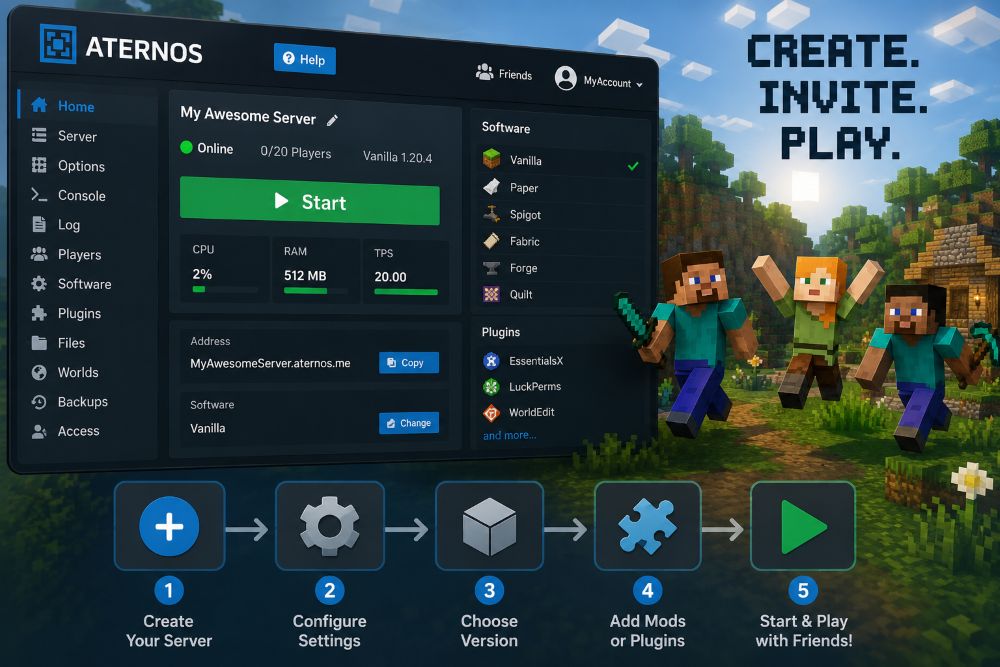
My first impression was surprisingly positive. The setup process did not feel intimidating, the interface was approachable, and getting a server running required far less technical knowledge than manually configuring your own environment.
If your goal is simply to create a world, invite a few friends, and start playing without touching complicated settings, Aternos makes a strong case for itself.
What I appreciated most was the accessibility.
You do not need to be somebody who understands Linux servers, Java arguments, or networking terminology. You create the server, configure the basics, choose your version, and you are largely ready to go.
Mod and plugin support is also better than many people expect. Whether you want Paper, Spigot, Forge, Fabric, or common plugin setups, the platform gives beginners room to experiment.
But this is also where reality begins to show.
Aternos is free because it serves an enormous user base.
That means queues happen.
That means startup delays can happen.
And yes, the “always online” dream becomes more complicated in practice.
For casual groups, these limitations might be acceptable. For players expecting a permanently available private world, frustration can build quickly.
Who do I think should use Aternos?
Beginners.
Small friend groups.
People who value simplicity over raw control.
If your expectations are realistic, it remains one of the strongest free starting points available.
2. Minehut: Fast Setup With A More Social Feel
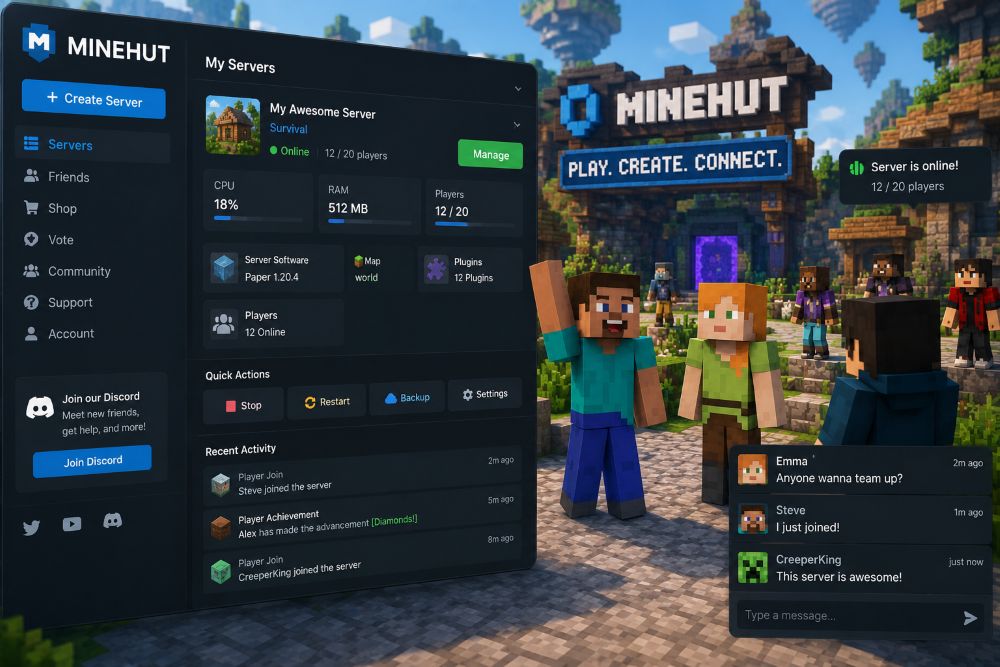
Minehut felt slightly different from traditional hosting platforms.
Instead of feeling like a server control panel first, it feels more connected to a broader Minecraft community ecosystem.
Getting started was straightforward, and I understood fairly quickly why so many newer players gravitate toward it.
The barrier to entry is low.
You can spin up a server quickly, manage basic settings without drowning in technical menus, and start experimenting without investing money upfront.
For players who mainly want convenience, that matters.
I also found the environment friendlier for people who are still figuring out how Minecraft hosting works.
That said, convenience and limitations tend to travel together in the free hosting world.
As my testing became more demanding, some familiar issues started appearing.
Resource limitations become easier to notice as worlds grow larger. Expectations around uninterrupted uptime need to stay grounded. And depending on how you play, performance consistency can become more important than setup speed.
That does not automatically make Minehut a poor choice.
Far from it.
It simply means you should match the platform to your use case.
If you want a lightweight multiplayer experience without diving deep into server administration, Minehut can feel approachable and enjoyable.
If you are chasing advanced modded gameplay, larger persistent communities, or maximum control, you may eventually want something stronger.
3. FalixNodes: Surprisingly Interesting For Modded Players
FalixNodes caught my attention because it sits in an interesting middle ground.
It tries to offer more flexibility than ultra-basic beginner platforms without immediately pushing users toward paid plans.
For players interested in mods and customization, that matters.
I approached this one cautiously because “free hosting with strong feature support” usually comes with fine print somewhere.
But the experience was better than I expected.
The platform gives users more room to experiment, which becomes valuable once you move beyond plain vanilla Minecraft.
If you enjoy tweaking server setups, exploring plugin combinations, or building slightly more customized environments, that extra flexibility is noticeable.
However, free hosting physics still apply.
You cannot completely escape resource ceilings.
Heavier worlds, demanding modpacks, or growing player counts will eventually expose limitations.
The difference is that FalixNodes feels more willing to let users push boundaries before those limits become painfully obvious.
For me, it felt like a reasonable option for players who have already outgrown extremely basic setups but are not yet ready to pay for premium hosting.
4. Oracle Cloud Free Tier: The Unexpected Power User Option
This was the option that genuinely surprised me.
And honestly, it is also the option I would not casually recommend to complete beginners.
Oracle Cloud is not traditional Minecraft hosting.
You are not clicking a giant “Create Server” button and jumping straight into gameplay.
You are stepping into cloud infrastructure territory.
That sounds intimidating because, well, it is a little intimidating at first.
My setup process involved more reading, more configuration, and more moments of questioning whether I had made a terrible life decision.
But once things started working, I understood why technically inclined players keep bringing this option up.
The biggest difference is control.
Real control.
Not “free hosting dashboard control.”
Actual server-level control.
That changes what becomes possible.
If your main frustration with free hosting has been inactivity shutdowns, resource restrictions, or lack of customization, Oracle Cloud approaches the problem from a very different angle.
There is a learning curve, absolutely.
You will likely spend more time setting things up compared to beginner-friendly platforms.
But for users willing to invest effort, the payoff can be surprisingly compelling.
I would frame it like this.
Aternos and Minehut feel like borrowing a managed playground.
Oracle Cloud feels closer to building your own playground.
More work.
More responsibility.
But also significantly more freedom.
So Which Free Minecraft Host Actually Worked Best?
After testing multiple providers, I stopped looking for a perfect answer.
Because the truth is, there is no universally perfect free Minecraft host.
The right choice depends heavily on how you play.
If you are completely new to server hosting and just want something approachable, Aternos remains one of the easiest places to begin.
If convenience and quick setup matter more than deep customization, Minehut makes sense.
If you want more experimentation room, especially around customization and mods, FalixNodes deserves serious consideration.
And if your biggest goal is escaping traditional free hosting limitations altogether, Oracle Cloud Free Tier becomes surprisingly compelling — assuming you are comfortable with a steeper learning curve.
The biggest lesson I learned through all of this was not which provider won.
It was that choosing free Minecraft hosting becomes much easier once you stop asking:
“Which server host is best?”…and start asking:
“Which problems am I trying to avoid?”
Because that answer changes everything.
If you hate startup queues, your choice changes.
If you care about mods, your choice changes.
If true 24/7 availability matters more than beginner simplicity, your choice changes again.
Free Minecraft hosting can absolutely work in 2026.
You just need to walk into it with realistic expectations.
I learned that after enough offline servers, enough broken mod experiments, enough unexplained lag spikes, and more troubleshooting tabs than I care to admit.
Hopefully, you do not have to learn it the same way.
