

Ten years ago, most apps were tested on stable office Wi-Fi and then shipped. That worked back when networks behaved roughly the same everywhere. They don’t anymore.
The shift from 3G to 5G did more than speed up downloads. It splintered the conditions an app has to survive, and testing teams have been scrambling to keep pace.
Carrier, region, signal strength, tower handoffs: each of these now decides whether software actually works for a real person holding a real phone.
The Lab Stopped Matching the Street
For years, the standard setup was a shelf of devices on fast office Wi-Fi. Cheap, repeatable, and mostly fine. But it stopped reflecting how people connect in the wild.
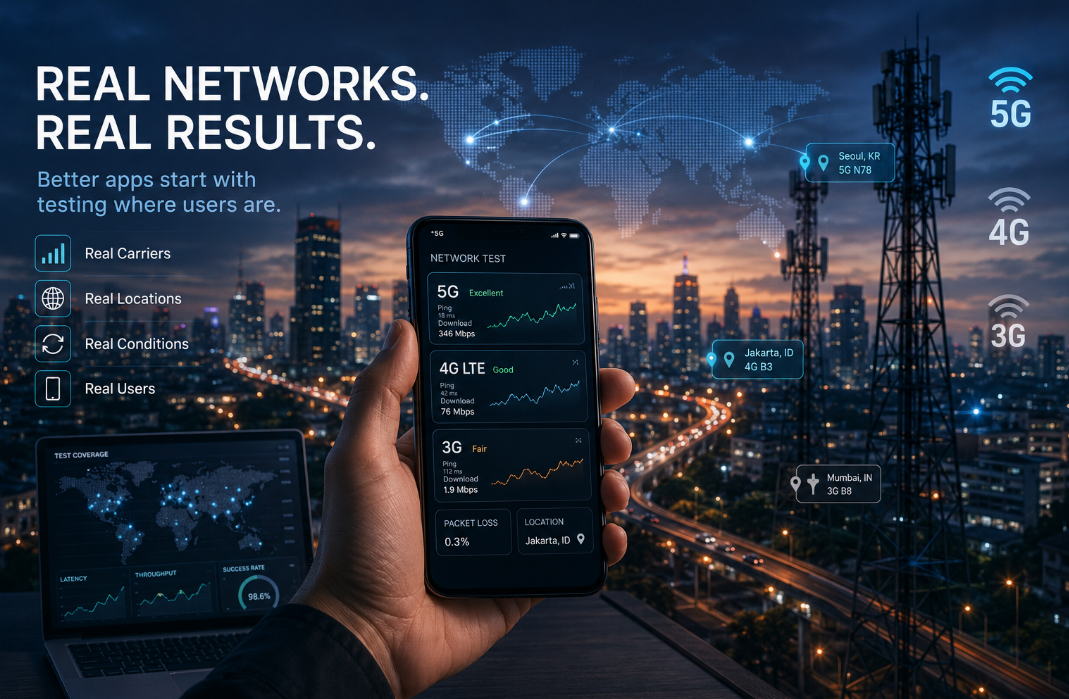
A user in Jakarta on a crowded 4G band has a completely different experience from someone in Seoul on a clean 5G signal. Carriers throttle and prioritize traffic in their own ways, and they pass devices between towers at different moments. An app that breezes through lab checks can stutter, drop sessions, or freeze on a network it never met.
Emulators and throttled Wi-Fi can fake a slow pipe, but they can’t reproduce a tower switch during a payment or packet loss on a congested band. Those gaps are where apps fail in front of paying customers. And the team usually finds out from a review, not a dashboard.
To test under conditions that match production, teams increasingly push traffic through real cellular connections. Some use providers offering unlimited mobile proxies, which route requests through carrier-assigned devices so an app behaves the way it would for someone on an actual phone plan.
5G Multiplied the Variables
5G was supposed to make developers’ lives simpler. In practice it added layers.
The standard introduced network slicing, where a carrier can split one physical network into virtual lanes, each with its own speed and latency guarantees. An app might land in a fast low-latency slice in one city and a best-effort slice in the next. Testing one slice tells you nothing about the others.
Then there’s the spread of spectrum. The 5G standard spans low, mid, and high-frequency bands, each with different range and behavior, and phones constantly drop back to 4G where coverage thins out. The testing matrix exploded well past what any fixed device lab can cover on its own.
When Testing Skips the Network, Users Pay
Skip real-network testing and the bugs don’t disappear, they just move downstream to users. A checkout flow that works on Wi-Fi can time out when a 5G signal hands off to 4G mid-transaction, and the customer sees a spinning wheel instead of a confirmation.
Streaming apps buffer endlessly on bands the team never tried. Maps reload from scratch every time a commuter passes through a dead zone.
These aren’t rare corner cases. They’re the daily reality for anyone using an app on the move, and they rarely surface in a quiet office. By the time the one-star reviews land, the fix costs far more than catching it earlier would have.
Testing Has To Live Where Users Do
Modern apps are expected to read the connection and adapt, dialing image quality down on a weak signal or holding big downloads until a stronger link shows up. Google’s Android documentation even spells out the logic with a plain example: a news reader might pull 3 articles at a time on 2G but 20 on Wi-Fi. Behavior like that has to be tested against real network states, not assumed.
Validating an app from one location tells you almost nothing about how it runs three time zones away on a different carrier. So geographic and carrier-level coverage now counts for as much as raw device count. A test that only ever runs from one well-connected city is testing a version of the world most users don’t live in.
The teams getting this right treat the network as a variable to test, not a constant to ignore.
Mobile networks will keep splintering. 5G-Advanced is already rolling out, direct satellite-to-phone messaging is reaching consumer handsets, and 6G research has started in labs around the world. Every step adds fresh conditions that software will be expected to handle without complaint.
Teams that bake network variability into testing today will ship apps that hold steady wherever they land. The ones still signing off on quality from a desk on office Wi-Fi are going to keep getting blindsided by bug reports from places they never thought to check.
