

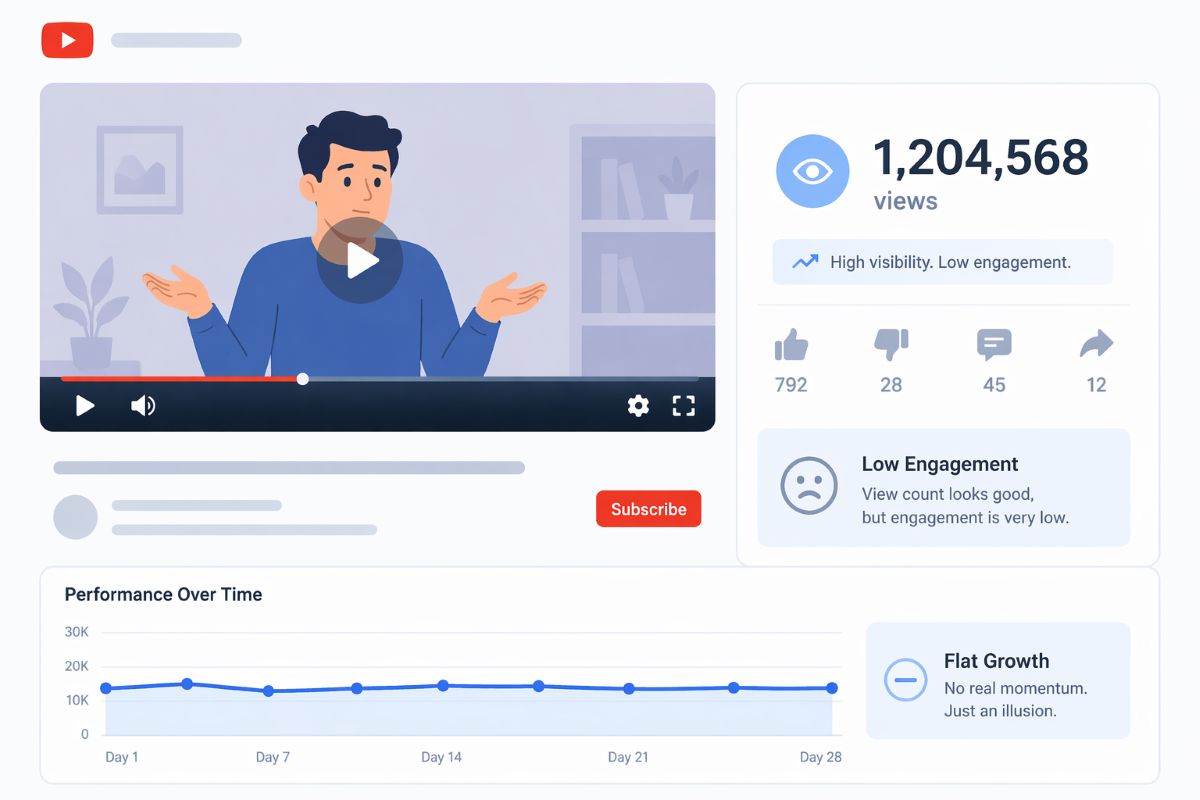
The question is no longer just about whether buying YouTube views works. It is about what kind of growth you are actually creating, and whether that growth holds up once the platform begins to evaluate your content beyond surface-level metrics.
On the surface, view counts still look like a signal of success. A video with 100,000 views appears more credible than one with 112 views. That psychological effect has not changed. What has changed is how YouTube interprets those numbers internally, and how quickly it separates signals that represent real audience interest from signals that are artificially inflated.
If you are trying to understand what actually drives early traction today, this breakdown on how to get YouTube views fast explains the mechanics behind initial momentum in a much more practical way:
So the real question is not “Is buying YouTube views worth it?” but rather “What kind of views are you buying, and how do they interact with YouTube’s recommendation system?”
Understanding that distinction is what determines whether this strategy becomes a growth lever or a silent liability.
The Shift From View Count to Behavioral Signals
A few years ago, view count carried more weight than it does today. It was a simpler metric that could influence perception and, to some extent, distribution. That era has largely passed.
In 2026, YouTube’s recommendation system is built around behavioral consistency. It does not just ask whether someone clicked on your video. It evaluates what happened after the click.
Did the viewer stay?
Did they watch a significant portion of the video?
Did they interact, subscribe, or continue watching related content?
Every video is constantly being tested against small audience segments.
If you have never structured your videos around these signals before, this YouTube SEO checklist for beginners gives a clear framework for aligning your content with how the platform evaluates performance.
If those viewers respond positively, the video expands to larger groups. If they do not, distribution slows down regardless of how many views the video technically has.
This is where the gap between “views” and “effective views” becomes critical.
A view that results in 10 seconds of watch time behaves very differently from a view that results in 4 minutes of watch time. Multiply that difference across thousands of impressions, and you start to see how the system identifies whether your content deserves further reach.
Buying views without understanding this mechanism often leads to a mismatch between appearance and performance. The numbers go up, but the video does not move.
Not All Purchased Views Are the Same

The conversation around buying YouTube views is often framed as either safe or dangerous, effective or ineffective. That binary view misses what actually matters.
There are fundamentally different types of view delivery systems, and they produce very different outcomes.
One category relies on low-retention, automated traffic. These views may increase your counter, but they rarely behave like real users. Watch time is low, engagement is almost nonexistent, and the traffic patterns often look unnatural. When YouTube detects these inconsistencies, it can discount or remove those views, and more importantly, it may limit further distribution because the early data signals are weak.
The other category uses real distribution mechanisms, often through ad-based delivery. In this model, your video is shown to actual users within YouTube’s ecosystem, typically through skippable ads or discovery placements. These viewers are real people making real choices, which means their behavior feeds into the system in a way that aligns with how organic growth works.
This distinction is where most people get misled.
They assume they are buying “views,” when in reality they are choosing between two completely different types of data being fed into the algorithm.
If the views you acquire behave like real users, they can support your video’s performance. If they do not, they create noise that works against you.
This difference becomes much clearer when you look at how real vs fake YouTube views actually behave inside the system, especially in terms of retention and engagement patterns:
The Role of Perception Still Matters, But It Has Limits
Even in a system driven by behavioral signals, perception continues to play a role. A video with a higher view count still benefits from social proof. When a new viewer lands on your content, that number influences whether they take the video seriously.
This effect is especially relevant in competitive niches where multiple videos are covering similar topics. When a user sees two thumbnails side by side, subtle cues such as view count can influence their choice.
Timing also plays a role in whether your video even enters that comparison window, which is why understanding the best time to post on YouTube can directly affect early click-through performance.
However, perception has a ceiling.
If a video attracts clicks because of its perceived popularity but fails to retain viewers, the algorithm quickly adjusts. The initial advantage fades, and the video struggles to gain further traction.
This creates an interesting dynamic.
Buying views can improve your first impression, but it cannot sustain performance unless the underlying content delivers on what viewers expect.
In practical terms, this means that view count can help you get attention, but it cannot hold attention. And on YouTube, holding attention is what drives growth.
When Buying Views Can Actually Work
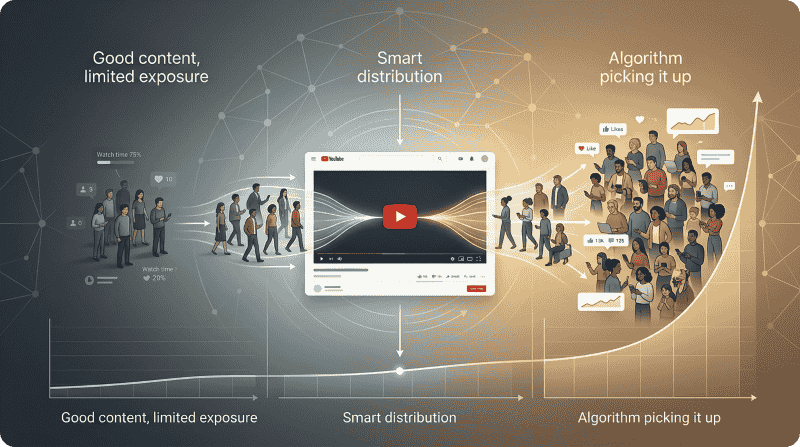
There are situations where buying YouTube views can be a strategic move, but they are more specific than most people realize.
It works best when it is used to support content that is already strong, rather than compensate for content that is weak.
For example, consider a well-produced video with a compelling hook, clear structure, and strong audience retention potential. In its early stage, it may struggle to get initial exposure simply because the channel is small or lacks momentum.
In this case, using real-user distribution to push the video in front of a targeted audience can accelerate the testing phase. At this stage, the focus should be on using methods that behave like real audience activity rather than artificial spikes, which is why many creators look for ways to buy YouTube views that align with how the platform actually distributes content. The algorithm gets more data, faster. If the content performs well, it can transition into organic growth more smoothly.
The key here is alignment.
This is also where the distinction between organic vs paid YouTube views becomes important, because both can work together if the traffic quality and audience intent are aligned properly.
The acquired views must match the type of audience the video is intended for. If a tutorial video for beginners is shown to an audience that has no interest in that topic, the data becomes misleading. Retention drops, engagement weakens, and the system interprets the video as less valuable than it actually is.
This is why targeting and context matter as much as the views themselves.
Where Most Strategies Fail Quietly
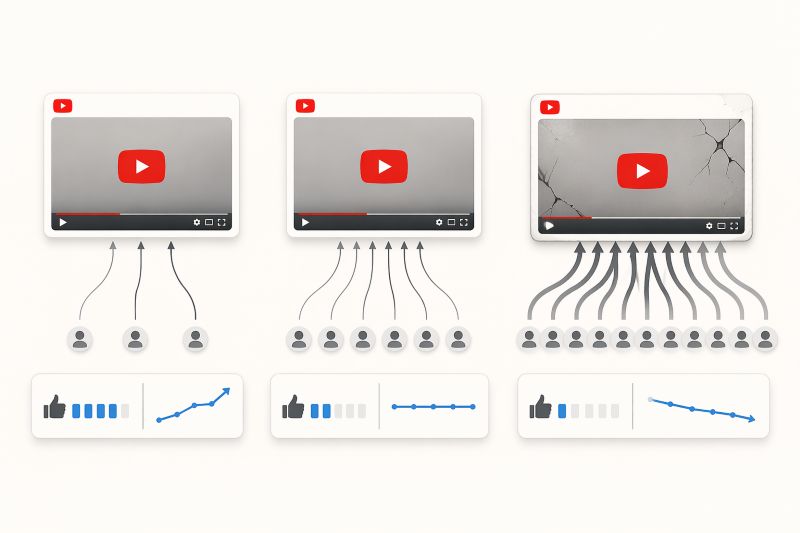
The biggest issue with buying YouTube views is not that it always fails. It is that it often fails in ways that are not immediately visible.
A creator sees the view count increase and assumes progress is being made. At the same time, the video is not gaining additional reach, and future uploads continue to struggle.
What is happening behind the scenes is a subtle distortion of performance data.
If early viewers do not engage meaningfully, the system becomes less confident in recommending the content to broader audiences. This effect can carry over to future videos, especially if the channel consistently produces weak engagement signals.
Over time, the creator ends up in a situation where every video requires external push just to reach a basic level of visibility. Organic growth slows down, and dependency on paid or artificial distribution increases.
This is the point where the strategy stops being a boost and starts becoming a crutch.
The Hidden Feedback Loop That Shapes Channel Growth
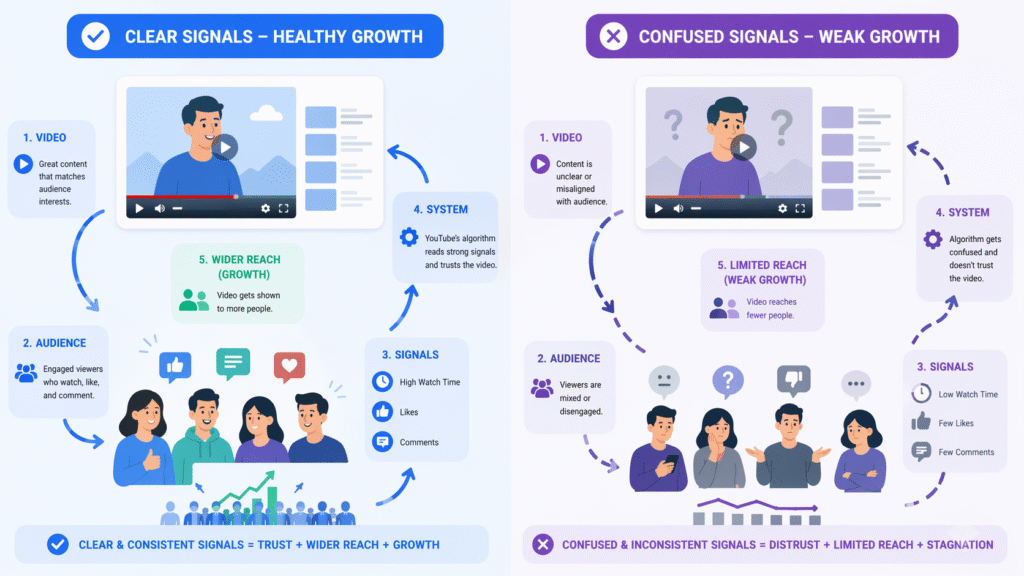
What many creators underestimate is how YouTube builds a profile around a channel, not just individual videos. Each upload contributes to a broader pattern of how audiences respond to your content.
When a video performs well, it does more than gain views. It strengthens YouTube’s confidence in your ability to satisfy a specific audience. That confidence influences how future videos are tested and distributed.
When performance signals are inconsistent or weak, the opposite happens.
Buying views can interfere with this feedback loop depending on how it is executed. If the incoming traffic behaves differently from your intended audience, the system receives mixed signals about who your content is for. Over time, this confusion reduces distribution efficiency.
For example, imagine a channel focused on in-depth tech tutorials. If purchased views come from a broad, untargeted audience that quickly drops off, YouTube begins associating the content with low retention behavior. Even if the content is genuinely valuable, it struggles to reach viewers who would actually appreciate it.
This is why many creators feel like they are “stuck” despite increasing their view counts. The numbers rise, but the system’s understanding of their audience becomes less precise.
Growth on YouTube is not just about exposure. It is about clarity. The clearer your audience signals are, the easier it becomes for the platform to match your content with the right viewers.
The Economics of Buying Views in 2026
Beyond algorithmic impact, there is a practical layer that often gets overlooked: cost versus return.
Buying YouTube views is an investment, whether it is framed that way or not. The question is what you are getting in return for that investment.
If the views contribute to stronger watch time, better audience retention, and increased subscriber conversion, they can create compounding value. A single video can start ranking in search, appearing in suggested feeds, and bringing in consistent traffic over time.
If the views only increase the visible counter without improving underlying performance, the return is mostly cosmetic.
Pricing differences can also influence how people approach this, especially when looking at why YouTube views are cheaper in India and what that actually means for traffic quality.
This distinction becomes important when you consider scale.
Spending a small amount to test distribution on a high-quality video can make sense. Repeatedly spending to inflate every upload, without improving content or targeting, becomes expensive very quickly with little long-term benefit.
A more grounded way to evaluate this is to ask what happens after the views are delivered.
Does the video continue to grow?
Do new viewers discover it organically?
Does it bring in subscribers who watch future content?
If the answer to these questions is no, then the views are not functioning as a growth mechanism. They are functioning as a temporary appearance boost.
A More Realistic Way to Use Paid Views
The most effective creators who use paid distribution do not treat it as a shortcut. They treat it as a testing tool.
Instead of asking “How can I increase this video’s views,” they ask “How does this video perform when real people see it?”
This shift in mindset changes how the strategy is applied.
Rather than pushing large volumes of untargeted traffic, they focus on smaller, controlled exposure to relevant audiences. They observe retention curves, click-through rates, and engagement patterns. They identify where viewers lose interest and refine their content accordingly.
In this sense, paid views become part of a feedback system.
They help answer questions such as:
Is the hook strong enough to hold attention?
Does the pacing match audience expectations?
Is the topic aligned with the audience I am targeting?
When used this way, buying views is not about inflating numbers. It is about accelerating learning.
This approach also reduces risk because it aligns with how YouTube already evaluates content. Instead of trying to bypass the system, it works within it.
The Decision Most Creators Are Actually Making
At its core, the decision to buy YouTube views is not about the views themselves. It is about how you want to build your channel.
There are two broad paths.
One path focuses on short-term perception. The goal is to make content look popular as quickly as possible, often without fully considering how that popularity is interpreted by the algorithm.
The other path focuses on long-term signal strength. The goal is to build consistent, reliable engagement patterns that the platform can trust.
These paths can overlap, but they are not the same.
Buying views can support the second path if it is done with precision, using real-user distribution and aligned targeting. It can undermine it if it introduces weak or misleading signals.
That is why the question “Is buying YouTube views worth it” does not have a simple yes or no answer.
It depends on intent, execution, and context.
For those evaluating providers, this breakdown of the best sites to buy YouTube views in 2026 compares how different services deliver views and what kind of results you can realistically expect.
So, Is It Worth It?
In 2026, buying YouTube views is neither inherently good nor inherently harmful. It is a tool, and like most tools, its impact depends on how it is used.
If it is used to mask weak content, it tends to fail. The algorithm detects the lack of genuine engagement, and the video stalls despite the inflated numbers.
If it is used to support strong content, with real-user exposure and proper targeting, it can accelerate the early stages of distribution and provide valuable performance data.
The important shift is to stop thinking of views as the goal.
Views are a byproduct of something more fundamental: audience satisfaction.
When viewers choose to watch, stay, and engage, growth follows naturally. When those elements are missing, no amount of purchased views can compensate for it in a sustainable way.
For creators and businesses alike, the more useful question is not whether to buy views, but when and why to use them.
Used carelessly, they create noise.
Used strategically, they can create momentum.
Understanding the difference is what determines whether the investment leads to real growth or just a higher number on the screen.
